User:Dave Keenan/sandbox: Difference between revisions
Dave Keenan (talk | contribs) |
Dave Keenan (talk | contribs) No edit summary |
||
| Line 1: | Line 1: | ||
===Sagittal notation=== | ===5-EDO Sagittal notation=== | ||
This notation is a subset of the notations for EDOs [[10edo#Sagittal notation|10]], [[15edo#Sagittal notation|15]], [[20edo#Sagittal notation|20]], [[25edo#Sagittal notation|25]], [[30edo#Sagittal notation|30]], and [[35edo#Second-best fifth notation|35b]]. | This notation uses the same sagittal sequence as EDOs [[12edo#Sagittal notation|12]], [[19edo#Sagittal notation|19]], and [[26edo#Sagittal notation|26]], and is a subset of the notations for EDOs [[10edo#Sagittal notation|10]], [[15edo#Sagittal notation|15]], [[20edo#Sagittal notation|20]], [[25edo#Sagittal notation|25]], [[30edo#Sagittal notation|30]], and [[35edo#Second-best fifth notation|35b]]. | ||
<imagemap> | <imagemap> | ||
| Line 13: | Line 13: | ||
Because it includes no Sagittal symbols, this Sagittal notation is also a conventional notation. | Because it includes no Sagittal symbols, this Sagittal notation is also a conventional notation. | ||
===Sagittal notation=== | ===6-EDO Sagittal notation=== | ||
This notation is a subset of the notations for EDOs [[12edo#Sagittal notation|12]], [[18edo#Sagittal notation|18]], [[24edo#Sagittal notation|24]], [[36edo#Sagittal notation|36]], [[48edo#Sagittal notation|48]], [[60edo#Sagittal notation|60]], [[72edo#Sagittal notation|72]], and [[84edo#Sagittal notation|84]]. | This notation is a subset of the notations for EDOs [[12edo#Sagittal notation|12]], [[18edo#Sagittal notation|18]], [[24edo#Sagittal notation|24]], [[36edo#Sagittal notation|36]], [[48edo#Sagittal notation|48]], [[60edo#Sagittal notation|60]], [[72edo#Sagittal notation|72]], and [[84edo#Sagittal notation|84]]. | ||
====Evo flavor==== | ====Evo flavor==== | ||
| Line 39: | Line 39: | ||
</imagemap> | </imagemap> | ||
===Sagittal notation=== | ===7-EDO Sagittal notation=== | ||
This notation is a subset of the notations for EDOs [[14edo#Sagittal notation|14]], [[21edo#Sagittal notation|21]], [[28edo#Sagittal notation|28]], [[35edo#Sagittal notation|35]], and [[42edo#Second-best fifth notation|42b]]. | This notation is a subset of the notations for EDOs [[14edo#Sagittal notation|14]], [[21edo#Sagittal notation|21]], [[28edo#Sagittal notation|28]], [[35edo#Sagittal notation|35]], and [[42edo#Second-best fifth notation|42b]]. | ||
| Line 53: | Line 53: | ||
Because it includes no Sagittal symbols, this Sagittal notation is also a conventional notation. | Because it includes no Sagittal symbols, this Sagittal notation is also a conventional notation. | ||
===Sagittal notation=== | ===8-EDO Sagittal notation=== | ||
This notation is a subset of the notations for EDOs [[24edo#Sagittal notation|24]], [[48edo#Sagittal notation|48]], and [[72edo#Sagittal notation|72]]. | This notation is a subset of the notations for EDOs [[24edo#Sagittal notation|24]], [[48edo#Sagittal notation|48]], and [[72edo#Sagittal notation|72]]. | ||
====Evo flavor==== | ====Evo flavor==== | ||
| Line 90: | Line 90: | ||
Because it contains no Sagittal symbols, this Evo-SZ Sagittal notation is also a Stein-Zimmerman notation. | Because it contains no Sagittal symbols, this Evo-SZ Sagittal notation is also a Stein-Zimmerman notation. | ||
===Sagittal notation=== | ===9-EDO Sagittal notation=== | ||
This notation uses the same sagittal sequence as [[14edo#Sagittal notation|14-EDO]]. | This notation uses the same sagittal sequence as [[14edo#Sagittal notation|14-EDO]]. | ||
| Line 102: | Line 102: | ||
</imagemap> | </imagemap> | ||
===Sagittal notation=== | ===10-EDO Sagittal notation=== | ||
This notation is a subset of the notations for EDOs [[20edo#Sagittal notation|20]] and [[30edo#Sagittal notation|30]] and a superset of the notation for [[5edo#Sagittal notation|5-EDO]]. | This notation is a subset of the notations for EDOs [[20edo#Sagittal notation|20]] and [[30edo#Sagittal notation|30]] and a superset of the notation for [[5edo#Sagittal notation|5-EDO]]. | ||
====Evo and Revo flavors==== | ====Evo and Revo flavors==== | ||
| Line 128: | Line 128: | ||
Because it contains no Sagittal symbols, this Evo-SZ Sagittal notation is also a Stein-Zimmerman notation. | Because it contains no Sagittal symbols, this Evo-SZ Sagittal notation is also a Stein-Zimmerman notation. | ||
===Sagittal notation=== | ===11-EDO Sagittal notation=== | ||
This notation is a subset of the notations for EDOs [[22edo#Sagittal notation|22]], [[44edo#Sagittal notation|44]], and [[66edo#Sagittal notation|66]]. | This notation is a subset of the notations for EDOs [[22edo#Sagittal notation|22]], [[44edo#Sagittal notation|44]], and [[66edo#Sagittal notation|66]]. | ||
====Evo flavor==== | ====Evo flavor==== | ||
| Line 153: | Line 153: | ||
===Sagittal notation=== | ===12-EDO Sagittal notation=== | ||
This notation is a subset of the notations for EDOs [[24edo#Sagittal notation|24]], [[36edo#Sagittal notation|36]], [[48edo#Sagittal notation|48]], [[60edo#Sagittal notation|60]], [[72edo#Sagittal notation|72]], and [[84edo#Sagittal notation|84]] and a superset of the notation for [[6edo#Sagittal notation|6-EDO]]. | This notation uses the same sagittal sequence as EDOs [[5edo#Sagittal notation|5]], [[19edo#Sagittal notation|19]], and [[26edo#Sagittal notation|26]], and is a subset of the notations for EDOs [[24edo#Sagittal notation|24]], [[36edo#Sagittal notation|36]], [[48edo#Sagittal notation|48]], [[60edo#Sagittal notation|60]], [[72edo#Sagittal notation|72]], and [[84edo#Sagittal notation|84]] and a superset of the notation for [[6edo#Sagittal notation|6-EDO]]. | ||
====Evo flavor==== | ====Evo flavor==== | ||
| Line 177: | Line 177: | ||
===Sagittal notation=== | ===13-EDO Sagittal notation=== | ||
This notation is a subset of the notations for EDOs [[26edo#Sagittal notation|26]] and [[52edo#Sagittal notation|52]]. | This notation is a subset of the notations for EDOs [[26edo#Sagittal notation|26]] and [[52edo#Sagittal notation|52]]. | ||
====Evo flavor==== | ====Evo flavor==== | ||
| Line 203: | Line 203: | ||
===Sagittal notation=== | ===14-EDO Sagittal notation=== | ||
This notation uses the same sagittal sequence as [[9edo#Sagittal notation|9-EDO]], is a subset of the notations for EDOs [[28edo#Sagittal notation|28]] and [[42edo#Second-best fifth notation|42b]], and is a superset of the notation for [[7edo#Sagittal notation|7-EDO]]. | This notation uses the same sagittal sequence as [[9edo#Sagittal notation|9-EDO]], is a subset of the notations for EDOs [[28edo#Sagittal notation|28]] and [[42edo#Second-best fifth notation|42b]], and is a superset of the notation for [[7edo#Sagittal notation|7-EDO]]. | ||
| Line 215: | Line 215: | ||
</imagemap> | </imagemap> | ||
===Sagittal notation=== | ===15-EDO Sagittal notation=== | ||
This notation uses the same sagittal sequence as EDOs [[22edo#Sagittal notation|22]] and [[29edo#Sagittal notation|29]], is a subset of the notation for [[30edo#Sagittal notation|30-EDO]], and is a superset of the notation for [[5edo#Sagittal notation|5-EDO]]. | This notation uses the same sagittal sequence as EDOs [[22edo#Sagittal notation|22]] and [[29edo#Sagittal notation|29]], is a subset of the notation for [[30edo#Sagittal notation|30-EDO]], and is a superset of the notation for [[5edo#Sagittal notation|5-EDO]]. | ||
| Line 228: | Line 228: | ||
===Sagittal notation=== | ===16-EDO Sagittal notation=== | ||
This notation uses the same sagittal sequence as [[21edo#Sagittal notation|21-EDO]]. | This notation uses the same sagittal sequence as [[21edo#Sagittal notation|21-EDO]]. | ||
| Line 241: | Line 241: | ||
===Sagittal notation=== | ===17-EDO Sagittal notation=== | ||
This notation uses the same sagittal sequence as EDOs [[24edo#Sagittal notation|24]], [[31edo#Sagittal notation|31]], and [[38edo#Sagittal notation|38]], and is a subset of the notation for [[34edo#Sagittal notation|34-EDO]]. | This notation uses the same sagittal sequence as EDOs [[24edo#Sagittal notation|24]], [[31edo#Sagittal notation|31]], and [[38edo#Sagittal notation|38]], and is a subset of the notation for [[34edo#Sagittal notation|34-EDO]]. | ||
====Evo and Revo flavors==== | ====Evo and Revo flavors==== | ||
| Line 278: | Line 278: | ||
Because it contains no Sagittal symbols, this Evo-SZ Sagittal notation is also a Stein-Zimmerman notation. | Because it contains no Sagittal symbols, this Evo-SZ Sagittal notation is also a Stein-Zimmerman notation. | ||
===Sagittal notation=== | ===18-EDO Sagittal notation=== | ||
This notation is a subset of the notations for EDOs [[36edo#Sagittal notation|36]] and [[72edo#Sagittal notation|72]] and a superset of the notation for [[6edo#Sagittal notation|6-EDO]]. | This notation is a subset of the notations for EDOs [[36edo#Sagittal notation|36]] and [[72edo#Sagittal notation|72]] and a superset of the notation for [[6edo#Sagittal notation|6-EDO]]. | ||
====Evo flavor==== | ====Evo flavor==== | ||
| Line 303: | Line 303: | ||
===Sagittal notation=== | ===19-EDO Sagittal notation=== | ||
This notation is a subset of the notations for EDOs [[38edo#Sagittal notation|38]], [[57edo#Sagittal notation|57]], and [[76edo#Sagittal notation|76]]. | This notation uses the same sagittal sequence as EDOs [[5edo#Sagittal notation|5]], [[12edo#Sagittal notation|12]], and [[26edo#Sagittal notation|26]], and is a subset of the notations for EDOs [[38edo#Sagittal notation|38]], [[57edo#Sagittal notation|57]], and [[76edo#Sagittal notation|76]]. | ||
====Evo flavor==== | ====Evo flavor==== | ||
| Line 327: | Line 327: | ||
===Sagittal notation=== | ===20-EDO Sagittal notation=== | ||
This notation is a superset of the notations for EDOs [[10edo#Sagittal notation|10]] and [[5edo#Sagittal notation|5]]. | This notation is a superset of the notations for EDOs [[10edo#Sagittal notation|10]] and [[5edo#Sagittal notation|5]]. | ||
====Evo and Revo flavors==== | ====Evo and Revo flavors==== | ||
| Line 352: | Line 352: | ||
===Sagittal notation=== | ===21-EDO Sagittal notation=== | ||
This notation uses the same sagittal sequence as [[16edo#Sagittal notation|16-EDO]], is a subset of the notation for [[42edo#Second-best fifth notation|42b]], and is a superset of the notation for [[7edo#Sagittal notation|7-EDO]]. | This notation uses the same sagittal sequence as [[16edo#Sagittal notation|16-EDO]], is a subset of the notation for [[42edo#Second-best fifth notation|42b]], and is a superset of the notation for [[7edo#Sagittal notation|7-EDO]]. | ||
| Line 364: | Line 364: | ||
</imagemap> | </imagemap> | ||
===Sagittal notation=== | ===22-EDO Sagittal notation=== | ||
This notation uses the same sagittal sequence as EDOs [[15edo#Sagittal notation|15]] and [[29edo#Sagittal notation|29]], is a subset of the notations for EDOs [[44edo#Sagittal notation|44]] and [[66edo#Sagittal notation|66]], and is a superset of the notation for [[11edo#Sagittal notation|11-EDO]]. | This notation uses the same sagittal sequence as EDOs [[15edo#Sagittal notation|15]] and [[29edo#Sagittal notation|29]], is a subset of the notations for EDOs [[44edo#Sagittal notation|44]] and [[66edo#Sagittal notation|66]], and is a superset of the notation for [[11edo#Sagittal notation|11-EDO]]. | ||
====Evo flavor==== | ====Evo flavor==== | ||
| Line 388: | Line 388: | ||
</imagemap> | </imagemap> | ||
===Sagittal notation=== | ===23-EDO Sagittal notation=== | ||
====Best fifth notation==== | ====Best fifth notation==== | ||
This notation uses the same sagittal sequence as EDOs [[28edo#Sagittal notation|28]] and [[33edo#Sagittal notation|33]]. | This notation uses the same sagittal sequence as EDOs [[28edo#Sagittal notation|28]] and [[33edo#Sagittal notation|33]]. | ||
| Line 414: | Line 414: | ||
===Sagittal notation=== | ===24-EDO Sagittal notation=== | ||
This notation uses the same sagittal sequence as EDOs [[17edo#Sagittal notation|17]], [[31edo#Sagittal notation|31]], and [[38edo#Sagittal notation|38]], is a subset of the notations for EDOs [[48edo#Sagittal notation|48]] and [[72edo#Sagittal notation|72]], and is a superset of the notations for EDOs [[12edo#Sagittal notation|12]], [[8edo#Sagittal notation|8]], and [[6edo#Sagittal notation|6]]. | This notation uses the same sagittal sequence as EDOs [[17edo#Sagittal notation|17]], [[31edo#Sagittal notation|31]], and [[38edo#Sagittal notation|38]], is a subset of the notations for EDOs [[48edo#Sagittal notation|48]] and [[72edo#Sagittal notation|72]], and is a superset of the notations for EDOs [[12edo#Sagittal notation|12]], [[8edo#Sagittal notation|8]], and [[6edo#Sagittal notation|6]]. | ||
====Evo flavor==== | ====Evo flavor==== | ||
| Line 451: | Line 451: | ||
Because it contains no Sagittal symbols, this Evo-SZ Sagittal notation is also a Stein-Zimmerman notation. | Because it contains no Sagittal symbols, this Evo-SZ Sagittal notation is also a Stein-Zimmerman notation. | ||
===Sagittal notation=== | ===25-EDO Sagittal notation=== | ||
This notation uses the same sagittal sequence as [[32edo#Sagittal notation|32-EDO]], and is a superset of the notation for [[5edo#Sagittal notation|5-EDO]]. | This notation uses the same sagittal sequence as [[32edo#Sagittal notation|32-EDO]], and is a superset of the notation for [[5edo#Sagittal notation|5-EDO]]. | ||
| Line 464: | Line 464: | ||
===Sagittal notation=== | ===26-EDO Sagittal notation=== | ||
This notation is a subset of the notation for [[52edo#Sagittal notation|52-EDO]] and a superset of the notation for [[13edo#Sagittal notation|13-EDO]]. | This notation uses the same sagittal sequence as EDOs [[5edo#Sagittal notation|5]], [[12edo#Sagittal notation|12]], and [[19edo#Sagittal notation|19]], and is a subset of the notation for [[52edo#Sagittal notation|52-EDO]] and a superset of the notation for [[13edo#Sagittal notation|13-EDO]]. | ||
====Evo flavor==== | ====Evo flavor==== | ||
| Line 2,114: | Line 2,114: | ||
</imagemap> | </imagemap> | ||
===Sagittal notation=== | ===73-EDO Sagittal notation=== | ||
This notation uses the same sagittal sequence as [[80edo#Sagittal notation|80-EDO]]. | This notation uses the same sagittal sequence as [[80edo#Sagittal notation|80-EDO]]. | ||
====Evo flavor==== | ====Evo flavor==== | ||
| Line 2,144: | Line 2,144: | ||
</imagemap> | </imagemap> | ||
===Sagittal notation=== | ===74-EDO Sagittal notation=== | ||
====Evo flavor==== | ====Evo flavor==== | ||
| Line 2,173: | Line 2,173: | ||
In the diagrams above, a sagittal symbol followed by an equals sign (=) means that the following comma is the symbol's [[Sagittal notation#Primary comma|primary comma]] (the comma it ''exactly'' represents in JI), while an approximately equals sign (≈) means it is a secondary comma (a comma it ''approximately'' represents in JI). In both cases the symbol exactly represents the tempered version of the comma in this EDO. | In the diagrams above, a sagittal symbol followed by an equals sign (=) means that the following comma is the symbol's [[Sagittal notation#Primary comma|primary comma]] (the comma it ''exactly'' represents in JI), while an approximately equals sign (≈) means it is a secondary comma (a comma it ''approximately'' represents in JI). In both cases the symbol exactly represents the tempered version of the comma in this EDO. | ||
===Sagittal notation=== | ===75-EDO Sagittal notation=== | ||
This notation uses the same sagittal sequence as [[68edo#Sagittal notation|68-EDO]]. | This notation uses the same sagittal sequence as [[68edo#Sagittal notation|68-EDO]]. | ||
====Evo flavor==== | ====Evo flavor==== | ||
| Line 2,219: | Line 2,219: | ||
In the diagrams above, a sagittal symbol followed by an equals sign (=) means that the following comma is the symbol's [[Sagittal notation#Primary comma|primary comma]] (the comma it ''exactly'' represents in JI), while an approximately equals sign (≈) means it is a secondary comma (a comma it ''approximately'' represents in JI). In both cases the symbol exactly represents the tempered version of the comma in this EDO. | In the diagrams above, a sagittal symbol followed by an equals sign (=) means that the following comma is the symbol's [[Sagittal notation#Primary comma|primary comma]] (the comma it ''exactly'' represents in JI), while an approximately equals sign (≈) means it is a secondary comma (a comma it ''approximately'' represents in JI). In both cases the symbol exactly represents the tempered version of the comma in this EDO. | ||
===Sagittal notation=== | ===76-EDO Sagittal notation=== | ||
This notation uses the same sagittal sequence as EDOs [[62edo#Sagittal notation|62]] and [[69edo#Sagittal notation|69]], and is a superset of the notations for EDOs [[38edo#Sagittal notation|38]] and [[19edo#Sagittal notation|19]]. | This notation uses the same sagittal sequence as EDOs [[62edo#Sagittal notation|62]] and [[69edo#Sagittal notation|69]], and is a superset of the notations for EDOs [[38edo#Sagittal notation|38]] and [[19edo#Sagittal notation|19]]. | ||
====Evo flavor==== | ====Evo flavor==== | ||
| Line 2,259: | Line 2,259: | ||
In the diagrams above, a sagittal symbol followed by an equals sign (=) means that the following comma is the symbol's [[Sagittal notation#Primary comma|primary comma]] (the comma it ''exactly'' represents in JI), while an approximately equals sign (≈) means it is a secondary comma (a comma it ''approximately'' represents in JI). In both cases the symbol exactly represents the tempered version of the comma in this EDO. | In the diagrams above, a sagittal symbol followed by an equals sign (=) means that the following comma is the symbol's [[Sagittal notation#Primary comma|primary comma]] (the comma it ''exactly'' represents in JI), while an approximately equals sign (≈) means it is a secondary comma (a comma it ''approximately'' represents in JI). In both cases the symbol exactly represents the tempered version of the comma in this EDO. | ||
===Sagittal notation=== | ===77-EDO Sagittal notation=== | ||
====Evo flavor==== | ====Evo flavor==== | ||
| Line 2,284: | Line 2,284: | ||
rect 220 80 340 106 [[33/32]] | rect 220 80 340 106 [[33/32]] | ||
default [[File:77-EDO_Revo_Sagittal.svg]] | default [[File:77-EDO_Revo_Sagittal.svg]] | ||
</imagemap> | </imagemap> | ||
Revision as of 23:03, 30 December 2024
5-EDO Sagittal notation
This notation uses the same sagittal sequence as EDOs 12, 19, and 26, and is a subset of the notations for EDOs 10, 15, 20, 25, 30, and 35b.

Because it includes no Sagittal symbols, this Sagittal notation is also a conventional notation.
6-EDO Sagittal notation
This notation is a subset of the notations for EDOs 12, 18, 24, 36, 48, 60, 72, and 84.
Evo flavor

Because it includes no Sagittal symbols, this Evo Sagittal notation is also a conventional notation.
Revo flavor

7-EDO Sagittal notation
This notation is a subset of the notations for EDOs 14, 21, 28, 35, and 42b.

Because it includes no Sagittal symbols, this Sagittal notation is also a conventional notation.
8-EDO Sagittal notation
This notation is a subset of the notations for EDOs 24, 48, and 72.
Evo flavor

Revo flavor

Evo-SZ flavor

Because it contains no Sagittal symbols, this Evo-SZ Sagittal notation is also a Stein-Zimmerman notation.
9-EDO Sagittal notation
This notation uses the same sagittal sequence as 14-EDO.

10-EDO Sagittal notation
This notation is a subset of the notations for EDOs 20 and 30 and a superset of the notation for 5-EDO.
Evo and Revo flavors

Evo-SZ flavor

Because it contains no Sagittal symbols, this Evo-SZ Sagittal notation is also a Stein-Zimmerman notation.
11-EDO Sagittal notation
This notation is a subset of the notations for EDOs 22, 44, and 66.
Evo flavor

Revo flavor

12-EDO Sagittal notation
This notation uses the same sagittal sequence as EDOs 5, 19, and 26, and is a subset of the notations for EDOs 24, 36, 48, 60, 72, and 84 and a superset of the notation for 6-EDO.
Evo flavor

Because it includes no Sagittal symbols, this Evo Sagittal notation is also a conventional notation.
Revo flavor

13-EDO Sagittal notation
This notation is a subset of the notations for EDOs 26 and 52.
Evo flavor

Because it includes no Sagittal symbols, this Evo Sagittal notation is also a conventional notation.
Revo flavor

14-EDO Sagittal notation
This notation uses the same sagittal sequence as 9-EDO, is a subset of the notations for EDOs 28 and 42b, and is a superset of the notation for 7-EDO.

15-EDO Sagittal notation
This notation uses the same sagittal sequence as EDOs 22 and 29, is a subset of the notation for 30-EDO, and is a superset of the notation for 5-EDO.

16-EDO Sagittal notation
This notation uses the same sagittal sequence as 21-EDO.

17-EDO Sagittal notation
This notation uses the same sagittal sequence as EDOs 24, 31, and 38, and is a subset of the notation for 34-EDO.
Evo and Revo flavors

Alternative Evo flavor

Evo-SZ flavor

Because it contains no Sagittal symbols, this Evo-SZ Sagittal notation is also a Stein-Zimmerman notation.
18-EDO Sagittal notation
This notation is a subset of the notations for EDOs 36 and 72 and a superset of the notation for 6-EDO.
Evo flavor

Revo flavor

19-EDO Sagittal notation
This notation uses the same sagittal sequence as EDOs 5, 12, and 26, and is a subset of the notations for EDOs 38, 57, and 76.
Evo flavor

Because it includes no Sagittal symbols, this Evo Sagittal notation is also a conventional notation.
Revo flavor

20-EDO Sagittal notation
This notation is a superset of the notations for EDOs 10 and 5.
Evo and Revo flavors

Evo-SZ flavor

21-EDO Sagittal notation
This notation uses the same sagittal sequence as 16-EDO, is a subset of the notation for 42b, and is a superset of the notation for 7-EDO.

22-EDO Sagittal notation
This notation uses the same sagittal sequence as EDOs 15 and 29, is a subset of the notations for EDOs 44 and 66, and is a superset of the notation for 11-EDO.
Evo flavor

Revo flavor

23-EDO Sagittal notation
Best fifth notation
This notation uses the same sagittal sequence as EDOs 28 and 33.

Second-best fifth notation
This notation uses the same sagittal sequence as EDOs 30, 37, and 44.

24-EDO Sagittal notation
This notation uses the same sagittal sequence as EDOs 17, 31, and 38, is a subset of the notations for EDOs 48 and 72, and is a superset of the notations for EDOs 12, 8, and 6.
Evo flavor

Revo flavor

Evo-SZ flavor

Because it contains no Sagittal symbols, this Evo-SZ Sagittal notation is also a Stein-Zimmerman notation.
25-EDO Sagittal notation
This notation uses the same sagittal sequence as 32-EDO, and is a superset of the notation for 5-EDO.

26-EDO Sagittal notation
This notation uses the same sagittal sequence as EDOs 5, 12, and 19, and is a subset of the notation for 52-EDO and a superset of the notation for 13-EDO.
Evo flavor

Because it includes no Sagittal symbols, this Evo Sagittal notation is also a conventional notation.
Revo flavor

Sagittal notation
This notation is a subset of the notation for 54-EDO.
Evo and Revo flavors

Alternative Evo flavor

Evo-SZ flavor

In the diagrams above, a sagittal symbol followed by an equals sign (=) means that the following comma is the symbol's primary comma (the comma it exactly represents in JI), while an approximately equals sign (≈) means it is a secondary comma (a comma it approximately represents in JI). In both cases the symbol exactly represents the tempered version of the comma in this EDO.
Sagittal notation
This notation uses the same sagittal sequence as EDOs 23 and 33, and is a superset of the notations for EDOs 14 and 7.

Sagittal notation
This notation uses the same sagittal sequence as EDOs 15 and 22.
Evo flavor

Revo flavor

Sagittal notation
Best fifth notation
This notation uses the same sagittal sequence as EDOs 23b, 37, and 44, and is a superset of the notations for EDOs 15, 10, and 5.
Evo and Revo flavors

Evo-SZ flavor

Second-best fifth notation
This notation uses the same sagittal sequence as EDOs 35 and 40.

Sagittal notation
This notation uses the same sagittal sequence as EDOs 17, 24, and 38, and is a subset of the notation for 62-EDO.
Evo flavor

Revo flavor

Evo-SZ flavor

Because it contains no Sagittal symbols, this Evo-SZ Sagittal notation is also a Stein-Zimmerman notation.
Sagittal notation
This notation uses the same sagittal sequence as 25-EDO, and is a subset of the notation for 64b.
Evo flavor

Revo flavor

Sagittal notation
This notation uses the same sagittal sequence as EDOs 23 and 28.

Sagittal notation
This notation uses the same sagittal sequence as 41-EDO, and is a superset of the notation for 17-EDO.
Evo flavor

Revo flavor

Evo-SZ flavor

Sagittal notation
Best fifth notation
This notation uses the same sagittal sequence as EDOs 30b and 40, and is a superset of the notation for 7-EDO.

Second-best fifth notation
This notation uses the same sagittal sequence as 42-EDO, and is a superset of the notation for 5-EDO.

Sagittal notation
This notation uses the same sagittal sequence as 43-EDO, is a subset of the notation for 72-EDO, and is a superset of the notations for EDOs 18, 12, and 6.
Evo flavor

Revo flavor

Sagittal notation
This notation uses the same sagittal sequence as EDOs 23b, 30, and 44.
Evo and Revo flavors

Alternative Evo flavor

Evo-SZ flavor

Sagittal notation
This notation uses the same sagittal sequence as EDOs 17, 24, and 31, is a subset of the notation for 76-EDO, and is a superset of the notation for 19-EDO.
Evo flavor

Revo flavor

Evo-SZ flavor

Because it contains no Sagittal symbols, this Evo-SZ Sagittal notation is also a Stein-Zimmerman notation.
Sagittal notation
This notation uses the same sagittal sequence as 46-EDO.
Evo flavor

Revo flavor

Sagittal notation
This notation uses the same sagittal sequence as EDOs 30b and 35.

Sagittal notation
This notation uses the same sagittal sequence as 34-EDO.
Evo flavor

Revo flavor

Evo-SZ flavor

Sagittal notation
Best fifth notation
This notation uses the same sagittal sequence as 35b.
Evo flavor

Revo flavor

Second-best fifth notation
This notation uses the same sagittal sequence as 47-EDO, and is a superset of the notations for EDOs 21, 14, and 7.

Sagittal notation
This notation uses the same sagittal sequence as 36-EDO.
Evo flavor

Revo flavor

Sagittal notation
This notation uses the same sagittal sequence as EDOs 23b, 30, and 37, and is a superset of the notations for EDOs 22 and 11.
Evo flavor

Revo flavor

Evo-SZ flavor

In the diagrams above, a sagittal symbol followed by an equals sign (=) means that the following comma is the symbol's primary comma (the comma it exactly represents in JI), while an approximately equals sign (≈) means it is a secondary comma (a comma it approximately represents in JI). In both cases the symbol exactly represents the tempered version of the comma in this EDO.
Sagittal notation
This notation uses the same sagittal sequence as EDOs 52 and 59b.
Evo flavor

Revo flavor

Evo-SZ flavor

Because it contains no Sagittal symbols, this Evo-SZ Sagittal notation is also a Stein-Zimmerman notation.
In the diagrams above, a sagittal symbol followed by an equals sign (=) means that the following comma is the symbol's primary comma (the comma it exactly represents in JI), while an approximately equals sign (≈) means it is a secondary comma (a comma it approximately represents in JI). In both cases the symbol exactly represents the tempered version of the comma in this EDO.
Sagittal notation
This notation uses the same sagittal sequence as 39-EDO.
Evo flavor

Revo flavor

Sagittal notation
Best fifth notation
This notation uses the same sagittal sequence as 42b.

Second-best fifth notation
Evo and Revo flavors

Alternative Evo flavor

Evo-SZ flavor

Sagittal notation
This notation is a superset of the notations for EDOs 24, 12, 8, and 6.
Evo flavor

Revo flavor

Evo-SZ flavor

Sagittal notation
Evo flavor

Revo flavor

Sagittal notation
This notation uses the same sagittal sequence as EDOs 57, 64, and 71b.
Evo flavor

Revo flavor

In the diagrams above, a sagittal symbol followed by an equals sign (=) means that the following comma is the symbol's primary comma (the comma it exactly represents in JI), while an approximately equals sign (≈) means it is a secondary comma (a comma it approximately represents in JI). In both cases the symbol exactly represents the tempered version of the comma in this EDO.
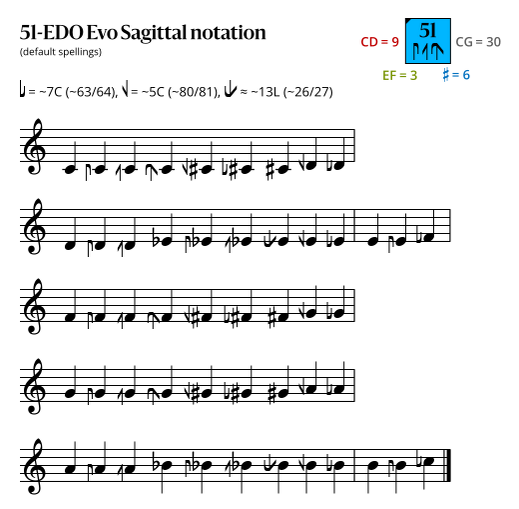
Sagittal notation
Evo flavor
Revo flavor

Evo-SZ flavor

In the diagrams above, a sagittal symbol followed by an equals sign (=) means that the following comma is the symbol's primary comma (the comma it exactly represents in JI), while an approximately equals sign (≈) means it is a secondary comma (a comma it approximately represents in JI). In both cases the symbol exactly represents the tempered version of the comma in this EDO.
Sagittal notation
This notation uses the same sagittal sequence as EDOs 45 and 59b, and is a superset of the notations for EDOs 26 and 13.
Evo flavor

Revo flavor

Evo-SZ flavor

Because it contains no Sagittal symbols, this Evo-SZ Sagittal notation is also a Stein-Zimmerman notation.
Sagittal notation
Evo flavor

Revo flavor

In the diagrams above, a sagittal symbol followed by an equals sign (=) means that the following comma is the symbol's primary comma (the comma it exactly represents in JI), while an approximately equals sign (≈) means it is a secondary comma (a comma it approximately represents in JI). In both cases the symbol exactly represents the tempered version of the comma in this EDO.
Sagittal notation
This notation uses the same sagittal sequence as 61-EDO, and is a superset of the notation for 27-EDO.
Evo flavor

Revo flavor

Evo-SZ flavor

In the diagrams above, a sagittal symbol followed by an equals sign (=) means that the following comma is the symbol's primary comma (the comma it exactly represents in JI), while an approximately equals sign (≈) means it is a secondary comma (a comma it approximately represents in JI). In both cases the symbol exactly represents the tempered version of the comma in this EDO.
Sagittal notation
Evo flavor

Revo flavor

Evo-SZ flavor

Sagittal notation
This notation uses the same sagittal sequence as 63-EDO.
Evo flavor

Revo flavor

Sagittal notation
This notation uses the same sagittal sequence as EDOs 50, 64, and 71b, and is a superset of the notation for 19-EDO.
Evo flavor

Revo flavor

In the diagrams above, a sagittal symbol followed by an equals sign (=) means that the following comma is the symbol's primary comma (the comma it exactly represents in JI), while an approximately equals sign (≈) means it is a secondary comma (a comma it approximately represents in JI). In both cases the symbol exactly represents the tempered version of the comma in this EDO.
Sagittal notation
Evo flavor

Revo flavor

Evo-SZ flavor

Sagittal notation
Best fifth notation
This notation uses the same sagittal sequence as 66-EDO.
Evo flavor

Revo flavor

In the diagrams above, a sagittal symbol followed by an equals sign (=) means that the following comma is the symbol's primary comma (the comma it exactly represents in JI), while an approximately equals sign (≈) means it is a secondary comma (a comma it approximately represents in JI). In both cases the symbol exactly represents the tempered version of the comma in this EDO.
Second-best fifth notation
This notation uses the same sagittal sequence as EDOs 45 and 52.
Evo flavor

Revo flavor

Evo-SZ flavor

Because it contains no Sagittal symbols, this Evo-SZ Sagittal notation is also a Stein-Zimmerman notation.
Sagittal notation
This notation is a superset of the notations for EDOs 12 and 6.
Evo flavor

Revo flavor

Sagittal notation
This notation uses the same sagittal sequence as 54-EDO.
Evo flavor

Revo flavor

Evo-SZ flavor

In the diagrams above, a sagittal symbol followed by an equals sign (=) means that the following comma is the symbol's primary comma (the comma it exactly represents in JI), while an approximately equals sign (≈) means it is a secondary comma (a comma it approximately represents in JI). In both cases the symbol exactly represents the tempered version of the comma in this EDO.
Sagittal notation
This notation uses the same sagittal sequence as EDOs 69 and 76, and is a superset of the notation for 31-EDO.
Evo flavor

Revo flavor

Evo-SZ flavor

In the diagrams above, a sagittal symbol followed by an equals sign (=) means that the following comma is the symbol's primary comma (the comma it exactly represents in JI), while an approximately equals sign (≈) means it is a secondary comma (a comma it approximately represents in JI). In both cases the symbol exactly represents the tempered version of the comma in this EDO.
Sagittal notation
This notation uses the same sagittal sequence as 56-EDO.
Evo flavor

Revo flavor

Sagittal notation
Best fifth notation
This notation uses the same sagittal sequence as EDOs 50, 57, and 71b.
Evo flavor

Revo flavor

In the diagrams above, a sagittal symbol followed by an equals sign (=) means that the following comma is the symbol's primary comma (the comma it exactly represents in JI), while an approximately equals sign (≈) means it is a secondary comma (a comma it approximately represents in JI). In both cases the symbol exactly represents the tempered version of the comma in this EDO.
Second-best fifth notation
This notation is a superset of the notation for 32-EDO.
Evo flavor

Revo flavor

Evo-SZ flavor

Sagittal notation
This notation uses the same sagittal sequence as EDOs 72 and 79.
Evo flavor

Revo flavor

Evo-SZ flavor

Sagittal notation
This notation uses the same sagittal sequence as 59-EDO, and is a superset of the notations for EDOs 22 and 11.
Evo flavor

Revo flavor

In the diagrams above, a sagittal symbol followed by an equals sign (=) means that the following comma is the symbol's primary comma (the comma it exactly represents in JI), while an approximately equals sign (≈) means it is a secondary comma (a comma it approximately represents in JI). In both cases the symbol exactly represents the tempered version of the comma in this EDO.
Sagittal notation
Evo flavor

Revo flavor

In the diagrams above, a sagittal symbol followed by an equals sign (=) means that the following comma is the symbol's primary comma (the comma it exactly represents in JI), while an approximately equals sign (≈) means it is a secondary comma (a comma it approximately represents in JI). In both cases the symbol exactly represents the tempered version of the comma in this EDO.
Sagittal notation
This notation uses the same sagittal sequence as 75-EDO.
Evo flavor

Revo flavor

Evo-SZ flavor

In the diagrams above, a sagittal symbol followed by an equals sign (=) means that the following comma is the symbol's primary comma (the comma it exactly represents in JI), while an approximately equals sign (≈) means it is a secondary comma (a comma it approximately represents in JI). In both cases the symbol exactly represents the tempered version of the comma in this EDO.
Sagittal notation
This notation uses the same sagittal sequence as EDOs 62 and 76.
Evo flavor

Revo flavor

Evo-SZ flavor

In the diagrams above, a sagittal symbol followed by an equals sign (=) means that the following comma is the symbol's primary comma (the comma it exactly represents in JI), while an approximately equals sign (≈) means it is a secondary comma (a comma it approximately represents in JI). In both cases the symbol exactly represents the tempered version of the comma in this EDO.
Sagittal notation
Evo flavor

Revo flavor

Sagittal notation
Best fifth notation
Evo flavor

Revo flavor

Evo-SZ flavor

In the diagrams above, a sagittal symbol followed by an equals sign (=) means that the following comma is the symbol's primary comma (the comma it exactly represents in JI), while an approximately equals sign (≈) means it is a secondary comma (a comma it approximately represents in JI). In both cases the symbol exactly represents the tempered version of the comma in this EDO.
Second-best fifth notation
This notation uses the same sagittal sequence as EDOs 50, 57, and 64.
Evo flavor

Revo flavor

In the diagrams above, a sagittal symbol followed by an equals sign (=) means that the following comma is the symbol's primary comma (the comma it exactly represents in JI), while an approximately equals sign (≈) means it is a secondary comma (a comma it approximately represents in JI). In both cases the symbol exactly represents the tempered version of the comma in this EDO.
Sagittal notation
This notation uses the same sagittal sequence as EDOs 65-EDO and 79, and is a superset of the notations for EDOs 36, 24, 18, 12, 8, and 6.
Evo flavor

Revo flavor

Evo-SZ flavor

73-EDO Sagittal notation
This notation uses the same sagittal sequence as 80-EDO.
Evo flavor

Revo flavor

74-EDO Sagittal notation
Evo flavor

Revo flavor

In the diagrams above, a sagittal symbol followed by an equals sign (=) means that the following comma is the symbol's primary comma (the comma it exactly represents in JI), while an approximately equals sign (≈) means it is a secondary comma (a comma it approximately represents in JI). In both cases the symbol exactly represents the tempered version of the comma in this EDO.
75-EDO Sagittal notation
This notation uses the same sagittal sequence as 68-EDO.
Evo flavor

Revo flavor

Evo-SZ flavor

In the diagrams above, a sagittal symbol followed by an equals sign (=) means that the following comma is the symbol's primary comma (the comma it exactly represents in JI), while an approximately equals sign (≈) means it is a secondary comma (a comma it approximately represents in JI). In both cases the symbol exactly represents the tempered version of the comma in this EDO.
76-EDO Sagittal notation
This notation uses the same sagittal sequence as EDOs 62 and 69, and is a superset of the notations for EDOs 38 and 19.
Evo flavor

Revo flavor

Evo-SZ flavor

In the diagrams above, a sagittal symbol followed by an equals sign (=) means that the following comma is the symbol's primary comma (the comma it exactly represents in JI), while an approximately equals sign (≈) means it is a secondary comma (a comma it approximately represents in JI). In both cases the symbol exactly represents the tempered version of the comma in this EDO.
77-EDO Sagittal notation
Evo flavor

Revo flavor
