51edo: Difference between revisions
→Music: Add Bryan Deister's ''51edo improv'' (2026-04-22) |
→Notation: SZG notation |
||
| Line 502: | Line 502: | ||
== Notation == | == Notation == | ||
=== | === Stein–Zimmermann–Gould notation === | ||
51edo can be notated with ups and downs, spoken as up, dup, trup, dudsharp, downsharp, sharp, upsharp etc. and down, dud, trud, dupflat etc. | [[Stein–Zimmermann–Gould notation]] for 51edo uses sharps and flats combined with quartertone accidentals and arrows: | ||
{{Sharpness-sharp6-szg}} | |||
If double arrows are not desirable, then arrows can be attached to quartertone accidentals: | |||
{{Sharpness-sharp6-qt}} | |||
=== Kite's ups and downs notation === | |||
51edo can also be notated with [[Kite's ups and downs notation|Kite's ups and downs]], spoken as up, dup, trup, dudsharp, downsharp, sharp, upsharp etc. and down, dud, trud, dupflat etc. | |||
{{Sharpness-sharp6a}} | {{Sharpness-sharp6a}} | ||
Half-sharps and half-flats can be used to avoid triple arrows: | Half-sharps and half-flats can be used to avoid triple arrows: | ||
{{Sharpness-sharp6b}} | {{Sharpness-sharp6b}} | ||
=== Ivan Wyschnegradsky's notation === | === Ivan Wyschnegradsky's notation === | ||
Since a sharp raises by six steps, Wyschnegradsky accidentals borrowed from [[72edo]] can also be used: | Since a sharp raises by six steps, Wyschnegradsky accidentals borrowed from [[72edo]] can also be used: | ||
{{Sharpness-sharp6-iw}} | {{Sharpness-sharp6-iw}} | ||
=== Sagittal notation === | === Sagittal notation === | ||
In the following diagrams, a sagittal symbol followed by an equals sign (=) means that the following comma is the symbol's [[Sagittal notation#Primary comma|primary comma]] (the comma it ''exactly'' represents in JI), while an approximately equals sign (≈) means it is a secondary comma (a comma it ''approximately'' represents in JI). In both cases the symbol exactly represents the tempered version of the comma in this edo. | In the following diagrams, a sagittal symbol followed by an equals sign (=) means that the following comma is the symbol's [[Sagittal notation #Primary comma|primary comma]] (the comma it ''exactly'' represents in JI), while an approximately equals sign (≈) means it is a secondary comma (a comma it ''approximately'' represents in JI). In both cases the symbol exactly represents the tempered version of the comma in this edo. | ||
==== Evo flavor ==== | ==== Evo flavor ==== | ||
Revision as of 14:21, 12 May 2026
| ← 50edo | 51edo | 52edo → |
51 equal divisions of the octave (abbreviated 51edo or 51ed2), also called 51-tone equal temperament (51tet) or 51 equal temperament (51et) when viewed under a regular temperament perspective, is the tuning system that divides the octave into 51 equal parts of about 23.5 ¢ each. Each step represents a frequency ratio of 21/51, or the 51st root of 2.
Theory
Since 51 = 3 × 17, 51edo shares its fifth with 17edo. Compared to other multiples of 17edo, notably 34edo and 68edo, 51edo's harmonic inventory seems lacking, getting few harmonics very well considering its step size. However, it does possess excellent approximations of 11/10 and 21/16, only about 0.3 cents off in each case.
Using the patent val, 51et tempers out 250/243 in the 5-limit, 225/224 and 2401/2400 in the 7-limit, and 55/54 and 100/99 in the 11-limit. It is the optimal patent val for sonic, the rank-3 temperament tempering out 55/54, 100/99, and 250/243, and also for the rank-4 temperament tempering out 55/54. It provides an alternative tuning to 22edo for porcupine, with a nice fifth but a rather flat major third, and the optimal patent val for the 7- and 11-limit porky temperament, which is sonic plus 225/224. It contains an archeotonic (6L 1s) scale based on repetitions of 8\51, creating a scale with a whole-tone-like drive towards the tonic through the 17edo semitone at the top.
Using the 51c val ⟨51 81 119 143], the 5/4 is mapped to 1\3 (400 cents), supporting augmented. In the 7-limit it tempers out 245/243 and supports hemiaug and rodan. Alternatively, the 51cd val ⟨51 81 119 144] takes the same 7/4 from 17edo, and supports augene. The 51ce val ⟨51 81 119 143 177 189] supports a variant of rodan called aerodino.
51edo's step is the closest direct approximation to the Pythagorean comma by edo steps, though that comma itself is mapped to a different interval.
Odd harmonics
| Harmonic | 2 | 3 | 5 | 7 | 11 | 13 | 17 | 19 | 23 | 29 | 31 | |
|---|---|---|---|---|---|---|---|---|---|---|---|---|
| Error | Absolute (¢) | +0.0 | +3.9 | -9.8 | -4.1 | -10.1 | +6.5 | -10.8 | +8.4 | +7.0 | +5.7 | +7.9 |
| Relative (%) | +0.0 | +16.7 | -41.8 | -17.5 | -43.1 | +27.8 | -46.1 | +35.6 | +29.8 | +24.3 | +33.6 | |
| Steps (reduced) |
51 (0) |
81 (30) |
118 (16) |
143 (41) |
176 (23) |
189 (36) |
208 (4) |
217 (13) |
231 (27) |
248 (44) |
253 (49) | |
Subsets and supersets
51edo contains 3edo and 17edo as subsets.
One of the very powerful (but very complex) supersets of 51edo is 612edo, which divides each step of 51edo into 12 equal parts, for which the name "skisma" has been proposed.
Intervals
| # | Cents | Approximate ratios* | Ups and downs notation | ||||
|---|---|---|---|---|---|---|---|
| 2.3.7.11/5.13 subgroup |
Ratios of 5 and 11 tending flat (51 val) |
Ratios of 5 and 11 tending sharp (51ce val) | |||||
| 0 | 0.0 | 1/1 | Perfect 1sn | P1 | D | ||
| 1 | 23.5 | 64/63, 49/48 | 40/39 | 81/80 | Up 1sn | ^1 | ^D |
| 2 | 47.1 | 28/27 | 33/32, 25/24, 81/80 | 36/35, 40/39 | Downminor 2nd | vm2 | vEb |
| 3 | 70.6 | 27/26 | 36/35 | 21/20, 33/32 | Minor 2nd | m2 | Eb |
| 4 | 94.1 | 21/20 | 16/15, 25/24 | Upminor 2nd | ^m2 | ^Eb | |
| 5 | 117.6 | 14/13 | 15/14, 16/15 | Downmid 2nd | v~2 | ^^Eb | |
| 6 | 141.2 | 13/12 | 12/11, 15/14 | Mid 2nd | ~2 | vvvE, ^^^Eb | |
| 7 | 164.7 | 11/10 | 10/9, 12/11 | Upmid 2nd | ^~2 | vvE | |
| 8 | 188.2 | 10/9 | Downmajor 2nd | vM2 | vE | ||
| 9 | 211.8 | 9/8 | Major 2nd | M2 | E | ||
| 10 | 235.3 | 8/7 | 15/13 | Upmajor 2nd | ^M2 | ^E | |
| 11 | 258.8 | 7/6 | 15/13 | Downminor 3rd | vm3 | vF | |
| 12 | 282.4 | 32/27 | 13/11 | Minor 3rd | m3 | F | |
| 13 | 305.9 | 13/11 | 6/5 | Upminor 3rd | ^m3 | ^F | |
| 14 | 329.4 | 40/33, 63/52 | 6/5, 11/9 | Downmid 3rd | v~3 | ^^F | |
| 15 | 352.9 | 16/13, 39/32 | 11/9, 27/22 | Mid 3rd | ~3 | ^^^F, vvvF# | |
| 16 | 376.5 | 26/21 | 5/4, 27/22 | Upmid 3rd | ^~3 | vvF# | |
| 17 | 400.0 | 5/4, 14/11 | Downmajor 3rd | vM3 | vF# | ||
| 18 | 423.5 | 81/64 | 14/11 | Major 3rd | M3 | F# | |
| 19 | 447.1 | 9/7 | 13/10 | Upmajor 3rd | ^M3 | ^F# | |
| 20 | 470.6 | 21/16 | 13/10 | Down 4th | v4 | vG | |
| 21 | 494.1 | 4/3 | Perfect 4th | P4 | G | ||
| 22 | 517.6 | 27/20 | Up 4th | ^4 | ^G | ||
| 23 | 541.2 | 15/11 | 11/8, 27/20 | Downdim 5th | vd5 | vAb | |
| 24 | 564.7 | 18/13 | 7/5, 11/8 | Dim 5th | d5 | Ab | |
| 25 | 588.2 | 39/28 | 7/5 | Updim 5th | ^d5 | ^Ab | |
| 26 | 611.8 | 56/39 | 10/7 | Downaug 4th | vA4 | vG# | |
| 27 | 635.3 | 13/9 | 10/7, 16/11 | Aug 4th | A4 | G# | |
| 28 | 658.8 | 22/15 | 16/11, 40/27 | Upaug 4th | ^A4 | ^G# | |
| 29 | 682.4 | 40/27 | Down 5th | v5 | vA | ||
| 30 | 705.9 | 3/2 | Perfect 5th | P5 | A | ||
| 31 | 729.4 | 32/21 | 20/13 | Up 5th | ^5 | ^A | |
| 32 | 752.9 | 14/9 | 20/13 | Downminor 6th | vm6 | vBb | |
| 33 | 776.5 | 128/81 | 11/7 | Minor 6th | m6 | Bb | |
| 34 | 800.0 | 8/5, 11/7 | Upminor 6th | ^m6 | ^Bb | ||
| 35 | 823.5 | 21/13 | 8/5, 44/27 | Downmid 6th | v~6 | ^^Bb | |
| 36 | 847.1 | 13/8, 64/39 | 18/11, 44/27 | Mid 6th | ~6 | vvvB, ^^^Bb | |
| 37 | 870.6 | 33/20, 104/63 | 5/3, 18/11 | Upmid 6th | ^~6 | vvB | |
| 38 | 894.1 | 22/13 | 5/3 | Downmajor 6th | vM6 | vB | |
| 39 | 917.6 | 27/16 | 22/13 | Major 6th | M6 | B | |
| 40 | 941.2 | 12/7 | 26/15 | Upmajor 6th | ^M6 | ^B | |
| 41 | 964.7 | 7/4 | 26/15 | Downminor 7th | vm7 | vC | |
| 42 | 988.2 | 16/9 | Minor 7th | m7 | C | ||
| 43 | 1011.8 | 9/5 | Upminor 7th | ^m7 | ^C | ||
| 44 | 1035.3 | 20/11 | 9/5, 11/6 | Downmid 7th | v~7 | ^^C | |
| 45 | 1058.8 | 24/13 | 11/6, 28/15 | Mid 7th | ~7 | ^^^C, vvvC# | |
| 46 | 1082.4 | 13/7 | 15/8, 28/15 | Upmid 7th | ^~7 | vvC# | |
| 47 | 1105.9 | 40/21 | 15/8, 48/25 | Downmajor 7th | vM7 | vC# | |
| 48 | 1129.4 | 52/27 | 35/18 | 40/21, 64/33 | Major 7th | M7 | C# |
| 49 | 1152.9 | 27/14 | 64/33, 48/25, 160/81 | 35/18, 39/20 | Upmajor 7th | ^M7 | ^C# |
| 50 | 1176.5 | 63/32, 96/49 | 39/20 | 160/81 | Down 8ve | v8 | vD |
| 51 | 1200.0 | 2/1 | Perfect 8ve | P8 | D | ||
* inconsistent intervals in italic.
Notation
Stein–Zimmermann–Gould notation
Stein–Zimmermann–Gould notation for 51edo uses sharps and flats combined with quartertone accidentals and arrows:
| Step offset | 0 | 1 | 2 | 3 | 4 | 5 | 6 | 7 | 8 | 9 | 10 | 11 | 12 | 13 | 14 |
|---|---|---|---|---|---|---|---|---|---|---|---|---|---|---|---|
| Sharp symbol | | | | | | | | | | | | | | | |
| Flat symbol | | | | | | | | | | | | | | |
If double arrows are not desirable, then arrows can be attached to quartertone accidentals:
| Step offset | 0 | 1 | 2 | 3 | 4 | 5 | 6 | 7 | 8 | 9 | 10 | 11 | 12 | 13 |
|---|---|---|---|---|---|---|---|---|---|---|---|---|---|---|
| Sharp symbol |  |
 |
 |
 |
 |
 |
 |
 |
 |
 |
 |
 |
 |
 |
| Flat symbol |  |
 |
 |
 |
 |
 |
 |
 |
 |
 |
 |
 |
 |
Kite's ups and downs notation
51edo can also be notated with Kite's ups and downs, spoken as up, dup, trup, dudsharp, downsharp, sharp, upsharp etc. and down, dud, trud, dupflat etc.
| Step offset | 0 | 1 | 2 | 3 | 4 | 5 | 6 | 7 | 8 | 9 | 10 | 11 | 12 |
|---|---|---|---|---|---|---|---|---|---|---|---|---|---|
| Sharp symbol | |

|
|
|

|
|
|
|
|
|
|
|
|
| Flat symbol |
|
|
|
|
|
|
|
|
|
|
|
|
Half-sharps and half-flats can be used to avoid triple arrows:
| Step offset | 0 | 1 | 2 | 3 | 4 | 5 | 6 | 7 | 8 | 9 | 10 | 11 | 12 |
|---|---|---|---|---|---|---|---|---|---|---|---|---|---|
| Sharp symbol | |
|
|
|
|
|
|
|
|
|
|
|
|
| Flat symbol |
|
|
|
|
|
|
|
|
|
|
|
|
Ivan Wyschnegradsky's notation
Since a sharp raises by six steps, Wyschnegradsky accidentals borrowed from 72edo can also be used:
| Step offset | 0 | 1 | 2 | 3 | 4 | 5 | 6 | 7 | 8 | 9 | 10 | 11 | 12 | 13 |
|---|---|---|---|---|---|---|---|---|---|---|---|---|---|---|
| Sharp symbol | |
 |
 |
|
 |
 |
|
 |
 |
|
 |
 |
|
|
| Flat symbol |  |
 |
 |
 |
 |
|
 |
 |
 |
 |
 |
|
|
Sagittal notation
In the following diagrams, a sagittal symbol followed by an equals sign (=) means that the following comma is the symbol's primary comma (the comma it exactly represents in JI), while an approximately equals sign (≈) means it is a secondary comma (a comma it approximately represents in JI). In both cases the symbol exactly represents the tempered version of the comma in this edo.
Evo flavor
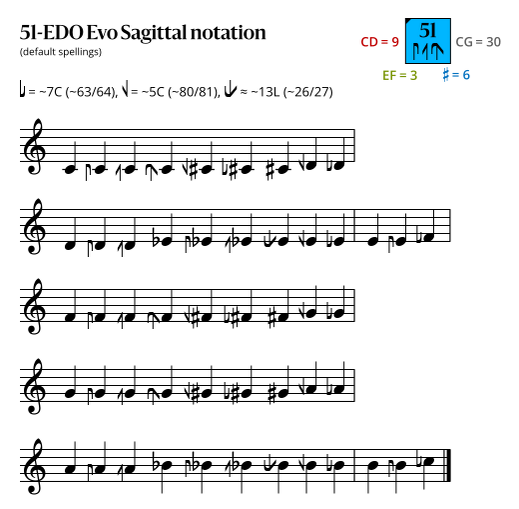
Revo flavor

Evo-SZ flavor

Approximation to JI
Interval mappings
The following tables show how 15-odd-limit intervals are represented in 51edo. Prime harmonics are in bold; inconsistent intervals are in italics.
| Interval and complement | Error (abs, ¢) | Error (rel, %) |
|---|---|---|
| 1/1, 2/1 | 0.000 | 0.0 |
| 11/10, 20/11 | 0.298 | 1.3 |
| 13/9, 18/13 | 1.324 | 5.6 |
| 15/14, 28/15 | 1.796 | 7.6 |
| 13/12, 24/13 | 2.604 | 11.1 |
| 3/2, 4/3 | 3.927 | 16.7 |
| 7/4, 8/7 | 4.120 | 17.5 |
| 15/11, 22/15 | 4.226 | 18.0 |
| 11/9, 18/11 | 5.533 | 23.5 |
| 7/5, 10/7 | 5.723 | 24.3 |
| 9/5, 10/9 | 5.832 | 24.8 |
| 15/8, 16/15 | 5.916 | 25.1 |
| 11/7, 14/11 | 6.021 | 25.6 |
| 13/8, 16/13 | 6.531 | 27.8 |
| 13/11, 22/13 | 6.857 | 29.1 |
| 13/10, 20/13 | 7.155 | 30.4 |
| 9/8, 16/9 | 7.855 | 33.4 |
| 7/6, 12/7 | 8.047 | 34.2 |
| 11/6, 12/11 | 9.461 | 40.2 |
| 5/3, 6/5 | 9.759 | 41.5 |
| 5/4, 8/5 | 9.843 | 41.8 |
| 11/8, 16/11 | 10.141 | 43.1 |
| 13/7, 14/13 | 10.651 | 45.3 |
| 15/13, 26/15 | 11.082 | 47.1 |
| 9/7, 14/9 | 11.555 | 49.1 |
| Interval and complement | Error (abs, ¢) | Error (rel, %) |
|---|---|---|
| 1/1, 2/1 | 0.000 | 0.0 |
| 11/10, 20/11 | 0.298 | 1.3 |
| 13/9, 18/13 | 1.324 | 5.6 |
| 15/14, 28/15 | 1.796 | 7.6 |
| 13/12, 24/13 | 2.604 | 11.1 |
| 3/2, 4/3 | 3.927 | 16.7 |
| 7/4, 8/7 | 4.120 | 17.5 |
| 15/11, 22/15 | 4.226 | 18.0 |
| 7/5, 10/7 | 5.723 | 24.3 |
| 15/8, 16/15 | 5.916 | 25.1 |
| 11/7, 14/11 | 6.021 | 25.6 |
| 13/8, 16/13 | 6.531 | 27.8 |
| 9/8, 16/9 | 7.855 | 33.4 |
| 7/6, 12/7 | 8.047 | 34.2 |
| 5/4, 8/5 | 9.843 | 41.8 |
| 11/8, 16/11 | 10.141 | 43.1 |
| 13/7, 14/13 | 10.651 | 45.3 |
| 9/7, 14/9 | 11.975 | 50.9 |
| 15/13, 26/15 | 12.447 | 52.9 |
| 5/3, 6/5 | 13.770 | 58.5 |
| 11/6, 12/11 | 14.069 | 59.8 |
| 13/10, 20/13 | 16.374 | 69.6 |
| 13/11, 22/13 | 16.673 | 70.9 |
| 9/5, 10/9 | 17.698 | 75.2 |
| 11/9, 18/11 | 17.996 | 76.5 |
| Interval and complement | Error (abs, ¢) | Error (rel, %) |
|---|---|---|
| 1/1, 2/1 | 0.000 | 0.0 |
| 11/10, 20/11 | 0.298 | 1.3 |
| 13/9, 18/13 | 1.324 | 5.6 |
| 13/12, 24/13 | 2.604 | 11.1 |
| 3/2, 4/3 | 3.927 | 16.7 |
| 7/4, 8/7 | 4.120 | 17.5 |
| 15/11, 22/15 | 4.226 | 18.0 |
| 11/9, 18/11 | 5.533 | 23.5 |
| 9/5, 10/9 | 5.832 | 24.8 |
| 13/8, 16/13 | 6.531 | 27.8 |
| 13/11, 22/13 | 6.857 | 29.1 |
| 13/10, 20/13 | 7.155 | 30.4 |
| 9/8, 16/9 | 7.855 | 33.4 |
| 7/6, 12/7 | 8.047 | 34.2 |
| 11/6, 12/11 | 9.461 | 40.2 |
| 5/3, 6/5 | 9.759 | 41.5 |
| 13/7, 14/13 | 10.651 | 45.3 |
| 15/13, 26/15 | 11.082 | 47.1 |
| 9/7, 14/9 | 11.975 | 50.9 |
| 11/8, 16/11 | 13.388 | 56.9 |
| 5/4, 8/5 | 13.686 | 58.2 |
| 11/7, 14/11 | 17.508 | 74.4 |
| 15/8, 16/15 | 17.614 | 74.9 |
| 7/5, 10/7 | 17.806 | 75.7 |
| 15/14, 28/15 | 21.734 | 92.4 |
Regular temperament properties
| Subgroup | Comma list | Mapping | Optimal 8ve stretch (¢) |
Tuning error | |
|---|---|---|---|---|---|
| Absolute (¢) | Relative (%) | ||||
| 2.3.7 | 1029/1024, [17 -16 3⟩ | [⟨51 81 143]] | −0.339 | 1.63 | 6.92 |
| 2.3.7.13 | 343/338, 512/507, 2197/2187 | [⟨51 81 143]] | −0.695 | 1.54 | 6.54 |
| 2.3.5 | 128/125, [-13 17 -6⟩ | [⟨51 81 119]] (51c) | −2.789 | 2.41 | 10.3 |
| 2.3.5.7 | 128/125, 245/243, 1029/1000 | [⟨51 81 119 143]] (51c) | −1.730 | 2.79 | 11.9 |
| 2.3.5 | 250/243, 34171875/33554432 | [⟨51 81 118]] (51) | +0.581 | 2.77 | 11.8 |
| 2.3.5.7 | 225/224, 250/243, 1029/1024 | [⟨51 81 118 143]] (51) | +0.803 | 2.43 | 10.3 |
Rank-2 temperaments
| Periods per 8ve |
Generator* | Cents* | Associated ratio* |
Temperament |
|---|---|---|---|---|
| 1 | 5\51 | 117.6 | 15/14 | Miracle (51e, out of tune) |
| 1 | 7\51 | 164.7 | 11/10 | Porky (51) |
| 1 | 10\51 | 235.3 | 8/7 | Rodan (51cf…, out of tune) / aerodino (51ce) |
| 1 | 19\51 | 447.1 | 13/10 | Supersensi (51cde) |
| 1 | 22\51 | 517.6 | 27/20 | Gravity (51ce) |
| 1 | 23\51 | 541.2 | 15/11 | Necromanteion (51ce) Oracle (51) Cypress (51cde…) |
| 3 | 19\51 (2\51) |
447.1 (47.1) |
9/7 (36/35) |
Hemiaug (51ce) |
| 3 | 21\51 (4\51) |
494.1 (94.1) |
4/3 (16/15) |
Augmented (7-limit, 51cd) |
| 4/3 (21/20) |
Fog (51) |
* Octave-reduced form, reduced to the first half-octave, and minimal form in parentheses if distinct
Scales
- Porky[7] (Palace[idiosyncratic term]): 7 7 7 9 7 7 7
- UFO scale[idiosyncratic term] (inflected MOS of Teefs[19][idiosyncratic term]): 2 2 4 1 2 2 2 4 2 5 2 4 4 2 2 1 4 2 2
- Cosmic scale[idiosyncratic term] subset of UFO scale): 21 9 4 9 8
Instruments
- Lumatone
- See Lumatone mapping for 51edo.
Music
- 51edo improv (2025-02-03)
- 51edo improv (2025-05-02)
- Northernlight - Deltarune (microtonal cover in 51edo) (2025)
- 51edo prelude (2026)
- 51edo improv (2026-04-22)
- Whalectric (2022) – YouTube | score – 7:4 semiquartal 4|4 mode
- James Mulvale (FASTFAST)
- STARS (Thoughts and Prayers) (2020)
- Fugue (2023) – for organ in 51edo Porcupine[7] ssssssL "Pandian"