Xenharmonic Wiki:Cross-platform dialogue: Difference between revisions
ranking poll! pls read the post for info! |
|||
| Line 250: | Line 250: | ||
Hello! I'm glad to see that this page exists. I'm a user on Discord who hasn't had much involvement in the previous conversations on this thread, but I'd like to try and work together with the old guard on some of my ideas- if that's even remotely feasible. To start with, I'd like to get some feedback on some of my ideas that I've worked on here on the wiki over the time I've been here, such as [[Alpharabian tuning]], [[telicity]], [[syntonic-rastmic subchroma notation]] and [[User:Aura/Aura's Ideas on Functional Harmony|my own take on microtonal functional harmony]]. Of these, I think telicity might be of the most interest to the old guard, since it's fairly math-heavy. I hope I'm not being a bother. --[[User:Aura|Aura]] ([[User talk:Aura|talk]]) 11:17, 19 March 2024 (UTC) | Hello! I'm glad to see that this page exists. I'm a user on Discord who hasn't had much involvement in the previous conversations on this thread, but I'd like to try and work together with the old guard on some of my ideas- if that's even remotely feasible. To start with, I'd like to get some feedback on some of my ideas that I've worked on here on the wiki over the time I've been here, such as [[Alpharabian tuning]], [[telicity]], [[syntonic-rastmic subchroma notation]] and [[User:Aura/Aura's Ideas on Functional Harmony|my own take on microtonal functional harmony]]. Of these, I think telicity might be of the most interest to the old guard, since it's fairly math-heavy. I hope I'm not being a bother. --[[User:Aura|Aura]] ([[User talk:Aura|talk]]) 11:17, 19 March 2024 (UTC) | ||
== Ranking poll for "good" EDOs from 27 to 140 == | |||
I thought it might be cool to do a poll to see which of these EDOs people subjectively prefer over others. It's far from all EDOs in the 27 to 140 range; I've picked the ones that seem the most significant theoretically as being worth interest, but if you think something's missing there is an option "[your favourite RTT EDO between 27 and 140 not on this list]" at the bottom of the list. The list is in order of number of notes per octave and I hope that each participant takes the time to sort all EDOs they have opinions on to the top and the bottom; if you're not sure that's why I've provided subgroups in up to the 89-prime-limit, although if you just focus on the 43-prime-limit part that's more reliable and probably a lot more intuitive for appraisal purposes. | |||
If you're wondering "why such a high prime limit"? here's details/explainers of the significance of all primes >43 that I've included: | |||
67/64 = 79.31c (close to 1\15 = 4\60, 2\31 = 4\62, 3\46 and practically exactly 8\121; the harmonic 15 EDOstep), | |||
64/61 = 83.12c (close to 1\14 = 5\70 = 6\84 = 10\140, 2\29 = 4\58 = 6\87, 3\43 and 5\72; almost exactly (4/3)^(1/6) (a third of a semifourth)), | |||
64/59 = 140.83c (close to 2\17 = 4\34 = 8\68, 3\26 = 15\130, 5\43, 7\60, 9\77, 11\94 and 13\111; appears in many systems as (3/2)^(1/5)), | |||
71/64 = 179.7c (close to 3\20 = 12\80 = 21\140 but also a harmonic ~10/9), | |||
73/64 = 227.79c (close to 3\16 = 9\48 = 15\80, 4\21 = 12\63, 7\37 = 14\74 = 21\111 and 11\58 but also the harmonic supermajor second), | |||
64/53 = 326.5c (close to 3\11 = 21\77 = 27\99, 10\37 = 20\74 = 30\111, 13\48, 16\59 = 32\118 and 19\70 = 38\140; this corresponds to a very distinctive size of third between minor and supraminor), | |||
79/64 = 364.54c (close to 3\23 = 6\46 and 10\33 = 30\99 but also the harmonic submajor third), | |||
83/64 = 450.05c (practically 3\8 but also the harmonic semisixth), | |||
89/64 = 570.9c (close to 10\21 = 30\63 and 19\40 = 38\80; like a harmonic analogue of 32/23), | |||
47/32 = 665.51c (close to 5\9 = 15\27 = 20\36 = 35\63 = 40\72 = 50\99; the harmonic wolf fifth / 9 EDO fifth), | |||
and 97/64 = 719.9c (practically 3\5; the harmonic 5 EDO fifth). | |||
As for primes > 13, I highly recommend looking at the [[25-odd-limit]] in all its glory if you are unfamiliar with using primes > 13, but as a quick summary, 17 is notable as introducing subminor ([[17/14]]) and supramajor ([[21/17]]) and neogothic minor ([[20/17]]) and neogothic major ([[51/40]]) and a good approximation of the half-octave of [[17/12]]~[[24/17]] but also for its naturalness as the general-purpose semitone in [[srutal archagall]], 19 introduces the harmonic minor third [[19/16]] between [[6/5]] and [[13/11]], and is close to [[32/27]] (and equated with it in [[nestoria]]), 23 introduces [[23/16]] which is what can be thought of as a harmonic augmented fourth in sharp-fifth systems and a harmonic diminished fifth in flat-fifth systems; it also introduces [[23/20]] which is between supermajor ([[8/7]]) and a semifourth ([[15/13]]), plus two new shades of supraminor third at [[23/19]] and [[28/23]], although the latter is more like a subneutral third, [[29/16]] is notable for being basically free in multiples of [[7edo]] (although is also notable as [[29/23]] approximates 400c reasonably well so [[21edo]] (and therefore [[63edo]] and [[84edo]]) has a good 23:29:32:39 chord for example), [[32/31]] is the subharmonic quarter-tone, [[37/32]] is the harmonic semifourth (implying a fourth around that of [[19edo]], so for higher-accuracy systems it works especially well with dual-semifourths; remarkably [[15/13]] and [[37/32]] are made fourth-complements in the miraculous harmonic series autotuner [[311edo]]), [[41/32]] is the harmonic supermajor third and [[43/32]] is the harmonic perfect fourth (as it approximates [[4/3]] significantly better than [[21/16]] and much better than [[11/8]]). | |||
Ranking poll is here: https://strawpoll.com/6QnMOMP7aZe | |||
Revision as of 12:24, 16 May 2024
Due to the prevailing winds of social media platforms, the Xen Wiki editor community has found ourselves divided into two mostly autonomous sub-communities: one on the #wiki channel in the Xenharmonic Alliance Discord, and the other in the Xenwiki Work Group on Facebook. When a change is proposed in one of these groups, and everyone in that group is on board, it can create the illusion of a consensus, even if the other group might not agree.
This page is intended as a place where everyone, from both Facebook and Discord, can share their views without having to subscribe to the other media platform. If there are any changes you are planning to make to the wiki's conventions (e.g. what types of information to list on temperament family pages, or what naming conventions should be used like ed3 vs edt), then it is a probably a good idea to discuss it here, so that neither Discord- nor Facebook-based editors are left out.
You can use this page like a talk page. Add subheadings for any topics you would like to discuss.
Please remember the Xenharmonic Wiki:Five pillars, especially 4. The Xenharmonic Wiki's editors should treat each other with respect and civility.
TE vs POTE vs CTE
I took some time to look through the changes from POTE to CTE. There are a hundred or so pages in which POTE has been removed, including main temperament pages like Porcupine, Mavila, etc. These tunings can be very different: Blackwood POTE has 4:5:6 around 0-400-720, but CTE 0-386-720, so that the 5/4 is pure but the major triad sucks. We spent a lot of time putting the POTE tunings up there. They are useful. It is frustrating that they have been removed. Can you please put them all back, Flora Canou? I'm pretty tuned out of this these days. Does anybody have the time or energy to moderate the Wiki more actively, to prevent this from happening? Carl Lumma Scott Dakota anyone? Or at this point, should we just fork the Wiki and make a copy of the way things were before, so at least these things are preserved somewhere? -- Mike Battaglia, 13 Mar 2024 (imported from Facebook)
- What's CTE? -- Carl Lumma, 13 Mar 2024 (imported from Facebook)
- "CTE" is "constrained Tenney Euclidean" where, instead of starting with the TE tuning and stretching so that octaves are pure, you do the optimization with the 2/1 kept at 1200 cents the entire time. It sounds like a good idea, but there's a subtlety in which it ends up weighting 8/7, 11/8, 13/8 etc so much more strongly than e.g. 6/5 that it can give strange results. Also for things like Blackwood, Mavila, etc. I would guess that whoever's pushed this change has decided these strange results are "philosophically correct" and so has removed POTE from everything and put CTE instead. -- Mike Battaglia, 13 Mar 2024 (imported from Facebook)
- Is it possible to make editing something that needs approval? I know it is a bit against the idea of a wiki, but that this point there is a body of work that needs to be preserved - perhaps forking a copy that can't be changed is a good solution. -- Chris Vaisvil, 13 Mar 2024 (imported from Facebook)
- Agree with Chris Vaisvil, to an even farther extent: only approved users should be able to edit. All in all, wiki software should be meant as a mean, not a goal 🙂 -- Claudi Meneghin, 13 Mar 2024 (imported from Facebook)
- We've done that with a lot of pages but not every single one. They clearly just don't care though - whatever we leave open they just change anyway - so it may just makes more sense to let them have their space to do stuff and fork the old version. -- Mike Battaglia, 13 Mar 2024 (imported from Facebook)
- We should fork it from like 2 years ago. I have xenharmonic.info if that's helpful. -- Carl Lumma, 13 Mar 2024 (imported from Facebook)
- I was thinking something similar and talking to Tyler Henthorn about this. It'd be a big project but probably worth doing. I'll look into it -- Mike Batteglia, 13 Mar 2024 (imported from Facebook)
- Are there something like yearly backups, or does undoing changes have to be done manually? -- Janne Karimäki, 13 Mar 2024 (imported from Facebook)
- I don’t particularly care about either of these two tunings, but if there’s one thing we should all agree on, it’s that different folks have different tuning preferences… this decision to *remove* a tuning broadly across the wiki certainly bothers me. -- Cmloegcmluin, 13 Mar 2024 (imported from Facebook)
- Just took a new job, moving to LA, cannot possible help at all right now, sorry!! -- Carl Lumma, 13 Mar 2024 (imported from Facebook)
Are people aware of this complaint Mike made on the Facebook Xen Wiki Workgroup page, about the recent replacing of POTE tunings with CTE tunings? He's considering locking even more pages on the wiki in response: https://www.facebook.com/groups/xenwiki/permalink/3585115431754435 I am very against locking pages, but I'm also against deleting information across the wiki like this (though I don't particularly care about either of these tunings). -- Cmloegcmluin, 16 Mar 2024 (imported from Discord)
- To some extent i feel this is exactly the kind of thing i was pointing out before
- Why remove information
- I get when you have some new thing you think is better, but why not include both
- Length be damned
- Also im very much against locking things its supposed to be editable its a wiki -- Wad Wizard, 16 Mar 2024 (imported from Discord)
- is mike aware of the reasoning? (that POTE just compresses all the gens to make the octave pure while CTE optimises with the pure octave in mind)
- iirc i havent usually done any replacements like this but im not against them. rather, when i am adding new temps i prefer CTE by default not only for this reason but cuz sintel's temp finder supports more subgroups than x31eq does, and sintel's temp finder uses CTE and TE but not POTE. -- pinkanberry, 16 Mar 2024 (imported from Discord)
- Correcting how
- Arent they two different approaches -- Wad Wizard, 16 Mar 2024 (imported from Discord)
- TE is a mathematical way of optimising a temperament. it assumes you can temper all the generators however you like, and optimises with that in mind. POTE is literally, "take the TE tuning, then stretch or compress all the generators by some ratio r such that the octave becomes pure". if you look at its definition here https://en.xen.wiki/w/POTE_tuning
- it gives the steps to find the TE tuning, then the last step is very simple and is (from what i understand) a mathematical way of saying exactly the procedure i described
- Find the POTE generators G' = G/T1; in other words G scalar divided by the first entry of T.
- in other words, it seems like a hackish solution to the problem of "i want TE but with pure octaves"
- i am not opposed to documenting TE and i wouldnt suggest "correcting" TE to CTE, as that's not a correction -- pinkanberry, 16 Mar 2024 (imported from Discord)
- POTE basically just scales the generator with the same scaling factor it does the octave from TE; it doesn't do what it claims to do.
- The POTE tuning sometimes has all the errors for the primes in the same direction, which is definitely not optimal. -- inthar, 16 Mar 2024 (imported from Discord)
- Now i feel like it should be documented in some way simply for the historical matter -- Wad Wizard, 16 Mar 2024 (imported from Discord)
- having prime errors all in the same direction isnt always bad (although keep in mind im of the opinion that p/q is more important to optimise than pq), but it does leave the question of whether you could tune the gens differently so that at least one of those primes becomes pure or flat instead. im not sure if that sort reasoning can feasibly apply to every (multidimensional) temperament; itd have to be proved i think; but certainly a lot/most -- pinkanberry, 16 Mar 2024 (imported from Discord)
- Its unfortunate that the community is split so the conversation isnt actually being had with them -- Wad Wizard, 16 Mar 2024 (imported from Discord)
- im allergic to facebook -- pinkanberry, 16 Mar 2024 (imported from Discord)
- Real -- Wad Wizard, 16 Mar 2024 (imported from Discord)
- Yeah, maybe it's a good idea to display both CTE and POTE tunings?
- I'm willing to make that compromise if it's needed to ensure pages won't be locked. -- inthar, 16 Mar 2024 (imported from Discord)
- im not if it means that whoever is just gonna revert the work put into a bunch of pages -- pinkanberry, 16 Mar 2024 (imported from Discord)
- I'll tell him it's consensus here that cte is superior to pote, okay? -- Magica Fumica, 16 Mar 2024 (imported from Discord)
- it's important to explain why and see if hes on the same page about it
- and maybe stress that we have nothing against also logging TE?
- certainly TE should never be removed -- pinkanberry, 16 Mar 2024 (imported from Discord)
- To tell the truth i experimented with putting both cte and ctwe before in the meantone family. Then i thought it was a readability hell so i didn't went on -- Magica Fumica, 16 Mar 2024 (imported from Discord)
- Actually, maybe osmium's right. POTE is certainly trivially obtainable from TE. -- inthar, 16 Mar 2024 (imported from Discord)
- that didnt cross my mind (hence my upvote) but yeah it would be very easy to derive if we listed the TE by default alongside the CTE
- just divide all the cent values of the gens by the ratio between the tempered octave and the pure octave
- maybe it would be good generally to log both TE and CTE? it shouldnt be an issue as the TE tuning is given by sintel's temp finder
- (also because i dont imagine two optimal tunings is excessive, if slightly less readable) -- pinkanberry, 16 Mar 2024 (imported from Discord)
- There's also something unnatural about POTE, right? It depends on the choice of generators we choose to scale. If you scale a different choice of generators that way, you'll get a different tuning. -- inthar, 16 Mar 2024 (imported from Discord)
- it makes some sense for prime generators and harmonic generators as it's proportional to the (logarithmic) size of the integer, but certainly not for subgroup generators in general -- pinkanberry, 16 Mar 2024 (imported from Discord)
- Then the discussion should be had with them
- And/or the change should be proposed -- Wad Wizard, 16 Mar 2024 (imported from Discord)
- Sure. We should be careful, lest they try to exact what they'd view as POTE-ic justice on us. -- inthar, 16 Mar, 2024 (imported from Discord)
Hi! I'm the one who currently has the nickname "pinkanberry" on the XA Discord. I think this page is a good idea. I hope this page will be good for getting on the same page of things for the wiki. --Godtone (talk) 22:30, 15 March 2024 (UTC)
Cases of suboptimal optimization
I was intrigued by this comment from above:
- "CTE" is "constrained Tenney Euclidean" where, instead of starting with the TE tuning and stretching so that octaves are pure, you do the optimization with the 2/1 kept at 1200 cents the entire time. It sounds like a good idea, but there's a subtlety in which it ends up weighting 8/7, 11/8, 13/8 etc so much more strongly than e.g. 6/5 that it can give strange results. Also for things like Blackwood, Mavila, etc. I would guess that whoever's pushed this change has decided these strange results are "philosophically correct" and so has removed POTE from everything and put CTE instead. -- Mike Battaglia, 13 Mar 2024 (imported from Facebook)
6/5 is an interval that, due to its extreme simplicity, has a lot of give when tempering (at least 6 ¢), so on principle I don't buy the argument that it is being underprioritised without seeing an example. Hence, a few examples of POTE having better tuning than CTE would be appreciated so we can go through what we think is going on. Kind regards, --Godtone (talk) 22:46, 15 March 2024 (UTC)
- I also want to note that often I have had the reverse impression about CTE: that more complex intervals - especially primes - were being underprioritised. The more complex an interval is, the less error it can tolerate when tempering, therefore I am also not sure I fully buy the reasoning that TE uses for weighting based on the inverse of logarithmic size; if anything weighting based on logarithmic size or just unweighted seems more favourable. However, this discussion isn't about whether or not TE is a flawed metric; rather it's about whether POTE or CTE is the appropriate way to get pure octave tunings out of it. --Godtone (talk) 22:49, 15 March 2024 (UTC)
- I also recognise/am aware that weighting in the way I suggested would lead to less mathematically elegant properties, if I recall discussions on the relationship between TE, complexity and rank correctly. I just wish to offer an alternate perspective to support the structure of my argument. --Godtone (talk) 22:51, 15 March 2024 (UTC)
- I can give you an example right now which is regarded by some as suboptimal: {128/125} (augmented) in CTE tuning is untempered, with pure 2, pure 3, and a 400-cent 5/4. It will have 6/5 at 302 cents whereas KE will have it more in tune at the expense of the purity of the 3. The logic of CTE is that since harmonic 3 isn't involved in the comma to be tempered out (128/125), of course it only makes sense that it should be pure, just as in 5-limit JI – and furthermore, any new prime added to this temperament should be pure. But POTE/KE also wanna take account of the sharp tendency induced by the sharp tuning of the 5. FloraC (talk) 04:37, 16 March 2024 (UTC)
- Hmm... maybe it's a bad example for me because I think tempering 128/125 is unfeasible (maybe 27edo does it well but that uses delta-rational chords to justify itself so it's not really the thing temperaments were designed for because the target isn't a fixed point) but I will follow the spirit of the logic of the example. The issue seems to be rather that CTE isn't designed to handle the case where extra generators are independent of the commas tempered if you are valuing p/q over pq (because CTE choosing pure generators makes perfect sense if you want to weight them equally and in this sense it's the logical constraining of TE which assumes the same). But POTE certainly doesn't seem to be the right fix to prioritising p/q over pq. Rather it seems like (at least in this case) what's wanted is a metric that respects tendency (a desire I've voiced before actually). For example it's noted here that "POTE tuning works as a quick approximation to CTWE" (AKA KE tuning), so maybe CTWE / KE tuning is desired? --Godtone (talk) 18:23, 16 March 2024 (UTC)
Mike's Response to All This
Hi. I see there's a lot of chatter above about my post on FB. Here's my response:
General situation:
- Yes, we're all pretty unhappy POTE was removed site-wide without asking us.
- Please don't make these kinds of changes unilaterally without asking us first.
- I'm happy to talk about the math, but that isn't what this is about. POTE may or may not be the best tuning, but it's still useful for what it is - even if partly for historical reasons - and it's information we want to have available.
- Even if you *do* come up with something which is better: don't just remove the previous thing from the entire Wiki, unless you are sure the people who wrote the previous thing are on board and happy having their work deleted!
Moderation:
- I think there is no point locking more pages. We've reached a tipping point. Either we can work together or we can't.
- There is a fairly broad consensus from people involved in this 15-20+ years that these site-wide breaking changes are destructive to the theory we were trying to build. Maybe that is worth pondering.
- This is the only place all this theory is stored besides forum posts. Whenever you delete stuff from the Wiki, most of the time it isn't preserved anywhere else except a handful of forum posts and in our heads.
- People are asking me to lock pages because it's been many times that we've asked not to delete stuff from all across the wiki. I guess the clear answer from you all, after hearing us ask it a lot, is "no." You know we feel this way but you have strong opinions and you want us to re-justify stuff to you or else you will delete it. OK.
- We're a bunch of old geezers at this point. If you simply feel your theory is better and you want to delete the parts of ours that you don't like, we just don't have the energy to fight. There are too many of you and the main guy driving our theory is dead. What choice do we have?
- For what it's worth, I genuinely like lots of the ideas that you have. I think Inthar's ideas about MOS are great. I try to stay caught up with it. It would be nice to somehow evolve that stuff without destroying our stuff. But if our ideas can't be preserved here, we'll have to try to preserve them somewhere else.
The actual math is neither here nor there, but FWIW, I'm the one who put together KE, WE, TWE, all of that to begin with, so I'm fairly familiar with it. Yes, I get that CTE has this claim on-paper that it's the closest point to the JIP with pure octaves and the TE norm. It also weights 16/13 higher than 6/5, because 16/13 happens to be octave-equivalent to 13/1. This has all been talked about in the past many times - if this is what you want, great, but it isn't the one-size-fits-all solution, and we generally prefer tunings like POTE, KE, etc.
Thanks. Mike Battaglia (talk) 08:19, 16 March 2024 (UTC)
- KE tuning seems acceptable to me. I personally don't disagree with using something different than CTE, only to using POTE as the default way of giving a pure-octaves optimised tuning given that it seems hackish compared to CTE, KE, etc. (Actually, I prefer EDO tunings, so the "optimal ET sequence" is strange to me, why list less rank 1 tunings rather than more? I am more interested in say, every patent val tuning, or if not patent val where the warted interval respects a strong tendency of the EO.) It would be nice if the info was easy to obtain/generate; that's why I mentioned x31eq and sintel's temp finder. There is some discussion on this side of the fence that perhaps a template could be used that auto-generates temperament data; this has a couple of advantages. First, if later a better metric is discovered and there is consensus to it, it can be switched, so that the default metrics shown can be fixed easily, and second, there has been suggested the idea of showing multiple optimal tunings. It seems like it might be a good idea to include TE due to being in many ways the simplest way of optimising and due to being a basis of other methods, also because the POTE tuning is trivially derivable from it so also for historicity, and KE sounds like a good suggestion, although I'm unfamiliar with it personally. --Godtone (talk) 18:53, 16 March 2024 (UTC)
- Thanks for expressing your general views tuning theory and tuning optimization. I see you seem to still think there is an open question if you want to "keep" the thing we made which you don't like, or replace it with the thing you made which we don't like. I think I've said my piece about this way of doing things at this point. When you folks figure out what you want to do, if it still involves removing stuff, please ask us on FB first. Thanks. Mike Battaglia (talk) 20:15, 16 March 2024 (UTC)
FloraC has added POTE tuning back to all the temperament pages which used to have it. If there are any pages we missed, please let us know so we can add POTE back to those as well. The consensus in the Discord channel is in favor of displaying multiple tunings on temperament pages, so that's what we're going to do moving forwards. No more removing one in favor of another. --Budjarn Lambeth (talk) 02:35, 17 March 2024 (UTC)
- Appreciate it. Thank you to Budjarn and Flora.
- OK, now that that is settled, regarding the actual math involved for Godtone, Inthar, Flora and others:
- Yes, it's true that one of the main reasons people liked POTE historically is because it approximates KE. If you want to declare KE some kind of best general-purpose tuning, or whatever, I would probably support that. However, we ought to compute POTE/KE tunings for a huge set of temperaments to see if for any they differ significantly (which would be very surprising to me).
- The bigger picture: all of these tuning optimizations are imperfect because they only measure dyadic error. A 4:5:6 chord, flattened to the "isoharmonic"/"proportional"/"Mt. Meru"/whatever 4:4.98:5.96 chord, or 0-379-690, sounds less far off than something with a similar amount of error which is non-proportional, so we really care about which way the errors are oriented within the triad. If you want, you can look at the Hessian of simple chords in 3-HE, which models this correctly, to build a simple linear model for tuning error of some triad. Then, you can try to optimize the entire "Z-algebroid" of chords, rather than just the Z-module of monzos. In principle it can be done - I've played around with this kind of thing a bit, though don't have any firm results.
- Or: just note empirically that TE seems to magically give pretty good results, even for triads, tetrads, etc. Why? Who knows. Maybe if you did the above thing out all the way you'd derive that TE, or something close enough to it, also happens to be the optimal tuning on the entire algebroid. Similarly, POTE gives good results for this but not CTE. Why? Again, who knows, but one idea is to note that stretching a chord isoharmonically/proportionally in Hz is very close to stretching it in cents, as a first order Taylor approximation. For instance, stretching 4:5:6 both ways so the outer dyad is 720 gives 0-397-720 (isoharmonic) vs 0-396-720 (stretching in cents). So scaling TE to POTE is approximately the same as isoharmonically stretching all chords in the entire tuning.
- So that is the other reason POTE, or any tuning, is useful: empirically, we note it sounds good.
- There are other reasons. Graham has expressed interest in it being the unique pure-octave tuning that minimizes the angle/dot product with the JIP. I don't remember what musical interpretation he gave to this angle; you'd have to ask him why. And there is always this "black magic" element to it where Gene knew a bunch of stuff about all of this, but has sadly passed on and we can't ask him about it. We have the same situation with, for instance, zeta integral and gap tunings - what theoretical justification do these things have, compared with something clear like zeta peak tunings? I don't know, but Gene did. Oh well. Mike Battaglia (talk)
- I have idiosyncratic reasons to favor CTE or a tuning that doesn't prioritize divisive ratios over multiplicative ratios based on where beating occurs in the frequency spectrum with any harmonic timbre. I documented the details in my essay (→ User:FloraC/Hard problems of harmony and psychoacoustically supported optimization). The essay also contains a design around Hahn distance so you might be interested. Regardless, as I've related to you on FB, I think of CTE as the most straight-forward solution that is most likely to be understood by the widest audience, so the main appeal is its methodological transparency, which is somewhat shared by KE and is in contrast with the "black magic" of POTE.
- Thanks, will read when I get a second. It would be great to have all of these things, as I still am not sure if KE and POTE ever give significantly different results. Aren't you writing a Lua module that computes them all at once anyway? Mike Battaglia (talk) 18:46, 17 March 2024 (UTC)
- I appreciate your in-depth response a lot. Sorry if I came across as hostile, it was not my intention. The thing about POTE being the tuning with a unique property is interesting; I hadn't heard it before. If I may offer my own thoughts: I agree that likely the reason POTE seems to be a good approximation is to do with delta-rational chords (which from what I understand is the appropriate and nontrivial generalisation of isoharmonic chords, in that delta-rational chords sound like JI without being JI while isoharmonic chords are JI tunings of delta-rational chords); in my mind though it would make more sense to devise a different measure entirely if you wanted to optimise that sort of thing like how you noted that one could devise measures of triadic/tetradic/etc. chords. I have a hypothesis to do with the divide between POTE and CTE, or I think more aptly, between weighting p/q over pq and weighting them the same. It seems to me that the lower accuracy a temperament is, the more we prioritise p/q over pq, so that CTE becomes increasingly worse, while the higher accuracy a temperament is, the more it makes sense to also want to model pq with p/q; maybe this caused an impression here that CTE made more sense. For example, I myself wouldn't usually look at temperaments like tempering 256/243 (Blackwood) or 128/125 (Augmented) because if I wanted something like that, I would instead investigate a DR (Delta-Rational) chord phenomenon rather than using CTE. Kind regards, --Godtone (talk) 20:51, 17 March 2024 (UTC)
- Also, if you haven't seen it already, you may want to look at Talk:POTE_tuning#Justification - it seems relevant to this discussion, as User:Sintel comments there, although I'm not sure if the comments are outdated. --Godtone (talk) 21:19, 17 March 2024 (UTC)
wayy back before I understood how the maths worked I always wondered why POTE on the wiki was always given by default. And this confusion was actually quite valid, because nowhere on the wiki is it explained why this is a reasonable choice at all. It seems to me like if you provide one default choice, it should be well-justified.
now, I am quite fond of just providing one default choice, as to not paralyze the reader with too many options, but then the question is which one?
in the past I have compared KE and POTE for like thousands of temperaments, and it seemed like they were always extremely close. so how about just using KE going forward? this way we have something that is both empirically *and* theoretically justified.
Sintel (talk) 22:14, 17 March 2024 (UTC)
- FWIW, that's essentially what I was trying to say in my comment starting with "KE tuning seems acceptable to me" (although I don't understand the specifics enough to argue it more strongly). I don't mind the other solution of listing CTE, POTE and TE together though if that will cause less friction going forwards, although I still think that due to POTE's trivial derivability from TE it seems redundant/unnecessary to list, but I guess dividing the cent values by the ratio between the tempered octave and pure octave (even though trivially easy) is enough of a hassle for anyone who really wants POTE specifically to justify listing it. --Godtone (talk) 00:40, 18 March 2024 (UTC)
- So far, my suggestion is to have a single standard optimal tuning displayed in any given temperament data block, and optionally append a collapsible box containing more "optimal tunings" for various optimization methods. These would serve as quick references for people who do not wish to use a calculator, namely if one wants to compare similar temperaments at a glance. These tunings can most likely be computed dynamically if we have the right modules, but they could also just be manually inserted if need be. --Fredg999 (talk) 03:01, 18 March 2024 (UTC)
- Showing a single standard tuning by default has the issue of which though. If they're on board with KE (if we can show that it's practically almost always very close to POTE) then that's not an issue, but otherwise I presume it means that they'd want it to be POTE; I would object to POTE being the standard tuning to show (as opposed to, say, KE) just as they object to CTE. In such a case it seems better to just show a few tunings side-by-side and let the reader make their own judgement. The values given are only meant to be a starting point anyways (for if one doesn't want to use an EDO tuning). --Godtone (talk) 03:35, 18 March 2024 (UTC)
- My pick for the standard tuning would be TE, with the others (POTE, KE, CTE, anything else) being included in the collapsed box. There seems to be a lot of disagreement about which pure-octaves optimal tuning is acceptable, but most people seem to be okay with TE as the stretched-octaves one, so with TE being the least controversial, it seems to make sense to list it first. --Budjarn Lambeth (talk) 06:09, 18 March 2024 (UTC)
- I think most users will want a pure-octave tuning to start with and that's why the controversy is on the pure-octave tunings. If there was only one tuning then KE would meet the needs of all parties the best, but at this point it's clear that POTE is to be preserved and CTE is to be added. If we add KE to POTE then they serve the same purpose so it's a waste of space. So I'll add CTE to POTE while leaving the question of replacing POTE with KE to the future. I think additional tunings can be added in the dedicated page for the temperament, properly organized as its own block. (All those additions are low-priority to me so if I'm doing it all alone, it won't happen too quick.) FloraC (talk) 08:43, 18 March 2024 (UTC)
- Alright, sounds like a good plan to me. Thank you for your hard work on this :) --Budjarn Lambeth (talk) 09:13, 18 March 2024 (UTC)
Table comparing POTE vs KE vs CTE
-
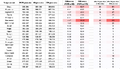 Comparison of POTE, KE, CTE tunings for several 5 limit temperaments
 -
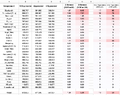 Comparison of POTE, KE, CTE tunings for several 7 limit temperaments


I made these tables comparing the POTE, KE and CTE tunings for all of the temperaments and microtemperaments listed in Erlich's Middle Path paper, as well as Pelogic, since a comparison like this is something that has been asked for a few times on this page.
I used Sintel's temperament calculator to find the KE and CTE tunings, so a big thank you to Sintel for that :)
--BudjarnLambeth (talk) 07:08, 19 March 2024 (UTC)
- I wrote some of the headings at the top wrong. I uploaded new versions of the files with this fixed, but it might take a few hours for the file pages to start showing the new versions. Specifically, the columns that say "CTE vs KE" are supposed to say "POTE vs CTE". Sorry for the confusion --BudjarnLambeth (talk) 07:17, 19 March 2024 (UTC)
- As Mike pointed out below, I put the wrong KE generator for 5-limit Porcupine. I have uploaded a new version of the file that fixes this now. The file page has not yet started displaying the changes but hopefully it will soon :) --BudjarnLambeth (talk) 09:44, 19 March 2024 (UTC)
- I'd just like to note I'm very happy with KE, my feeling is that for low-accuracy temperaments CTE doesn't weight p/q over pq enough but POTE seems to overdo it, so it's very favourable that KE seems to be close to POTE but slightly in the CTE direction. Hopefully KE will continue this trend upon analysis in higher limits with various subgroups. (Not that I don't like CTE, I personally have generally liked the CTE tuning a lot for mid-to-high-accuracy temperaments, EG I think its tuning of meantone as ~2/9-comma (between 1/4 and 1/5) makes sense.) --Godtone (talk) 21:08, 19 March 2024 (UTC)
- I have made a table comparing some high-limit temperaments (specifically the ones Mike named) as well as some subgroup temperaments in POTE, KE and CTE. The same trend seems to continue, as all the KE tunings are in between POTE and CTE, and most of them lean closer to POTE.
-
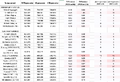 Comparison of POTE, KE, CTE generators for high limit & subgroup temperaments

- --BudjarnLambeth (talk) 21:59, 19 March 2024 (UTC)
Mike is Done For Now
Hi all
This has been fun but I need to be done with this for a while, so I leave it with you all.
So some parting words for POTE vs KE:
- Thanks for putting POTE back and making the charts.
- I've added a bunch of theory, history and Python to the constrained tunings page, so it's easy to compute any arbitrary the CTE/KE/whatever in closed form. Since it looks like you have Lua code for the pseudoinverse you'll be able to use this to easily compute the KE tuning without needing nonlinear optimization.
- When comparing these things it's best to compare the tuning maps, not the generators. It's hard to know how much difference a cent makes just looking at the generator map.
- I would just subtract the two tuning maps and take an RMS of the differences.
- It looks like the biggest differences involve temperaments where the period is some fraction of an octave: Augmented, Diminished, Blackwood, etc.
- The differences should also be pretty small for stuff like magic, porcupine, etc, and also for 5-limit temperaments. It's the things that are a bit further out error-wise and in higher limits that I'm curious about: superpyth, machine, semaphore, pajara, modus, mohajira, etc.
- I think there are some errors - Porcupine doesn't look right; I think it should be 164.0621.
- In general I'm fairly impressed with KE though.
For organizing this stuff:
- I agree having one or two "default" tunings shown prominently is good, and then the rest below it. Maybe one pure-octave and one stretched-octave, if you like.
- Yes, please do put a pure-octave tuning up there. Nobody wants to grab a calculator to derive POTE from TE!
- The above results for POTE vs KE look fairly good to me. If they look this good after checking with higher-limit temperaments and ones a bit less accurate, I'd be alright with making KE the standard and POTE secondary.
- If you like CTE then add it but I don't think it should be standard. It's awful, really.
For the math:
- I don't know how I always end up in this position of defending the "old guard" - I spent the last 15 years arguing with people about changing stuff and now suddenly I'm defending it.
- If you really want my view, I don't really think any of these optimal tunings are ideal. I think log-weighting in general is ridiculous. All of these higher primes end up weighted ridiculously strongly. The "best" EDOs (http://x31eq.com/cgi-bin/more.cgi?r=1&limit=2_3_5_7_11_13_17_19_23_29_31_37_41_43_47_53&error=5) in very high limits with log-weighting are always very strange things like 26, 29, etc, because higher primes just pop up faster than they roll off.
- There is a version of the zeta function which weights things as 1/log(nd) instead of 1/(nd)^s, and the results just seem very silly compared to the real one.
- I came up with the "BOP" and "BE" tunings for this reason, which weight ratios inversely proportional to the exponential of their norm (i.e. 1/(nd)) instead. FWIW I think they're better, the BE tuning in particular. It would not be that hard to figure out some kind of Weil version of this.
- The subgroup version of these is a little bit less easy to do, as you need to check the convex hull of all intervals divided by the exponential of their norm.
- I think this is a much more radical change though and I'd say to go with POTE/KE for now and do this later.
That's it for now, thanks. Mike Battaglia (talk) 09:27, 19 March 2024 (UTC)
Working with the Old Guard
Hello! I'm glad to see that this page exists. I'm a user on Discord who hasn't had much involvement in the previous conversations on this thread, but I'd like to try and work together with the old guard on some of my ideas- if that's even remotely feasible. To start with, I'd like to get some feedback on some of my ideas that I've worked on here on the wiki over the time I've been here, such as Alpharabian tuning, telicity, syntonic-rastmic subchroma notation and my own take on microtonal functional harmony. Of these, I think telicity might be of the most interest to the old guard, since it's fairly math-heavy. I hope I'm not being a bother. --Aura (talk) 11:17, 19 March 2024 (UTC)
Ranking poll for "good" EDOs from 27 to 140
I thought it might be cool to do a poll to see which of these EDOs people subjectively prefer over others. It's far from all EDOs in the 27 to 140 range; I've picked the ones that seem the most significant theoretically as being worth interest, but if you think something's missing there is an option "[your favourite RTT EDO between 27 and 140 not on this list]" at the bottom of the list. The list is in order of number of notes per octave and I hope that each participant takes the time to sort all EDOs they have opinions on to the top and the bottom; if you're not sure that's why I've provided subgroups in up to the 89-prime-limit, although if you just focus on the 43-prime-limit part that's more reliable and probably a lot more intuitive for appraisal purposes.
If you're wondering "why such a high prime limit"? here's details/explainers of the significance of all primes >43 that I've included:
67/64 = 79.31c (close to 1\15 = 4\60, 2\31 = 4\62, 3\46 and practically exactly 8\121; the harmonic 15 EDOstep),
64/61 = 83.12c (close to 1\14 = 5\70 = 6\84 = 10\140, 2\29 = 4\58 = 6\87, 3\43 and 5\72; almost exactly (4/3)^(1/6) (a third of a semifourth)),
64/59 = 140.83c (close to 2\17 = 4\34 = 8\68, 3\26 = 15\130, 5\43, 7\60, 9\77, 11\94 and 13\111; appears in many systems as (3/2)^(1/5)),
71/64 = 179.7c (close to 3\20 = 12\80 = 21\140 but also a harmonic ~10/9),
73/64 = 227.79c (close to 3\16 = 9\48 = 15\80, 4\21 = 12\63, 7\37 = 14\74 = 21\111 and 11\58 but also the harmonic supermajor second),
64/53 = 326.5c (close to 3\11 = 21\77 = 27\99, 10\37 = 20\74 = 30\111, 13\48, 16\59 = 32\118 and 19\70 = 38\140; this corresponds to a very distinctive size of third between minor and supraminor),
79/64 = 364.54c (close to 3\23 = 6\46 and 10\33 = 30\99 but also the harmonic submajor third),
83/64 = 450.05c (practically 3\8 but also the harmonic semisixth),
89/64 = 570.9c (close to 10\21 = 30\63 and 19\40 = 38\80; like a harmonic analogue of 32/23),
47/32 = 665.51c (close to 5\9 = 15\27 = 20\36 = 35\63 = 40\72 = 50\99; the harmonic wolf fifth / 9 EDO fifth),
and 97/64 = 719.9c (practically 3\5; the harmonic 5 EDO fifth).
As for primes > 13, I highly recommend looking at the 25-odd-limit in all its glory if you are unfamiliar with using primes > 13, but as a quick summary, 17 is notable as introducing subminor (17/14) and supramajor (21/17) and neogothic minor (20/17) and neogothic major (51/40) and a good approximation of the half-octave of 17/12~24/17 but also for its naturalness as the general-purpose semitone in srutal archagall, 19 introduces the harmonic minor third 19/16 between 6/5 and 13/11, and is close to 32/27 (and equated with it in nestoria), 23 introduces 23/16 which is what can be thought of as a harmonic augmented fourth in sharp-fifth systems and a harmonic diminished fifth in flat-fifth systems; it also introduces 23/20 which is between supermajor (8/7) and a semifourth (15/13), plus two new shades of supraminor third at 23/19 and 28/23, although the latter is more like a subneutral third, 29/16 is notable for being basically free in multiples of 7edo (although is also notable as 29/23 approximates 400c reasonably well so 21edo (and therefore 63edo and 84edo) has a good 23:29:32:39 chord for example), 32/31 is the subharmonic quarter-tone, 37/32 is the harmonic semifourth (implying a fourth around that of 19edo, so for higher-accuracy systems it works especially well with dual-semifourths; remarkably 15/13 and 37/32 are made fourth-complements in the miraculous harmonic series autotuner 311edo), 41/32 is the harmonic supermajor third and 43/32 is the harmonic perfect fourth (as it approximates 4/3 significantly better than 21/16 and much better than 11/8).
Ranking poll is here: https://strawpoll.com/6QnMOMP7aZe