|
|
| Line 141: |
Line 141: |
|
| |
|
| === Herculean === | | === Herculean === |
| It adds the [[schisma]] diacritic to the Promethean symbol set, which can be stacked with the remaining alterations, allowing for a maximum resolution of 58EDA, of which a great edo is [[612edo|612]]. When used for JI, it defines the ''Standard Ultra Precision JI'' capable of writing in the 23-limit with higher precision. | | It adds the [[schisma]] accent (a diacritic) to the Promethean symbol set, which can be stacked with the remaining alterations, allowing for a maximum resolution of 58EDA, of which a great edo is [[612edo|612]]. When used for JI, it defines the ''Standard Ultra Precision JI'' capable of writing in the 23-limit with higher precision. |
|
| |
|
| === Olympian === | | === Olympian === |
| It adds the [[4096/4095|''mina'']] diacritic to the Herculean symbol set, able to be stacked up to twice with the schisma and the remaining alterations, allowing for a maximum resolution of 233EDA, The zeta peak [[2460edo]] has been used as a base to define the mina as an interval measure, and the Olympian set of intervals generally, due to its extremely precise 27-odd-limit palette. When used for JI, it defines the ''Standard Extreme Precision JI'' capable of writing in the [[47-limit]] with great precision. It also is the smallest precision level that has an "exact" mapping for prime 13, thanks to the mina's appearance. 13/8 is now written as a major sixth minus the 35 large diesis and a mina. From C, this would be C - A{{sagittal|,}}{{sagittal|(!/}} . | | It adds the [[4096/4095|''mina'']] accent to the Herculean symbol set, able to be stacked up to twice with the schisma and the remaining alterations, allowing for a maximum resolution of 233EDA, The zeta peak [[2460edo]] has been used as a base to define the mina as an interval measure, and the Olympian set of intervals generally, due to its extremely precise 27-odd-limit palette. When used for JI, it defines the ''Standard Extreme Precision JI'' capable of writing in the [[47-limit]] with great precision. It also is the smallest precision level that has an "exact" mapping for prime 13, thanks to the mina's appearance. 13/8 is now written as a major sixth minus the 35 large diesis and a mina. From C, this would be C - A{{sagittal|,}}{{sagittal|(!/}} . |
|
| |
|
| === Magrathean === | | === Magrathean === |
| It adds the ''tina'' diacritic to the Olympian symbol set, able to be stacked up to thrice with any of the symbols (three tinas make a ~mina), allowing for a whopping maximum resolution of 809EDA. The strict zeta peak [[8539edo]] has been used to define the tina as an interval measure, due its insanely precise 27-odd-limit (and beyond) interval palette. When used for JI, it defines the ''Standard Insane Precision JI'' capable of writing in the 127-limit with astonishing precision. There is no level of precision higher than this, and it is unlikely that one will ever exist. Unless you want some hot sauce.<ref name=":0">https://forum.sagittal.org/viewtopic.php?p=2714&hilit=bomb#p2714 "A tina is approximately 1/809th of an apotome, 1/8539th of an octave (a [[Zeta peak edo|zeta-peak EDO]]), or 0.14 cents. The fractional-tina is generally half a tina but is intentionally arbitrary, because if you need any more precision than that, I have a bottle of Da' Bomb Beyond Insanity Hot Sauce with your name on it"</ref> | | It adds the ''tina'' accent to the Olympian symbol set, able to be stacked up to thrice with any of the symbols (three tinas make a ~mina), allowing for a whopping maximum resolution of 809EDA. The strict zeta peak [[8539edo]] has been used to define the tina as an interval measure, due its insanely precise 27-odd-limit (and beyond) interval palette. When used for JI, it defines the ''Standard Insane Precision JI'' capable of writing in the 127-limit with astonishing precision. There is no level of precision higher than this, and it is unlikely that one will ever exist. Unless you want some hot sauce.<ref name=":0">https://forum.sagittal.org/viewtopic.php?p=2714&hilit=bomb#p2714 "A tina is approximately 1/809th of an apotome, 1/8539th of an octave (a [[Zeta peak edo|zeta-peak EDO]]), or 0.14 cents. The fractional-tina is generally half a tina but is intentionally arbitrary, because if you need any more precision than that, I have a bottle of Da' Bomb Beyond Insanity Hot Sauce with your name on it"</ref> |
|
| |
|
| == Prime approximations == | | == Prime approximations == |
| Line 194: |
Line 194: |
| Tempered systems might yield better or worse approximations to each just interval. Used for JI, only some non-Pythagorean intervals in the 23-limit will ever be exact. The error gets increasingly small however, down to hundredths of a cent in Magrathean. | | Tempered systems might yield better or worse approximations to each just interval. Used for JI, only some non-Pythagorean intervals in the 23-limit will ever be exact. The error gets increasingly small however, down to hundredths of a cent in Magrathean. |
|
| |
|
| == Gallery == | | == Gallery of core accidentals == |
| === Spartan single-shaft === | | === Spartan single-shaft === |
| {{sge| ¦( | !( | n | 5120/5103 | 7/5 kleisma }} | | {{sge| ¦( | !( | n | 5120/5103 | 7/5 kleisma }} |
| Line 329: |
Line 329: |
| {{sge| (X~ | (Y~ | r | 81/76 | 19s }} | | {{sge| (X~ | (Y~ | r | 81/76 | 19s }} |
|
| |
|
| === Herculean extension diacritics === | | == Gallery of accents == |
| | Fine-grained Sagittal notations starting with Herculean can use accents, also called diacritics, to the left of a sagittal or a bare shaft, to indicate very subtle distinctions in pitch. |
| | <div class="mw-collapsible mw-collapsed"> |
| | === Herculean extension accents === |
| {{sge| ¦ | ! | ⁠ | 1/1 | shaft }} | | {{sge| ¦ | ! | ⁠ | 1/1 | shaft }} |
| Ai and ao are not diacritics but bare shafts which do not alter the pitch. They are used when there would otherwise be bare diacritics. | | Ai and ao are not accents but bare shafts which do not alter the pitch. They are used when there would otherwise be bare accents. |
| {| class="wikitable" | | {| class="wikitable" |
| |- style="text-align: center;" | | |- style="text-align: center;" |
| Line 343: |
Line 346: |
| |5s down | | |5s down |
| |} | | |} |
| The interval is called a "schisma". The diacritic's shape is called "tick" (up or down). | | The interval is called a "schisma". The accent's shape is called "tick" (up or down). |
|
| |
|
| === Olympian extension diacritics === | | === Olympian extension accents === |
| {| class="wikitable" | | {| class="wikitable" |
| |- style="text-align: center;" | | |- style="text-align: center;" |
| Line 365: |
Line 368: |
| The average unit interval is called a "mina" (rhymes with ballerina) and is approximately 0.42 of a cent. The shapes are called "wing" and "bird". | | The average unit interval is called a "mina" (rhymes with ballerina) and is approximately 0.42 of a cent. The shapes are called "wing" and "bird". |
|
| |
|
| === Magrathean extension diacritics === | | === Magrathean extension accents === |
| {| class="wikitable" | | {| class="wikitable" |
| |- style="text-align: center;" | | |- style="text-align: center;" |
| Line 446: |
Line 449: |
| |77/(5⋅37)n down | | |77/(5⋅37)n down |
| |} | | |} |
| The average unit interval is called a "tina" (rhymes with ballerina) and is approximately 0.14 of a cent. The new shapes are called "horn" and "wedge". Notice how 3 tinas is ''approximately'' equal to one mina, so the system just equates the 3. Either way, this is an ''insane'' level of pitch precision. The "i/o" diacritic, whose shape is called "dot", represents some unit fraction of a tina, often a half as shown, but it is intentionally left to be defined by the user.<ref name=":0" /> | | The average unit interval is called a "tina" (rhymes with ballerina) and is approximately 0.14 of a cent. The new shapes are called "horn" and "wedge". Notice how 3 tinas is ''approximately'' equal to one mina, so the system just equates the 3. Either way, this is an ''insane'' level of pitch precision. The "i/o" accent, whose shape is called "dot", represents some unit fraction of a tina, often a half as shown, but it is intentionally left to be defined by the user.<ref name=":0" /> |
| | </div> |
|
| |
|
| == See also == | | == See also == |
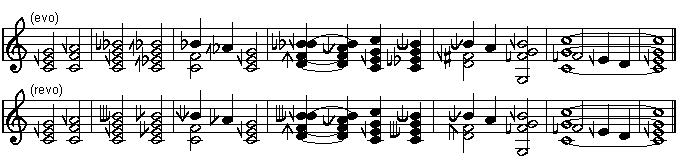
Sagittal notation is a musical notation system capable of notating almost any conceivable tuning. It was developed by Dave Keenan and George Secor with significant contributions from numerous others.
Flavors of Sagittal notation
Sagittal notation comes in two mutually compatible flavors.
Evo
The Evo flavor (short for "evolutionary", previously called "mixed") uses only single-shaft Sagittal symbols, e.g. , alone or in combination with conventional sharps and flats and their doubles. Only the large variant of the double sharp (U+E47D) is considered to be stylistically-compatible with Sagittal symbols. Evo is much easier to learn, but it results in a greater number of symbols on the sheet, which can give it a more cluttered appearance, particularly with chords, and it may be confusing when two symbols alter the same note in opposite directions.
A sub-flavor of Evo is Evo-SZ (Evo with Stein–Zimmermann). This is where any sagittals that are notating exactly half the alteration of a sharp or flat (most often ) are replaced by the Stein–Zimmermann semisharp and narrow reversed flat , and the corresponding combinations (most often and ) are replaced by and . The narrow variants of the fractional flats (U+E284) and (U+E285) are preferred because they preserve the Sagittal principle that the visual size of a symbol should indicate the relative size of its alteration and they reduce left-right confusion.
In tempered systems, Evo-SZ accidentals may instead be distinct from Sagittals like , when the apotome can be split in two equal parts as in Hemipythagorean as literal half-sharps and half-flats, with a distinction between mapped neutral thirds like ~11/9 or ~16/13 and hemififths which might be mapped to another interval like 49/40 in particularly fine-grained EDOs like 270 or 311. There is no need for this in coarser EDOs like 24, 31 or 41, where in this case the rastma is tempered out, and thus the mappings of the irrational hemififth and 11/9 coincide.
Revo
The Revo flavor (short for "revolutionary", previously called "pure") only requires one accidental per note. Revo therefore takes up less space on the sheet and presents a cleaner appearance, and it clearly indicates the direction of the overall alteration. It discards the conventional sharps and flats and their doubles and replaces them with these multi-shaft arrow-like symbols: . Adding a sharp or flat to a Sagittal is achieved by adding two more shafts, e.g. becomes and becomes , as expected. Apotome complements, that arise when the Sagital accidental alters in the opposite direction to the apotome, are not predictable. becomes , becomes , becomes , becomes ; one must learn these apotome complements by rote memorization.
Table of apotome complements[1]
| Symbol
|
|
|
|
|
|
|
|
|
|
|
|
|
|
|
|
|
|
|
|
|
|
|
|
|
|
|
|
| Complement
|
|
|
|
|
|
|
|
|
|
|
|
|
|
|
|
|
|
|
|
|
|
|
|
|
|
|
doesn't have an assigned apotome complement, so in many tuning systems it is itself.
Notation software support
Sibelius
Sagibelius 2.0 – plugins for using Sagittal notation in Sibelius 4 and up. By Jacob Barton. Hosted on this wiki. Donationware.
Sagibelius_2.0.zip
Lilypond
Plugin for Sagittal notation in Lilypond by Graham Breed
MuseScore
Sagittal accidentals are available in MuseScore via the Bravura font which implements the SMuFL standard. They can be accessed by opening the Master Palette and finding them in the Symbols section at the end.
Scala
Sagittal notation is available in Scala.
Dorico
Because Dorico is built by Steinberg Media, the same company that maintains the SMuFL standard, it supports Sagittal.
Scores in Sagittal notation
The symbol sets
Sagittal symbols are defined in 6 "official" symbol sets, each one being defined as spliting the apotome in psuedoequal or equal parts (latter being EDA). It is not necessary to learn all of the Sagittal notation sets to be able to compose with it. The Spartan and Athenian sets will be more than enough for most purposes.
Sagittal accidentals are not intended to be combined with one another, except in the Prime Factor JI notation, as symbols representing useful combinations and powers of primes are already provided. An accidental can often be used to represent alternative commas that differ by 2 cents or less. In such cases the intended comma ratio may be determined by the note to which it is applied, or by the musical context. Alternatively, accent marks (from the Herculean and subsequent extensions) may be added to distinguish these commas.
You can look up what the minimum precision is required to write an EDO in this Desmos graph.
Sharps/Flats
Using and (or for Revo flavor) is still technically Sagittal notation, however, it's just a reskin of the usual chain-of-fifths notation. Ditto for Stein-Zimmermann half-sharps and half-flats in hemipythagorean.
Spartan
It is the simplest and coarsest of the Sagittal sets. The Spartan set has a maximum resolution of 13EDA[2], which is sufficient to notate 13*-limit just intonation (if used for JI), and all EDOs which are at most sharp-13, including all EDOs from 1 up to and including 111, the zeta peaks 130, 142, among many others. If used with tempered systems, it can be used to write music in the 23-limit, such as with 94edo.
*In this set, ratios of 13 are represented by reusing the accidentals for ratios of 35 (7*5). This is because the resulting interval, 512/315 (the ~13/8 interval) is only 0.4 ¢ (4096/4095) from just. The prime 13 will not have a distinct accidental up until the Olympian set.
The eight pairs of single-shaft accidentals shown below are sufficient to provide these capabilities when used alone, and to the left of the standard sharp, flat and their doubles (the Evo flavor).
As an alternative, the multi-shaft Spartans provides a complete set of stand-alone accidentals to replace each of the above combinations of a single-shaft Sagittal with a standard accidental (the Revo flavor). The standard natural is used alone in both Evo and Revo variants, but only to cancel a previous accidental when a barline will not suffice.
Sagittal extensions following Spartan allow notation of JI ratios with primes beyond 13 (and 13 proper), and more combinations of lower primes, as well as finer tone-fractions, degrees of larger EDOs, and more complex temperaments, all with single Sagittal accidentals. The same choice of Evo versus Revo is available with each extension.
Athenian
It is a handy symbol set, adding 10 symbol pairs to Spartan, with a total of 23 symbol pairs*, allowing for a maximum resolution of 21EDA. Early in the design of the Sagittal notation system, Secor and Keenan found that by extending the Spartan set with a further five pairs of single-shaft accidentals shown below an economical universal JI notation system could be defined, by dividing the apotome (Pythagorean sharp or flat) into 21 almost-equal divisions. This set of thirteen pairs is called the Athenian set. If the divisions were made exactly equal (5.4136 ¢), this would be an example of Brahmagupta temperament, of which the two most salient EDOs are 217 and 224.
When used for JI, it defines the Standard Medium Precision JI, capable of writing in the 17-limit. In tempered systems, it can be used to write music in the 31-limit, such as with 217edo.
*There are two symbol pairs that are interchangeable in this level of precision[3], these being / and / . They will not become distinct until the next level of precision.
Trojan (12-EDO relative)
This is a special extension to Spartan which adds 3 more symbol pairs, which is exclusively used to notate compton EDOs (12N EDOs up to 312) in which the apotome is 100 cents. However, all of these EDOs lower than 168EDO can be notated using just Spartan, in which cases, depending on the composer's needs, may prove Athenian to be more useful.
Promethean
It adds 20 more symbols to Athenian symbol set, allowing for a maximum resolution of 47EDA. When used for JI, it defines the Standard High Precision JI capable of writing in the 23-limit or 41-limit, however, this JI notation is not recommended. It instead can be used to write in EDOs such as the zeta edos 270 and 311, the latter to write music in the 41-limit.
Herculean
It adds the schisma accent (a diacritic) to the Promethean symbol set, which can be stacked with the remaining alterations, allowing for a maximum resolution of 58EDA, of which a great edo is 612. When used for JI, it defines the Standard Ultra Precision JI capable of writing in the 23-limit with higher precision.
Olympian
It adds the mina accent to the Herculean symbol set, able to be stacked up to twice with the schisma and the remaining alterations, allowing for a maximum resolution of 233EDA, The zeta peak 2460edo has been used as a base to define the mina as an interval measure, and the Olympian set of intervals generally, due to its extremely precise 27-odd-limit palette. When used for JI, it defines the Standard Extreme Precision JI capable of writing in the 47-limit with great precision. It also is the smallest precision level that has an "exact" mapping for prime 13, thanks to the mina's appearance. 13/8 is now written as a major sixth minus the 35 large diesis and a mina. From C, this would be C - A .
Magrathean
It adds the tina accent to the Olympian symbol set, able to be stacked up to thrice with any of the symbols (three tinas make a ~mina), allowing for a whopping maximum resolution of 809EDA. The strict zeta peak 8539edo has been used to define the tina as an interval measure, due its insanely precise 27-odd-limit (and beyond) interval palette. When used for JI, it defines the Standard Insane Precision JI capable of writing in the 127-limit with astonishing precision. There is no level of precision higher than this, and it is unlikely that one will ever exist. Unless you want some hot sauce.[4]
Prime approximations
Here are some approximations to octave reduced primes from D, using the several precision sets available in JI. Values in parentheses are absolute error in cents from just; if exact, none is displayed.
|
|
5
|
7
|
11
|
13
|
17
|
19
|
23
|
29
|
31
|
| Spartan
|
F
|
C
|
G
|
B (0.42)
|
D (2.971)
|
F (2.380)
|
A (3.008)
|
C (6.223)
|
D (1.691)
|
| Athenian
|
E
|
A (1.009)
|
C (0.339)
|
| Promethean
|
F
|
A
|
D (0.436)
|
| Olympian
|
B
|
C (0.130)
|
D (0.013)
|
| Magrathean
|
C (0.039)
|
Tempered systems might yield better or worse approximations to each just interval. Used for JI, only some non-Pythagorean intervals in the 23-limit will ever be exact. The error gets increasingly small however, down to hundredths of a cent in Magrathean.
Gallery of core accidentals
Spartan single-shaft
|
|
| phao
|
| 25 small diesis down
|
|
|
| patao
|
| 35 medium diesis down
|
|
|
| pakao
|
| 11 medium diesis down
|
|
|
| jatao
|
| 11 large diesis down
|
|
|
| jakao
|
| 35 large diesis down
|
Phai/phao, patai/patao, pakai/pakao, jatai/jatao, and jakai/jakao can be spelled (respectively) fai/fao, gai/gao, vai/vao, wai/wao, and dai/dao. Pronunciation is intentionally loosely defined to accommodate various languages.
Spartan multi-shaft
Multi-shaft sagittals are only used in the Revo flavor of Sagittal.
|
|
| sharp phao
|
| sharp 25S down
|
|
|
| sharp tao
|
| sharp 7C down
|
|
|
| sharp pao
|
| sharp 5C down
|
|
|
| sharp nao
|
| sharp 7/5k down
|
|
|
| flat nao
|
| flat 7/5k down
|
|
|
| flat phao
|
| flat 25S down
|
|
|
| flat patao
|
| flat 35M down
|
|
|
| flat pakao
|
| flat 11M down
|
|
|
| flat jatao
|
| flat 11L down
|
|
|
| flat jakao
|
| flat 35L down
|
|
|
| double sharp phao
|
| double sharp 25S down
|
|
|
| double flat phai
|
| double flat 25S up
|
|
|
| double sharp tao
|
| double sharp 7C down
|
|
|
| double flat tai
|
| double flat 7C up
|
|
|
| double sharp pao
|
| double sharp 5C down
|
|
|
| double flat pai
|
| double flat 5C up
|
|
|
| double sharp nao
|
| double sharp 7/5k down
|
|
|
| double flat nai
|
| double flat 7/5k up
|
|
|
| sagidouble sharp
|
| double sharp
|
|
|
| sagidouble flat
|
| double flat
|
Athenian extension single-shaft
|
|
| ranao
|
| 11/7 kleisma down
|
|
|
| janao
|
| 11/5 small diesis down
|
Athenian extension multi-shaft
Multi-shaft sagittals are only used in the Revo flavor of Sagittal.
|
|
| sharp janao
|
| sharp 11/5S down
|
|
|
| sharp jao
|
| sharp 11/7C down
|
|
|
| sharp kao
|
| sharp 55C down
|
|
|
| sharp sanao
|
| sharp 17C down
|
|
|
| sharp ranao
|
| sharp 11/7k down
|
|
|
| flat ranao
|
| flat 11/7k down
|
|
|
| flat sanao
|
| flat 17C down
|
|
|
| flat jao
|
| flat 11/7C down
|
|
|
| flat janao
|
| flat 11/5S down
|
|
|
| double sharp janao
|
| double sharp 11/5S down
|
|
|
| double flat janai
|
| double flat 11/5S up
|
|
|
| double sharp jao
|
| double sharp 11/7C down
|
|
|
| double sharp kao
|
| double sharp 55C down
|
|
|
| double flat kai
|
| double flat 55C up
|
|
|
| double sharp sanao
|
| double sharp 17C down
|
|
|
| double flat sanai
|
| double flat 17C up
|
|
|
| double sharp ranao
|
| double sharp 11/7k down
|
|
|
| double flat ranai
|
| double flat 11/7k up
|
Trojan extension
|
|
| sharp pazao
|
| sharp 23S down
|
|
|
| sharp prao
|
| sharp 19/5C down
|
|
|
| sharp zao
|
| sharp 23C down
|
|
|
| flat prao
|
| flat 19/5C down
|
|
|
| flat pazao
|
| flat 23/5S down
|
|
|
| double sharp pazao
|
| double sharp 23S down
|
|
|
| double flat pazai
|
| double flat 23S up
|
|
|
| double sharp prao
|
| double sharp 19/5C down
|
|
|
| double sharp zao
|
| double sharp 23C down
|
|
|
| double flat zai
|
| double flat 23C up
|
Promethean extension single-shaft
Srai/srao, phrai/phrao, prakai/prakao, khai/khao, and rakhai/rakhao can be spelled (respectively) slai/slao, frai/frao, vrai/vrao, chai/chao, and rachai/rachao.
Promethean extension multi-shaft
Multi-shaft sagittals are only used in the Revo flavor of Sagittal.
|
|
| sharp sakao
|
| sharp 23S down
|
|
|
| sharp satao
|
| sharp 49S down
|
|
|
| sharp ratao
|
| sharp 19/7C down
|
|
|
| sharp razao
|
| sharp 19C down
|
|
|
| sharp shao
|
| sharp 49/11C down
|
|
|
| sharp srao
|
| sharp 143C down
|
|
|
| sharp sao
|
| sharp 17k down
|
|
|
| sharp rao
|
| sharp 19s down
|
|
|
| flat srao
|
| flat 143C down
|
|
|
| flat shao
|
| flat 49/11C down
|
|
|
| flat razao
|
| flat 19C down
|
|
|
| flat ratao
|
| flat 19/7C down
|
|
|
| flat satao
|
| flat 49S down
|
|
|
| flat sakao
|
| flat 23S down
|
|
|
| flat phrao
|
| flat 13/5M down
|
|
|
| flat jazao
|
| flat 19/11M down
|
|
|
| flat jpao
|
| flat 49M down
|
|
|
| flat prakao
|
| flat 49/5M down
|
|
|
| flat ktao
|
| flat 49L down
|
|
|
| flat khao
|
| flat 19/11L down
|
|
|
| flat rakhao
|
| flat 13/5L down
|
|
|
| double sharp sakao
|
| double sharp 23S down
|
|
|
| double flat sakai
|
| double flat 23S up
|
|
|
| double sharp satao
|
| double sharp 49S down
|
|
|
| double flat satai
|
| double flat 49S up
|
|
|
| double sharp ratao
|
| double sharp 19/7C down
|
|
|
| double flat ratai
|
| double flat 19/7C up
|
|
|
| double sharp razao
|
| double sharp 19C down
|
|
|
| double flat razai
|
| double flat 19C up
|
|
|
| double sharp shao
|
| double sharp 49/11C down
|
|
|
| double sharp srao
|
| double sharp 143C down
|
|
|
| double flat srai
|
| double flat 143C up
|
|
|
| double sharp sao
|
| double sharp 17k down
|
|
|
| double flat sai
|
| double flat 17k up
|
|
|
| double sharp rao
|
| double sharp 19s down
|
|
|
| double flat rai
|
| double flat 19s up
|
Gallery of accents
Fine-grained Sagittal notations starting with Herculean can use accents, also called diacritics, to the left of a sagittal or a bare shaft, to indicate very subtle distinctions in pitch.
Herculean extension accents
Ai and ao are not accents but bare shafts which do not alter the pitch. They are used when there would otherwise be bare accents.
The interval is called a "schisma". The accent's shape is called "tick" (up or down).
Olympian extension accents
The average unit interval is called a "mina" (rhymes with ballerina) and is approximately 0.42 of a cent. The shapes are called "wing" and "bird".
Magrathean extension accents
The average unit interval is called a "tina" (rhymes with ballerina) and is approximately 0.14 of a cent. The new shapes are called "horn" and "wedge". Notice how 3 tinas is approximately equal to one mina, so the system just equates the 3. Either way, this is an insane level of pitch precision. The "i/o" accent, whose shape is called "dot", represents some unit fraction of a tina, often a half as shown, but it is intentionally left to be defined by the user.[4]
See also
External links
