Starling and thrush: Difference between revisions
Created page with "'''Starling''' is the rank-3 temperament tempering out 126/125, the starling comma. Its best 11-limit extension, '''thrush''', adds 17..." |
m Text replacement - "rank-3 temperament" to "rank-3 temperament" |
||
| (11 intermediate revisions by 3 users not shown) | |||
| Line 1: | Line 1: | ||
{{Infobox regtemp | |||
| Title = Starling; thrush | |||
| Subgroups = 2.3.5.7, 2.3.5.7.11 | |||
| Comma basis = [[126/125]] (7-limit); <br>[[126/125]], [[176/175]] (11-limit) | |||
| Edo join 1 = 12 | Edo join 2 = 15 | Edo join 3 = 31 | |||
| Mapping = 1; 1 0 -2 -2; 0 1 3 5 | |||
| Generators = 3/2, 5/4 | |||
| Generators tuning = 701.6, 390.9 | |||
| Optimization method = CWE | |||
| Odd limit 1 = 9 | Mistuning 1 = 4.60 | Complexity 1 = ? | |||
| Odd limit 2 = 11-limit 21 | Mistuning 2 = 5.27 | Complexity 2 = ? | |||
}} | |||
'''Starling''' is a [[rank-3 temperament]] with the same [[lattice]] structure as 5-limit JI, while identifying the [[7/4|harmonic seventh (7/4)]] as a stack of a [[3/2|perfect fifth (3/2)]] and three [[5/3|classical major sixths (5/3)]] octave-reduced, [[tempering out]] [[126/125]]. It is the head of the [[starling family]]. | |||
Starling was named by [[Herman Miller]] in 1999. | In starling, classical minor thirds and major sixths are low-complexity intervals. A suitable 5-limit scale to temper via starling will be one where there are chains of minor thirds. Starling has a 6/5, 6/5, 6/5, 7/6 version of the [[diminished seventh chord]], which is very characteristic of it. Since this is a chord of [[meantone]] in wide use in Western {{w|common practice}} harmony long before [[12edo]] established itself as the standard tuning, it is arguably more authentic to tune it as three stacked minor thirds and an augmented second, which is what it is in meantone, than as the modern version of four stacked very flat minor thirds. | ||
Starling's best [[11-limit]] [[extension]], '''thrush''', adding [[176/175]] and [[441/440]] to the comma list, makes it a member of both [[valinorsmic clan]] and [[werckismic temperaments]]. It also has an obvious [[13-limit]] extension tempering out [[196/195]], [[351/350]], and [[352/351]]. | |||
Starling was named by [[Herman Miller]] in 1999<ref>[https://yahootuninggroupsultimatebackup.github.io/tuning/topicId_6385.html Yahoo! Tuning Group | ''Meantone and "starling" scale with slightly stretched octaves'']</ref><ref>[https://yahootuninggroupsultimatebackup.github.io/tuning-math/topicId_3732.html Yahoo! Tuning Group | ''Starling temperament mapping'']</ref>, and thrush was named by [[Gene Ward Smith]] in 2004<ref>[https://yahootuninggroupsultimatebackup.github.io/tuning-math/topicId_8625.html Yahoo! Tuning Group | ''11-limit Starling'']</ref>. | |||
See [[Starling family #Thrush]] for technical details. | See [[Starling family #Thrush]] for technical details. | ||
| Line 7: | Line 23: | ||
== Interval lattice == | == Interval lattice == | ||
<gallery> | <gallery> | ||
File:Lattice Thrush.png | File:Lattice Thrush.png|11-limit thrush | ||
File:Lattice Thrush13.png|13-limit thrush | |||
</gallery> | </gallery> | ||
| Line 34: | Line 51: | ||
| Quintuple-down double-augmented third | | Quintuple-down double-augmented third | ||
| C-v<sup>5</sup>Ex | | C-v<sup>5</sup>Ex | ||
|- | |||
| 13/8 | |||
| Quintuple-down double-augmented fifth | |||
| C-v<sup>5</sup>Gx | |||
|} | |} | ||
Alternatively, it can be notated the same as full prime-limit just intonation, with a distinct accidental pair for each prime. That makes some intervals more intuitive, at the cost of hiding the structure of starling/thrush tempering. For example, it is customary of the 5/4 to be a major third, and 7/4 to be a minor seventh. As a result, the fact that the 12/7 is a stack of three 6/5's is not revealed, and the related chords can be less convenient. | Alternatively, it can be notated the same as full prime-limit just intonation, with a distinct accidental pair for each prime. That makes some intervals more intuitive, at the cost of hiding the structure of starling/thrush tempering. For example, it is customary of the 5/4 to be a major third, and 7/4 to be a minor seventh. As a result, the fact that the 12/7 is a stack of three 6/5's is not revealed, and the related chords can be less convenient. | ||
== Chords == | == Chords and harmony == | ||
Starling/thrush enables [[essentially tempered chord]]s of [[Starling chords|starling]], [[Valinorsmic chords|valinorsmic]], [[Werckismic chords|werckismic]], and [[Thrush chords|thrush]]. Extending the temperament to the 13-limit enables chords of [[Mynucumic chords|mynucumic]], [[Ratwolfsmic chords|ratwolfsmic]] and [[Minthmic chords|minthmic]]. | Starling/thrush enables [[essentially tempered chord]]s of [[Starling chords|starling]], [[Valinorsmic chords|valinorsmic]], [[Werckismic chords|werckismic]], and [[Thrush chords|thrush]]. Extending the temperament to the 13-limit enables chords of [[Mynucumic chords|mynucumic]], [[Ratwolfsmic chords|ratwolfsmic]] and [[Minthmic chords|minthmic]]. | ||
== Scales == | == Scales == | ||
| Line 56: | Line 77: | ||
* [[Thrush12]] | * [[Thrush12]] | ||
* [[Thrush15]] | * [[Thrush15]] | ||
=== Other scales === | |||
* [[Starling diatonic]] | |||
* [[Starling chromatic]] | |||
* [[Starling wholetone]] | |||
== Tunings == | |||
{| class="wikitable mw-collapsible mw-collapsed" | |||
|+ style="font-size: 105%; white-space: nowrap;" | 7-limit norm-based tunings | |||
|- | |||
! rowspan="2" | | |||
! colspan="3" | Euclidean | |||
|- | |||
! Constrained | |||
! Constrained & skewed | |||
! Destretched | |||
|- | |||
! Tenney | |||
| CTE: ~3/2 = 700.9120{{c}}, ~5/4 = 389.6713{{c}} | |||
| CWE: ~3/2 = 701.0811{{c}}, ~5/4 = 389.8833{{c}} | |||
| POTE: ~3/2 = 701.2515{{c}}, ~5/4 = 390.0970{{c}} | |||
|} | |||
{| class="wikitable mw-collapsible mw-collapsed" | |||
|+ style="font-size: 105%; white-space: nowrap;" | 11-limit norm-based tunings | |||
|- | |||
! rowspan="2" | | |||
! colspan="3" | Euclidean | |||
|- | |||
! Constrained | |||
! Constrained & skewed | |||
! Destretched | |||
|- | |||
! Tenney | |||
| CTE: ~3/2 = 701.1852{{c}}, ~5/4 = 390.3842{{c}} | |||
| CWE: ~3/2 = 701.6298{{c}}, ~5/4 = 390.8558{{c}} | |||
| POTE: ~3/2 = 701.9454{{c}}, ~5/4 = 391.1906{{c}} | |||
|} | |||
== Music == | == Music == | ||
; [[Jake Freivald]] | ; [[Jake Freivald]] | ||
* [https://soundcloud.com/jdfreivald/a-seed-planted-starling-pure ''A Seed Planted''] – the melody depends on tempering out 126/125. | * [https://soundcloud.com/jdfreivald/a-seed-planted-starling-pure ''A Seed Planted''] (2013) – the melody depends on tempering out 126/125. | ||
== References == | |||
[[Category:Starling| ]] <!-- main article --> | [[Category:Starling| ]] <!-- main article --> | ||
[[Category:Thrush| ]] <!-- main article --> | [[Category:Thrush| ]] <!-- main article --> | ||
[[Category:Rank-3 temperaments]] | |||
[[Category:Starling family]] | [[Category:Starling family]] | ||
[[Category:Valinorsmic clan]] | [[Category:Valinorsmic clan]] | ||
[[Category:Werckismic temperaments]] | [[Category:Werckismic temperaments]] | ||
Latest revision as of 08:36, 8 June 2026
| Starling; thrush |
126/125, 176/175 (11-limit)
11-limit 21-odd-limit: 5.27 ¢
11-limit 21-odd-limit: ? notes
Starling is a rank-3 temperament with the same lattice structure as 5-limit JI, while identifying the harmonic seventh (7/4) as a stack of a perfect fifth (3/2) and three classical major sixths (5/3) octave-reduced, tempering out 126/125. It is the head of the starling family.
In starling, classical minor thirds and major sixths are low-complexity intervals. A suitable 5-limit scale to temper via starling will be one where there are chains of minor thirds. Starling has a 6/5, 6/5, 6/5, 7/6 version of the diminished seventh chord, which is very characteristic of it. Since this is a chord of meantone in wide use in Western common practice harmony long before 12edo established itself as the standard tuning, it is arguably more authentic to tune it as three stacked minor thirds and an augmented second, which is what it is in meantone, than as the modern version of four stacked very flat minor thirds.
Starling's best 11-limit extension, thrush, adding 176/175 and 441/440 to the comma list, makes it a member of both valinorsmic clan and werckismic temperaments. It also has an obvious 13-limit extension tempering out 196/195, 351/350, and 352/351.
Starling was named by Herman Miller in 1999[1][2], and thrush was named by Gene Ward Smith in 2004[3].
See Starling family #Thrush for technical details.
Interval lattice
-
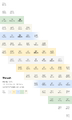 11-limit thrush
 -
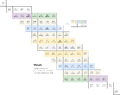 13-limit thrush


Notation
Starling/thrush can be notated the same as 5-limit just intonation since they share the same lattice structure. One way to do this is to take the conventional circle-of-fifths notation with an additional module of accidentals for the 81/80 comma. In this system, 5/4 is a major third, 7/4 an augmented sixth, and 11/8 a double diminished 5th.
| Ratio | Nominal | Example |
|---|---|---|
| 3/2 | Perfect fifth | C-G |
| 5/4 | Down major third | C-vE |
| 7/4 | Triple-down augmented sixth | C-v3A# |
| 11/8 | Quintuple-down double-augmented third | C-v5Ex |
| 13/8 | Quintuple-down double-augmented fifth | C-v5Gx |
Alternatively, it can be notated the same as full prime-limit just intonation, with a distinct accidental pair for each prime. That makes some intervals more intuitive, at the cost of hiding the structure of starling/thrush tempering. For example, it is customary of the 5/4 to be a major third, and 7/4 to be a minor seventh. As a result, the fact that the 12/7 is a stack of three 6/5's is not revealed, and the related chords can be less convenient.
Chords and harmony
Starling/thrush enables essentially tempered chords of starling, valinorsmic, werckismic, and thrush. Extending the temperament to the 13-limit enables chords of mynucumic, ratwolfsmic and minthmic.
Scales
Starling hobbit scales
Thrush hobbit scales
Other scales
Tunings
| Euclidean | |||
|---|---|---|---|
| Constrained | Constrained & skewed | Destretched | |
| Tenney | CTE: ~3/2 = 700.9120 ¢, ~5/4 = 389.6713 ¢ | CWE: ~3/2 = 701.0811 ¢, ~5/4 = 389.8833 ¢ | POTE: ~3/2 = 701.2515 ¢, ~5/4 = 390.0970 ¢ |
| Euclidean | |||
|---|---|---|---|
| Constrained | Constrained & skewed | Destretched | |
| Tenney | CTE: ~3/2 = 701.1852 ¢, ~5/4 = 390.3842 ¢ | CWE: ~3/2 = 701.6298 ¢, ~5/4 = 390.8558 ¢ | POTE: ~3/2 = 701.9454 ¢, ~5/4 = 391.1906 ¢ |
Music
- A Seed Planted (2013) – the melody depends on tempering out 126/125.