Marvel
Marvel is a rank-3 temperament with the same lattice structure as 5-limit JI, while identifying the harmonic seventh (7/4) as a stack of two classical major sevenths (15/8) octave-reduced, tempering out 225/224. It is the head of the marvel family.
| Marvel |
225/224, 385/384 (11-limit)
11-limit 21-odd-limit: 3.86 ¢
11-limit 21-odd-limit: ? notes
Marvel tends to tune 5/4 flat, such that a stack of two such thirds give a sharp 14/9, and a stack of three such thirds give a sub-octave of 35/18 just short of the octave by a quartertone of 36/35. The canonical 11-limit extension, sometimes aliased unimarv, identifies the quartertone as 33/32, so that 11/8 is that plus a perfect fourth. This adds 385/384 and 540/539 to the comma list and makes it a member of both keenansimic and swetismic temperaments.
The temperament was named by Gene Ward Smith in 2002–2003, when the 11-limit version was found first[1][2]. Gene carried it to the 7-limit restriction in 2004[3].
Extending marvel to the 13-limit is not as obvious. Gene has chosen helios, tempering out 351/350, as the canonical extension, but hecate, tempering out 325/324 and 729/728, arguably makes more sense as it is closer in tuning[4]. Hecate has a natural extension to the no-17 19-limit, by tempering out 400/399 and 513/512.
See Marvel family #Marvel for technical data.
Interval lattice
-
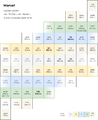 11-limit marvel
 -
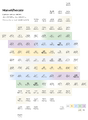 13-limit marvel/hecate
 -
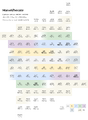 2.3.5.7.11.13.19 subgroup marvel/hecate


Notation
Marvel can be notated the same as 5-limit just intonation since they share the same lattice structure. One way to do this is to take the conventional circle-of-fifths notation with an additional module of accidentals for the 81/80 comma. In this system, 5/4 is a major third, 7/4 an augmented sixth, and 11/8 a double diminished 5th.
| Ratio | Nominal | Example |
|---|---|---|
| 3/2 | Perfect fifth | C-G |
| 5/4 | Down major third | C-vE |
| 7/4 | Dudaugmented sixth | C-vvA# |
| 11/8 | Trup double-diminished fifth | C-^3Gbb |
| 13/8 | Dup minor sixth | C-^^Ab |
| 19/16 | Minor third | C-Eb |
Alternatively, it can be notated the same as full prime-limit just intonation, with a distinct accidental pair for each prime. That makes some intervals more intuitive, at the cost of hiding the structure of marvel tempering. For example, it is customary of the 5/4 to be a major third, and 7/4 to be a minor seventh. As a result, the fact that the 14/9 is a stack of two 5/4's is not revealed, and the related chords can be less convenient.
Chords and harmony
Marvel enables essentially tempered chords of marvel, keenanismic, swetismic, and undecimal marvel.
Extending the temperament to the 13-limit through 325/324, resulting in hecate, enables chords of marveltwin and squbemic. Hecate hexad is a chord peculiar to this temperament. Alternatively, helios enables chords of ratwolfsmic.
Alternative 11-limit extensions give different sets of chords. One notable example, tempering out 441/440, enables prodigy chords.
Scales
Marvel hobbit scales
Undecimal marvel hobbit scales
Other marvel scales
Tunings
In the 7-limit, the optimal way such as that taken by TE and derivatives to close out the comma 225/224 is to tune primes 3 and 5 flat, and 2 and 7 sharp. If we tune the octave pure, the other inclinations remain. This indicates that the diminished third ~256/225 should be sharp (towards ~8/7), the augmented second ~75/64 be flat (towards ~7/6), the diminished fourth ~32/25 be sharp (towards ~9/7) and the tritone ~45/32 be flat (towards ~7/5), such that every 7-limit 9-odd-limit interval is tuned between itself and the 5-limit interpretation it is separated from by 225/224. If we take these as hard constraints, then 53edo and 84edo are the smallest edo tunings to satisfy them, but if overtempering is allowed, many smaller edos are possible, such as 31- and 41edo. Interestingly, 72edo, though very performant as a 7- and 11-limit tuning, is overtempered for some of these constraints, whereas 53edo, though satisfying these constraints, tempers the intervals closer to the more complex 5-limit interpretations, though the 7-limit concordances of the 9-odd-limit still clearly work. 84edo, another superset of 12edo, is an interesting edo to look at for its high performance in large odd-limits. Going up to larger edos, 125-, 166-, 178-, 197-, and 240edo are all great choices with different intonational characteristics.
The marvel extension hecate has the no-17's 19-limit as its subgroup, and helios is in the 13-limit. They merge in the rank-2 temperament catakleismic, which can be conceptualized as accepting both rank-3 marvel structures simultaneously. One such tuning is excellently given by 125edo. If we are looking for a small edo tuning instead, 53edo and 72edo are also reasonable edo tunings for the full no-17's 19-limit catakleismic, though in 53edo the 11 and 19 are a little off and in 72edo the 13 and 19 are a little off instead; 72edo is positioned better as a full 17-limit marvel system while 53edo is positioned better as a (potentially no-11's) 13-limit marvel system. If we focus on the 11-limit of undecimal marvel (discarding the mapping of 13), 31edo and 41edo are the smallest to clearly succeed, though many accept 41edo's mapping of ~13/8 to the neutral sixth and some accept that mapping for 31edo as contextually usable too.
Norm-based tunings
| Euclidean | |||
|---|---|---|---|
| Constrained | Constrained & skewed | Destretched | |
| Tenney | CTE: ~3/2 = 700.9740 ¢, ~5/4 = 384.2084 ¢ | CWE: ~3/2 = 700.6222 ¢, ~5/4 = 383.8540 ¢ | POTE: ~3/2 = 700.4075 ¢, ~5/4 = 383.6376 ¢ |
| Euclidean | |||
|---|---|---|---|
| Constrained | Constrained & skewed | Destretched | |
| Tenney | CTE: ~3/2 = 701.3729 ¢, ~5/4 = 383.1461 ¢ | CWE: ~3/2 = 700.6048 ¢, ~5/4 = 383.4538 ¢ | POTE: ~3/2 = 700.3887 ¢, ~5/4 = 383.5403 ¢ |
Tuning spectrum
This spectrum assumes pure 2 and 7.
| Eigenmonzo (Unchanged-interval) |
Perfect fifth (¢) |
Classical major third (¢) |
Comments |
|---|---|---|---|
| 5/4 | 698.099 | 386.314 | |
| 6/5 | 700.027 | 384.386 | 7-odd-limit minimax |
| 15/11 | 700.351 | 384.062 | |
| 10/9 | 700.670 | 383.743 | 9-odd-limit minimax |
| 11/10 | 700.885 | 383.528 | |
| 15/13 | 700.916 | 383.497 | 15-odd-limit hecate minimax |
| 13/10 | 701.065 | 383.348 | 13-odd-limit hecate minimax |
| 13/11 | 701.199 | 383.214 | |
| 18/13 | 701.361 | 383.052 | |
| 13/12 | 701.480 | 382.933 | |
| 16/13 | 701.559 | 382.854 | |
| 4/3 | 701.955 | 382.458 | |
| 14/11 | 702.278 | 382.135 | |
| 11/8 | 702.278 | 382.135 | |
| 12/11 | 702.602 | 381.811 |
Music
- Pump1 – in pump12 1, 197edo tuning
- Semimarvelous Blue Drawf (2010) – in Dwarf17marv, equal-beating tuning
See also
- Marvel temperaments, the collection of rank-2 temperaments that temper out the marvel comma
References
- ↑ Yahoo! Tuning Group | Relative complexity and scale construction – first mention of marvel.
- ↑ Yahoo! Tuning Group | Top 135 11-limit planar temperaments – establishment as an 11-limit temperament.
- ↑ Yahoo! Tuning Group | Marvel
- ↑ Yahoo! Tuning Group | 13-limit marvel