Sensamagic: Difference between revisions
m - parent category |
Rework on intro |
||
| Line 1: | Line 1: | ||
'''Sensamagic''' is the [[ | '''Sensamagic''' is the [[rank-3 temperament|rank-3]] [[regular temperament|temperament]] with the same [[lattice]] structure as the [[2.3.7 subgroup]], while identifying the [[5/4|classical major third (5/4)]] as a stack consisting of two [[9/7|supermajor thirds (9/7)]] and a [[3/2|perfect fifth]] [[octave reduction|octave reduced]], [[tempering out]] [[245/243]]. It is the head of the [[sensamagic family]], and the canonical [[11-limit]] [[extension]] adding [[385/384]] and [[896/891]] to the comma list makes it a member of both [[keenanismic temperaments]] and [[pentacircle clan]]. | ||
The temperament was named after the corresponding comma, which was named by [[Gene Ward Smith]] in 2010. See [[245/243 #Etymology]]. | The temperament was named after the corresponding comma, which was named by [[Gene Ward Smith]] in 2010. See [[245/243 #Etymology]]. | ||
Revision as of 16:18, 11 October 2025
Sensamagic is the rank-3 temperament with the same lattice structure as the 2.3.7 subgroup, while identifying the classical major third (5/4) as a stack consisting of two supermajor thirds (9/7) and a perfect fifth octave reduced, tempering out 245/243. It is the head of the sensamagic family, and the canonical 11-limit extension adding 385/384 and 896/891 to the comma list makes it a member of both keenanismic temperaments and pentacircle clan.
The temperament was named after the corresponding comma, which was named by Gene Ward Smith in 2010. See 245/243 #Etymology.
See Sensamagic family #Sensamagic for technical data.
Interval lattice
-
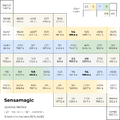 11-limit sensamagic

Notation
Sensamagic can be notated the same as 2.3.7 just intonation since they share the same lattice structure. One way to do this is to take the conventional circle-of-fifths notation with an additional module of accidentals for the 64/63 comma. In this system, 7/4 is a minor seventh, 5/4 an augmented second, and 11/8 a diminished fifth.
| Ratio | Nominal | Example |
|---|---|---|
| 3/2 | Perfect 5th | C-G |
| 5/4 | Double-up augmented 2nd | C-^^D# |
| 7/4 | Down minor 7th | C-vBb |
| 11/8 | Down diminished 5th | C-vGb |
Alternatively, it can be notated the same as full prime-limit just intonation, with a distinct accidental module for each prime harmonic. That makes some intervals more intuitive, at the cost of hiding the structure of sensamagic tempering. For example, it is customary of the 5/4 to be a major third, and 7/4 to be a minor seventh. As a result, the fact that the 5/3 is a stack of two 9/7's is not revealed, and the related chords can be less convenient.
Chords
Sensamagic enables essentially tempered chords of sensamagic, keenanismic, pentacircle, and undecimal sensamagic.
The sensamagic dominant chord is a dominant seventh chord useful for tonal harmony in this temperament.