Sagittal notation is a musical notation system capable of notating almost any conceivable tuning. It was developed by Dave Keenan and George Secor with significant contributions from numerous others.
Flavors of Sagittal notation
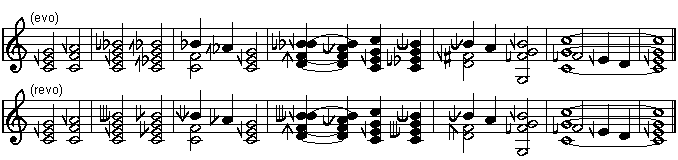
Sagittal notation comes in two mutually compatible flavors.
Evo
The Evo flavor (short for "evolutionary", previously called "mixed") uses only single-shaft Sagittal symbols, e.g. , alone or in combination with conventional sharps and flats and their doubles. Only the large variant of the double sharp (U+E47D) is considered to be stylistically-compatible with Sagittal symbols. Evo is much easier to learn, but it results in a greater number of symbols on the sheet, which can give it a more cluttered appearance, particularly with chords, and it may be confusing when two symbols alter the same note in opposite directions.
A sub-flavor of Evo is Evo-SZ (Evo with Stein-Zimmermann). This is where any sagittals that are notating exactly half the alteration of a sharp or flat (most often ) are replaced by the Stein-Zimmermann semisharp and narrow reversed flat , and the corresponding combinations (most often and ) are replaced by and . The narrow variants of the fractional flats (U+E284) and (U+E285) are preferred because they preserve the Sagittal principle that the visual size of a symbol should indicate the relative size of its alteration and they reduce left-right confusion.
Revo
The Revo flavor (short for "revolutionary", previously called "pure") only requires one accidental per note. Revo therefore takes up less space on the sheet and presents a cleaner appearance, and it clearly indicates the direction of the overall alteration. It discards the conventional sharps and flats and their doubles and replaces them with these multi-shaft arrow-like symbols: . Adding a sharp or flat to a Sagittal is achieved by adding two more shafts, e.g. becomes and becomes . When the Sagittal part alters in the opposite direction to the sharp or flat part, the rules are not so simple, e.g. becomes and becomes ; one must simply learn these apotome complements.
Resources
Notation software support
Sibelius
Sagibelius 2.0 - plugins for using Sagittal notation in Sibelius 4 and up. By Jacob Barton. Hosted on this wiki. Donationware.
Sagibelius_2.0.zip
Lilypond
Plugin for Sagittal notation in Lilypond by Graham Breed
MuseScore
Sagittal accidentals are available in MuseScore via the Bravura font which implements the SMuFL standard. They can be accessed by opening the Master Palette and finding them in the Symbols section at the end.
Scala
Sagittal notation is available in Scala.
Dorico
Because Dorico is built by Steinberg Media, the same company that maintains the SMuFL standard, it supports Sagittal.
Scores in Sagittal notation
Gallery
Spartan single-shaft
|
|
| phao
|
| 25 small diesis down
|
|
|
| patao
|
| 35 medium diesis down
|
|
|
| pakao
|
| 11 medium diesis down
|
|
|
| jatao
|
| 11 large diesis down
|
|
|
| jakao
|
| 35 large diesis down
|
Spartan multi-shaft
Multi-shaft sagittals are only used in the Revo flavor of Sagittal.
|
|
| sharp phao
|
| sharp 25S down
|
|
|
| sharp tao
|
| sharp 7C down
|
|
|
| sharp pao
|
| sharp 5C down
|
|
|
| sharp nao
|
| sharp 7/5k down
|
|
|
| flat nao
|
| flat 7/5k down
|
|
|
| flat phao
|
| flat 25S down
|
|
|
| flat patao
|
| flat 35M down
|
|
|
| flat pakao
|
| flat 11M down
|
|
|
| flat jatao
|
| flat 11L down
|
|
|
| flat jakao
|
| flat 35L down
|
|
|
| double sharp phao
|
| double sharp 25S down
|
|
|
| double flat phai
|
| double flat 25S up
|
|
|
| double sharp tao
|
| double sharp 7C down
|
|
|
| double flat tai
|
| double flat 7C up
|
|
|
| double sharp pao
|
| double sharp 5C down
|
|
|
| double flat pai
|
| double flat 5C up
|
|
|
| double sharp nao
|
| double sharp 7/5k down
|
|
|
| double flat nai
|
| double flat 7/5k up
|
|
|
| sagidouble sharp
|
| double sharp
|
|
|
| sagidouble flat
|
| double flat
|
Athenian extension single-shaft
|
|
| ranao
|
| 11/7 kleisma down
|
|
|
| janao
|
| 11/5 small diesis down
|
Athenian extension multi-shaft
Multi-shaft sagittals are only used in the Revo flavor of Sagittal.
|
|
| sharp janao
|
| sharp 11/5S down
|
|
|
| sharp jao
|
| sharp 11/7C down
|
|
|
| sharp kao
|
| sharp 55C down
|
|
|
| sharp sanao
|
| sharp 17C down
|
|
|
| sharp ranao
|
| sharp 11/7k down
|
|
|
| flat ranao
|
| flat 11/7k down
|
|
|
| flat sanao
|
| flat 17C down
|
|
|
| flat jao
|
| flat 11/7C down
|
|
|
| flat janao
|
| flat 11/5S down
|
|
|
| double sharp janao
|
| double sharp 11/5S down
|
|
|
| double flat janai
|
| double flat 11/5S up
|
|
|
| double sharp jao
|
| double sharp 11/7C down
|
|
|
| double sharp kao
|
| double sharp 55C down
|
|
|
| double flat kai
|
| double flat 55C up
|
|
|
| double sharp sanao
|
| double sharp 17C down
|
|
|
| double flat sanai
|
| double flat 17C up
|
|
|
| double sharp ranao
|
| double sharp 11/7k down
|
|
|
| double flat ranai
|
| double flat 11/7k up
|
Template:Notation navbox
