Archytas and ares: Difference between revisions
Update tdlinks |
→Etymology: Two temperaments on the same page |
||
| Line 6: | Line 6: | ||
== Etymology == | == Etymology == | ||
These temperaments are named after the ancient Greek mathematician {{w|Archytas}} and the Greek god {{w|Ares}} respectively, the latter being most likely related to the fact that Archytas was Greek. | |||
{{todo|add etymology|inline=1|text=Add name (person who coined the | {{todo|add etymology|inline=1|text=Add name (person who coined the terms) and year (when they were coined). Review reasoning if possible.}} | ||
== Interval lattice == | == Interval lattice == | ||
Revision as of 15:20, 2 September 2024
- "Archytas" redirects here. For the ancient Greek Pythagorean, see Wikipedia: Archytas.
Archytas is the rank-3 temperament tempering out 64/63, with the same 2.3.7-subgroup structure as archy but giving prime 5 an independent generator. It has an obvious extension to the 11-limit tempering out 100/99 and 176/175, called ares, as 64/63 = (100/99)(176/175).
For technical data, see Archytas family #Archytas. See also: Archytas family #Ares.
Etymology
These temperaments are named after the ancient Greek mathematician Archytas and the Greek god Ares respectively, the latter being most likely related to the fact that Archytas was Greek.

|
Todo: add etymology
Add name (person who coined the terms) and year (when they were coined). Review reasoning if possible. |
Interval lattice
-
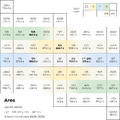 11-limit ares

Chords
Archytas enables the eponymous essentially tempered chords of archytas chords. Ares further enables ptolemismic and valinorsmic chords.