Lattice: Difference between revisions
No edit summary |
expanded the tonnetz writeup |
||
| Line 1: | Line 1: | ||
{{Wikipedia|Lattice (music)}} | {{Wikipedia|Lattice (music)}} | ||
A '''harmonic lattice diagram''' ('''lattice''') is an instrument to visualize relations of tones. | A '''harmonic lattice diagram''' ('''lattice''') is an instrument to visualize relations of tones, which projects the multidimensional [[just intonation|JI]] interval space onto a plane in such a way that intervals that differ by one particular JI relation will always appear at fixed relative positions to each other. Most commonly, the dimensionality of JI [[subgroups]] is reduced by one by means of [[octave equivalence]], so that intervals an octave apart are mapped to the same point. | ||
{{Wikipedia|Tonnetz}} | {{Wikipedia|Tonnetz}} | ||
{{Wikipedia|Vogel's Tonnetz}} | {{Wikipedia|Vogel's Tonnetz}} | ||
The '''Tonnetz''' is the lattice that represents | The '''Tonnetz''' is the lattice that represents a tuning system's mapping of [[5-limit]] intervals, conventionally arranged in a hexagonal fashion such that [[5/4]] and [[3/2]] are 60 degrees apart, with [[5/3]] being 60 degrees from 5/4 and 120 degrees from 3/2, so that the 5-limit [[4:5:6|major (4:5:6)]] and [[10:12:15|minor (10:12:15)]] chords form triangles. Such lattices can also be extended to other subgroups with 3 primes in them, where a respective fundamental chord such as [[4:5:7]] or [[8:11:14]] can be assigned to a triangle. '''Vogel's Tonnetz''' is a 7-limit extension of Euler's 5-limit Tonnetz. | ||
It is also possible to create lattices for [[regular temperament|tempered]] systems, in particular [[rank-3 temperament|rank-3]] systems generated by two distinct intervals (aside from the [[equave]] or fraction thereof) and which thus function equivalently to three-prime JI subgroups. | |||
== Examples == | == Examples == | ||
Revision as of 00:27, 24 April 2025

A harmonic lattice diagram (lattice) is an instrument to visualize relations of tones, which projects the multidimensional JI interval space onto a plane in such a way that intervals that differ by one particular JI relation will always appear at fixed relative positions to each other. Most commonly, the dimensionality of JI subgroups is reduced by one by means of octave equivalence, so that intervals an octave apart are mapped to the same point.
The Tonnetz is the lattice that represents a tuning system's mapping of 5-limit intervals, conventionally arranged in a hexagonal fashion such that 5/4 and 3/2 are 60 degrees apart, with 5/3 being 60 degrees from 5/4 and 120 degrees from 3/2, so that the 5-limit major (4:5:6) and minor (10:12:15) chords form triangles. Such lattices can also be extended to other subgroups with 3 primes in them, where a respective fundamental chord such as 4:5:7 or 8:11:14 can be assigned to a triangle. Vogel's Tonnetz is a 7-limit extension of Euler's 5-limit Tonnetz.
It is also possible to create lattices for tempered systems, in particular rank-3 systems generated by two distinct intervals (aside from the equave or fraction thereof) and which thus function equivalently to three-prime JI subgroups.
Examples
-
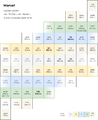 A square lattice representing marvel temperament.
 -
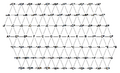 A hexagonal lattice representing 41edo's mapping of 5-limit intervals, using ups and downs notation.
 -
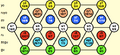 A hexagonal lattice representing a subset of 7-limit intervals, using color notation.
 -
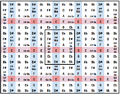 A torus of notes in 15edo, notated by porcupine notation with LH-NiceIonian as the base scale.


External links
- Beginner's guide to lattices: See chapter 1.3 of Alternative Tunings: Theory, Notation and Practice by Kite Giedraitis (2016)
- "lattice/lattice diagram" on Tonalsoft Encyclopedia
- "Octave Equivalent Music Lattices" by Graham Breed (2008)
- "Unison Vectors and Periodicity Blocks in the Three-Dimensional (3-5-7-) Harmonic Lattice of Notes" by Adriaan Fokker (1969)
- "Harmonic Lattice Diagrams" by Joseph L. Monzo (1998)