Horogram: Difference between revisions
m Add links |
add see also |
||
| (2 intermediate revisions by one other user not shown) | |||
| Line 8: | Line 8: | ||
The most familiar form of the horogram is based on Wilson's work. Here, the size of the generating intervals are represented as angles, and successive circles radiating from the center represent increasingly chromatic (fine) child scales. | The most familiar form of the horogram is based on Wilson's work. Here, the size of the generating intervals are represented as angles, and successive circles radiating from the center represent increasingly chromatic (fine) child scales. | ||
==== | ==== Examples ==== | ||
<gallery mode="nolines"> | |||
File:5EDO Horogram P1200G720L3.png|720 cent generator ending in 5edo | |||
File:7EDO-Horogram P1200G685.71L4.png|685.71 cent generator ending in 7edo | |||
File:9EDO Horogram P1200G666.67L5.png|666.67 cent generator ending in 9edo | |||
File:10EDO Horogram P1200G840L5.png|840 cent generator ending in 10edo | |||
File:11EDO Horogram P1200G763.64L5.png|763.64 cent generator ending in 11edo | |||
File:13EDO Horogram P1200G738.46L5.png|738.46 cent generator ending in 13edo | |||
File:14EDO Horogram P1200G771.43L6.png|771.43 cent generator ending in 14edo | |||
File:15EDO Horogram P1200G880L6.png|880 cent generator ending in 15edo | |||
</gallery> | |||
==== Construction ==== | ==== Construction ==== | ||
The construction of a circular horogram is based on rotating a pointer hand by the same angle repeatedly. | The construction of a circular horogram is based on rotating a pointer hand by the same angle repeatedly. | ||
| Line 86: | Line 94: | ||
=== Max-variety-3 scales === | === Max-variety-3 scales === | ||
{{todo|inline=1|complete section}} | {{todo|inline=1|complete section}} | ||
== See also == | |||
* [[Circle diagram]] | |||
== External links == | == External links == | ||
Latest revision as of 02:44, 4 December 2025
A horogram is a diagram that visualizes the interval pattern for a scale based on a repeated generating interval. This is useful for visualizing the step pattern for moment-of-symmetry scales and other similar scales.
Horograms are primarily the work of Erv Wilson.
Diagrams
Circular horogram
The most familiar form of the horogram is based on Wilson's work. Here, the size of the generating intervals are represented as angles, and successive circles radiating from the center represent increasingly chromatic (fine) child scales.
Examples
-
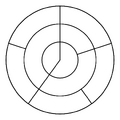 720 cent generator ending in 5edo
 -
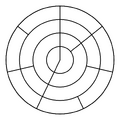 685.71 cent generator ending in 7edo
 -
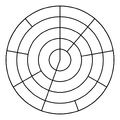 666.67 cent generator ending in 9edo
 -
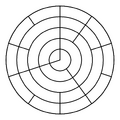 840 cent generator ending in 10edo
 -
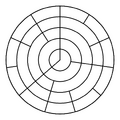 763.64 cent generator ending in 11edo
 -
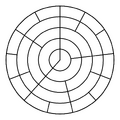 738.46 cent generator ending in 13edo
 -
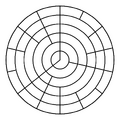 771.43 cent generator ending in 14edo
 -
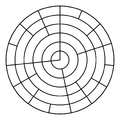 880 cent generator ending in 15edo


Construction
The construction of a circular horogram is based on rotating a pointer hand by the same angle repeatedly.

|
Todo: complete section
Explain in step by step detail. |
Rectangular horogram
A rectangular version of a horogram conveys the same information as a circular horogram but in a rectangular format.
Example
The use of a spreadsheet application, such as Microsoft Excel, makes it easy to construct a rectangular horogram, as well as representing the information as a table. Shown below is the rectangular horogram for 12edo diatonic (5L 2s).
| Steps for Generators 7\12 and 5\12 | Mos | Step Ratio | |||||||||||
|---|---|---|---|---|---|---|---|---|---|---|---|---|---|
| 7 | 5 | 1L 1s | 7:5 | ||||||||||
| 2 | 5 | 5 | 2L 1s | 5:2 | |||||||||
| 2 | 2 | 3 | 2 | 3 | 2L 3s | 3:2 | |||||||
| 2 | 2 | 2 | 1 | 2 | 2 | 1 | 5L 2s | 2:1 | |||||
| 1 | 1 | 1 | 1 | 1 | 1 | 1 | 1 | 1 | 1 | 1 | 1 | 12edo | 1 |
Construction
One way to conceptualize the construction of a rectangular horogram is to think of it as a partitioning a rectangle until every partition is of the same size. The algorithm for partitioning is shown below for a rectangle of length e initially partitioned into two such that one of the partitions is of length g.
- For a rectangle of length e, partition a section of length g from the right of that rectangle. This splits the rectangle into two parts of sizes (e - g)\e and g\e, from left to right.
- Assign the larger of the two partitions as partition L and the smaller of the two as s.
- If, from left to right, the larger of the two partitions precedes the smaller one, the larger partition is partitioned such that a partition of size s is broken off from the right. Otherwise, if the smaller partition precedes the larger one, a partition of size s is partitioned from the left.
- In either case, update the running values of L and s and repeat the previous step. If partitions L and s are of the same size, then no further partitioning is possible.
Applications
Moment-of-symmetry scales
|
|
Todo: complete section |
Max-variety-3 scales
|
|
Todo: complete section |
See also
External links
- The Wilson Archives (contains various PDF files depicting horograms)
|
|
Todo: add examples |