|
|
| (35 intermediate revisions by 7 users not shown) |
| Line 1: |
Line 1: |
| <h2>IMPORTED REVISION FROM WIKISPACES</h2>
| | '''Crossbone tuning''' is a coordinated tuning (two separate tunings intended to be used simultaneously) system utilizing pairs of twin primes (primes separated by the integer 2) separated by the integer 12. Crossbone is capable of being applied to any set of prime twins separated by this constant, though higher orders often yield less musical results. |
| This is an imported revision from Wikispaces. The revision metadata is included below for reference:<br>
| |
| : This revision was by author [[User:joeydinardo2|joeydinardo2]] and made on <tt>2014-07-15 22:00:09 UTC</tt>.<br>
| |
| : The original revision id was <tt>516333908</tt>.<br>
| |
| : The revision comment was: <tt></tt><br>
| |
| The revision contents are below, presented both in the original Wikispaces Wikitext format, and in HTML exactly as Wikispaces rendered it.<br>
| |
| <h4>Original Wikitext content:</h4>
| |
| <div style="width:100%; max-height:400pt; overflow:auto; background-color:#f8f9fa; border: 1px solid #eaecf0; padding:0em"><pre style="margin:0px;border:none;background:none;word-wrap:break-word;white-space: pre-wrap ! important" class="old-revision-html"><span style="background-color: #ffffff; font-family: 'Open Sans','Helvetica Neue',Arial,Helvetica,sans-serif; font-size: 20px;">Crossbone Tuning is a coordinated tuning (intended to be used simultaneously) advocated by Joey Di using the 19th root of the 7th harmonic (septave) and the 17th root of the 5th harmonic (pentave). Crossbone is expressed through various formats: as two coordinated equally divided harmonic intervals (Crossbone Temperament), as a 19-limit lattice (Crossbone Lattice), and as an octave-repeating, singular 'just' 12-tone version derived by eliminating the pure harmonic approximations within the first septave and pentave. (Crossbone Scale)</span>
| |
|
| |
|
| //**__<span style="background-color: #ffffff; color: #444444; font-family: 'Open Sans','Helvetica Neue',Arial,Helvetica,sans-serif; font-size: 20px;">Background:</span>__**//
| | == Example == |
| <span style="background-color: #f6f5f1; color: #444444; font-family: 'Open Sans','Helvetica Neue',Arial,Helvetica,sans-serif; font-size: 20px; vertical-align: baseline;"> </span>
| |
| <span style="background-color: #ffffff; color: #444444; font-family: 'Open Sans','Helvetica Neue',Arial,Helvetica,sans-serif; font-size: 20px; vertical-align: baseline;">Crossbone Tuning was inspired by the fact that primes share a special relationship when seperated by the integer twelve. Using a prime number wheel -a face with 24 repeating integers equally spaced over 2pi- this special relationship is easily visualized. We are familiar with the special relationships prime numbers</span>[[image:xenharmonic/crossbones.png width="424" align="right"]]<span style="background-color: #ffffff; color: #444444; font-family: 'Open Sans','Helvetica Neue',Arial,Helvetica,sans-serif; font-size: 20px; line-height: 1.5;"> have to music, and we understand the relationship certain primes share with each other as just described, so it is not unfeasable that prime relationships in communication with one another also share musical significance.</span>
| |
|
| |
|
| //__**<span style="background-color: #ffffff; color: #444444; font-family: 'Open Sans','Helvetica Neue',Arial,Helvetica,sans-serif; font-size: 20px;">Crossbone Temperament:</span>**__//
| | Twin primes {5,7} and {17,19} represent a set of twin primes capable of being Crossbone'd, as both 17 - 5 = 12 and 19 - 7 = 12. Once a pair of permissible twin primes is composed, two temperaments are devised by taking each member of the lesser set and dividing it into x equi-distant intervals |
| <span style="background-color: #ffffff; color: #444444; font-family: 'Open Sans','Helvetica Neue',Arial,Helvetica,sans-serif; font-size: 20px;">It is such that the 19th root of 7 and the 17th root of 5 share a unique correspondence, being both reasonable in harmonic range and distance, the pentave and septave ending between the 2nd and 3rd octave in 17 or 19 steps respectively. Because the temperaments are coordinated in Crossbone, each combination of septave and pentave I refer to as a 'sepent'.</span>
| |
|
| |
|
| <span style="background-color: #ffffff; color: #444444; font-family: 'Open Sans','Helvetica Neue',Arial,Helvetica,sans-serif; font-size: 20px;">Because the septave and pentave are not based around the octave, each individual septave and pentave will be completely unique and be found to approximate different intervals. Notice below that many of the intervals approximated happen to be harmonics! Those which are not harmonics happen to be readily usable just intervals no greater than 7-limit in the first sepent and 11-limit in the second sepent.</span>
| | where x is the corresponding member of the greater set and each interval having a distance of the corresponding lesser member raised by (1/x). |
|
| |
|
| <span style="background-color: #ffffff; color: #444444; font-family: 'Open Sans','Helvetica Neue',Arial,Helvetica,sans-serif; font-size: 20px;">One beautiful alignment of this temperament is that it uses a combination of 17 (pentave) and 19 (septave) tones per sepent. We notice that the standard 12-tone keyboard has 12 keys broken into a grouping of 5 notes and a grouping of 7 notes. This means that Crossbones tuning can be easily realized on any 'standard' keyboard, the first 5 7 5 grouping of keys representing the pentave, the second 7 5 7 grouping of keys representing the septave.. a sepent spanning a total key range of 3 12-tone octaves, coinciding beautifully with the fact that the natural sepent occurs between the 2nd and 3rd standard octave naturally. Note that below, the intervals represented are octave-reduced, though the true harmonic range of the septave and pentave are true and preserved on the keyboard, representing the absolute pitch approximation I find to be much more intuitive in comparison to the octave-equivalent versions (ex. a twelfth being represented as 3/2 though sounding as a twelfth).</span>
| | For {5,7} and {17,19}, the yielded Crossbone Tuning would utilize both 5^(1/17) and 7^(1/19), or 17EDP (Equally-divided pentave) and 19EDS (Equally-divided septave). |
|
| |
|
| [[image:crossbonepiano.png width="993" height="199"]]
| | == Ordering == |
|
| |
|
| | Because Crossbone is, at heart, a system for deriving tunings, Crossbone'd sets are described by 'orders'. |
|
| |
|
| __//**<span style="background-color: #ffffff; color: #444444; font-family: 'Open Sans','Helvetica Neue',Arial,Helvetica,sans-serif; font-size: 20px;">Crossbone Lattice:</span>**//__
| | Order is determined by the numerical indexing of valid prime sets suitable for Crossbone. |
| <span style="background-color: #ffffff; color: #444444; font-family: 'Open Sans','Helvetica Neue',Arial,Helvetica,sans-serif; font-size: 20px;">The Crossbone Lattice is a 4-dimensional lattice generated using the 5-limit, 7-limit, 17-limit, and 19-limit. By not including the 3-limit (but still implying the octave) and skipping over the 11 and 13 limits, we can arrive at very unique and interesting destinations.</span>
| |
| <span style="background-color: #ffffff; color: #444444; font-family: 'Open Sans','Helvetica Neue',Arial,Helvetica,sans-serif; font-size: 20px;">Because the lattice is octave-based and generated using the Crossbone primes, represented as harmonics, and doesn't enforce a relationship between them -as in Crossbone Temperament-, the relationship between the lattice and the temperament should be considered tangential, and the usage of the lattice </span>
| |
| [[image:tessa.png width="435" align="right"]]
| |
| <span style="background-color: #ffffff; color: #444444; font-family: 'Open Sans','Helvetica Neue',Arial,Helvetica,sans-serif; font-size: 20px;">considered </span><span style="background-color: #ffffff; color: #444444; font-family: 'Open Sans','Helvetica Neue',Arial,Helvetica,sans-serif; font-size: 20px; line-height: 1.5;">novel. I personally use it simply to add 17 and 19 limit 'spice' to certain intervals generated using my 3rds and 7ths. Arriving at destinations by combination of 3rd and 7ths without piggybacking on the 5th I find to be very satisfying.</span>
| |
|
| |
|
| __//**<span style="background-color: #ffffff; color: #444444; font-family: 'Open Sans','Helvetica Neue',Arial,Helvetica,sans-serif; font-size: 20px;">Crossbone Scale (1st sepent):</span>**//__
| | {5,7}|{17,19} is of order 1. |
| <span style="background-color: #ffffff; color: #444444; font-family: 'Open Sans','Helvetica Neue',Arial,Helvetica,sans-serif; font-size: 20px;">The Crossbone Scale is an octave-repeating simplified version of the Crossbone Temperament, forcing the intervals found within the sepent into a 12-tone octave-repeating scale. Within the first sepent, when one simply neglects including the harmonic approximations (and the 128/125 anamoly), he is left with 12 just 7-limit ratios between 1/1 and 2/1:</span>
| |
| [[image:crossbonepiano12scale.png width="216" height="202" align="right"]]
| |
| **<span style="background-color: #ffffff; color: #444444; font-family: 'Open Sans','Helvetica Neue',Arial,Helvetica,sans-serif; font-size: 20px;">•1/1</span>**<span style="background-color: #ffffff; color: #444444; font-family: 'Open Sans','Helvetica Neue',Arial,Helvetica,sans-serif; font-size: 20px;"> - tonic</span>
| |
| **<span style="background-color: #ffffff; color: #444444; font-family: 'Open Sans','Helvetica Neue',Arial,Helvetica,sans-serif; font-size: 20px;">•16/15</span>**<span style="background-color: #ffffff; color: #444444; font-family: 'Open Sans','Helvetica Neue',Arial,Helvetica,sans-serif; font-size: 20px;"> - major 5-limit half-step</span>
| |
| <span style="background-color: #ffffff; color: #444444; font-family: 'Open Sans','Helvetica Neue',Arial,Helvetica,sans-serif; font-size: 20px;">•**7/6** - septimal minor third</span>
| |
| <span style="background-color: #ffffff; color: #444444; font-family: 'Open Sans','Helvetica Neue',Arial,Helvetica,sans-serif; font-size: 20px;">•**5/4** - 5-limit major third</span>
| |
| <span style="background-color: #ffffff; color: #444444; font-family: 'Open Sans','Helvetica Neue',Arial,Helvetica,sans-serif; font-size: 20px;">•**9/7** - septimal major third</span>
| |
| <span style="background-color: #ffffff; color: #444444; font-family: 'Open Sans','Helvetica Neue',Arial,Helvetica,sans-serif; font-size: 20px;">•**10/7** - septimal tritone</span>
| |
| <span style="background-color: #ffffff; color: #444444; font-family: 'Open Sans','Helvetica Neue',Arial,Helvetica,sans-serif; font-size: 20px;">•**3/2** - perfect fifth</span>
| |
| <span style="background-color: #ffffff; color: #444444; font-family: 'Open Sans','Helvetica Neue',Arial,Helvetica,sans-serif; font-size: 20px;">•**14/9** - septimal minor sixth</span>
| |
| <span style="background-color: #ffffff; color: #444444; font-family: 'Open Sans','Helvetica Neue',Arial,Helvetica,sans-serif; font-size: 20px;">•**5/3** - 5-limit major sixth</span>
| |
| <span style="background-color: #ffffff; color: #444444; font-family: 'Open Sans','Helvetica Neue',Arial,Helvetica,sans-serif; font-size: 20px;">•**12/7** - septimal major sixth</span>
| |
| <span style="background-color: #ffffff; color: #444444; font-family: 'Open Sans','Helvetica Neue',Arial,Helvetica,sans-serif; font-size: 20px;">•**7/4** - septimal minor seventh</span>
| |
| <span style="background-color: #ffffff; color: #444444; font-family: 'Open Sans','Helvetica Neue',Arial,Helvetica,sans-serif; font-size: 20px;">•**15/8** - 5-limit major seventh</span>
| |
|
| |
|
| <span style="background-color: #ffffff; color: #444444; font-family: 'Open Sans','Helvetica Neue',Arial,Helvetica,sans-serif; font-size: 20px;">Because the scale is octave-repeating (though derived from the sepent), all sorts of 7-limit inversional fun can be had, and because it is 12-tone, it can be played on a standard keyboard.</span>
| | {17,19}|{29,31} is of order 2. |
|
| |
|
| __//**<span style="background-color: #ffffff; color: #444444; font-family: 'Open Sans','Helvetica Neue',Arial,Helvetica,sans-serif; font-size: 20px;">Final Thoughts:</span>**//__
| | and so on. |
| <span style="background-color: #ffffff; color: #444444; font-family: 'Open Sans','Helvetica Neue',Arial,Helvetica,sans-serif; font-size: 20px;">In the near future it would be wise to create a partner scale to the Crossbone Scale based on the 11-limit 2nd sepent as well as extend the current Crossbone Temperament to a full four sepents (the near limit of human hearing).</span></pre></div>
| | |
| <h4>Original HTML content:</h4>
| | There is currently no conjecture detailing the total possible number of orderings. |
| <div style="width:100%; max-height:400pt; overflow:auto; background-color:#f8f9fa; border: 1px solid #eaecf0; padding:0em"><pre style="margin:0px;border:none;background:none;word-wrap:break-word;width:200%;white-space: pre-wrap ! important" class="old-revision-html"><html><head><title>Crossbone Tuning</title></head><body><span style="background-color: #ffffff; font-family: 'Open Sans','Helvetica Neue',Arial,Helvetica,sans-serif; font-size: 20px;">Crossbone Tuning is a coordinated tuning (intended to be used simultaneously) advocated by Joey Di using the 19th root of the 7th harmonic (septave) and the 17th root of the 5th harmonic (pentave). Crossbone is expressed through various formats: as two coordinated equally divided harmonic intervals (Crossbone Temperament), as a 19-limit lattice (Crossbone Lattice), and as an octave-repeating, singular 'just' 12-tone version derived by eliminating the pure harmonic approximations within the first septave and pentave. (Crossbone Scale)</span><br />
| | |
| <br />
| | == Background == |
| <em><strong><u><span style="background-color: #ffffff; color: #444444; font-family: 'Open Sans','Helvetica Neue',Arial,Helvetica,sans-serif; font-size: 20px;">Background:</span></u></strong></em><br />
| | |
| <span style="background-color: #f6f5f1; color: #444444; font-family: 'Open Sans','Helvetica Neue',Arial,Helvetica,sans-serif; font-size: 20px; vertical-align: baseline;"> </span><br />
| | Using a prime number wheel - a face with 24 repeating integers equally spaced over 2pi - the relationship between twin primes separated by 12 is easily visualized. We are familiar with the special relationships prime numbers have to music, and we understand the relationship certain primes share with each other, so it is not unfeasible that prime relationships in communication with one another also share musical significance. |
| <span style="background-color: #ffffff; color: #444444; font-family: 'Open Sans','Helvetica Neue',Arial,Helvetica,sans-serif; font-size: 20px; vertical-align: baseline;">Crossbone Tuning was inspired by the fact that primes share a special relationship when seperated by the integer twelve. Using a prime number wheel -a face with 24 repeating integers equally spaced over 2pi- this special relationship is easily visualized. We are familiar with the special relationships prime numbers</span><!-- ws:start:WikiTextLocalImageRule:0:&lt;img src=&quot;http://xenharmonic.wikispaces.com/file/view/crossbones.png/516326650/crossbones.png&quot; alt=&quot;&quot; title=&quot;&quot; style=&quot;width: 424px;&quot; align=&quot;right&quot; /&gt; --><img src="http://xenharmonic.wikispaces.com/file/view/crossbones.png/516326650/crossbones.png" alt="crossbones.png" title="crossbones.png" style="width: 424px;" align="right" /><!-- ws:end:WikiTextLocalImageRule:0 --><span style="background-color: #ffffff; color: #444444; font-family: 'Open Sans','Helvetica Neue',Arial,Helvetica,sans-serif; font-size: 20px; line-height: 1.5;"> have to music, and we understand the relationship certain primes share with each other as just described, so it is not unfeasable that prime relationships in communication with one another also share musical significance.</span><br />
| | |
| <br />
| | [[File:crossbones.png|alt=crossbones.png|424px|crossbones.png]] |
| <em><u><strong><span style="background-color: #ffffff; color: #444444; font-family: 'Open Sans','Helvetica Neue',Arial,Helvetica,sans-serif; font-size: 20px;">Crossbone Temperament:</span></strong></u></em><br />
| | |
| <span style="background-color: #ffffff; color: #444444; font-family: 'Open Sans','Helvetica Neue',Arial,Helvetica,sans-serif; font-size: 20px;">It is such that the 19th root of 7 and the 17th root of 5 share a unique correspondence, being both reasonable in harmonic range and distance, the pentave and septave ending between the 2nd and 3rd octave in 17 or 19 steps respectively. Because the temperaments are coordinated in Crossbone, each combination of septave and pentave I refer to as a 'sepent'.</span><br />
| | == Crossbone Tuning (1st Order) == |
| <br />
| | |
| <span style="background-color: #ffffff; color: #444444; font-family: 'Open Sans','Helvetica Neue',Arial,Helvetica,sans-serif; font-size: 20px;">Because the septave and pentave are not based around the octave, each individual septave and pentave will be completely unique and be found to approximate different intervals. Notice below that many of the intervals approximated happen to be harmonics! Those which are not harmonics happen to be readily usable just intervals no greater than 7-limit in the first sepent and 11-limit in the second sepent.</span><br />
| | The first order of the Crossbone Tuning encompasses the first pair of twin pair of twin primes separated by 12, the set {5,7}|{17,19}. |
| <br />
| | |
| <span style="background-color: #ffffff; color: #444444; font-family: 'Open Sans','Helvetica Neue',Arial,Helvetica,sans-serif; font-size: 20px;">One beautiful alignment of this temperament is that it uses a combination of 17 (pentave) and 19 (septave) tones per sepent. We notice that the standard 12-tone keyboard has 12 keys broken into a grouping of 5 notes and a grouping of 7 notes. This means that Crossbones tuning can be easily realized on any 'standard' keyboard, the first 5 7 5 grouping of keys representing the pentave, the second 7 5 7 grouping of keys representing the septave.. a sepent spanning a total key range of 3 12-tone octaves, coinciding beautifully with the fact that the natural sepent occurs between the 2nd and 3rd standard octave naturally. Note that below, the intervals represented are octave-reduced, though the true harmonic range of the septave and pentave are true and preserved on the keyboard, representing the absolute pitch approximation I find to be much more intuitive in comparison to the octave-equivalent versions (ex. a twelfth being represented as 3/2 though sounding as a twelfth).</span><br />
| | The septave and pentave are not based around the [[octave]], thus each individual septave and pentave will be completely unique and be found to approximate different intervals. Notice below that many of the intervals approximated happen to be harmonics! Those which are not harmonics happen to be readily usable just intervals no greater than 7-limit in the first sepent and 11-limit in the second sepent. (The sepent refers to the total keyspace represented by the pentave followed by the septave.) |
| <br />
| | |
| <!-- ws:start:WikiTextLocalImageRule:1:&lt;img src=&quot;/file/view/crossbonepiano.png/516324958/993x199/crossbonepiano.png&quot; alt=&quot;&quot; title=&quot;&quot; style=&quot;height: 199px; width: 993px;&quot; /&gt; --><img src="/file/view/crossbonepiano.png/516324958/993x199/crossbonepiano.png" alt="crossbonepiano.png" title="crossbonepiano.png" style="height: 199px; width: 993px;" /><!-- ws:end:WikiTextLocalImageRule:1 --><br />
| | One beautiful alignment of the 1st order of Crossbone is that it uses a combination of 17 and 19 tones. We notice that the standard 12-tone keyboard has 12 keys broken into a grouping of 5 notes and a grouping of 7 notes. This means that Crossbones tuning can be easily realized on any 'standard' keyboard, the first 5 7 5 grouping of keys representing the pentave, the second 7 5 7 grouping of keys representing the septave... spanning a total key range of 3 12-tone octaves, coinciding beautifully with the fact that the natural septave and pentave naturally occur between the 2nd and 3rd standard octave. Note that below, the intervals represented are octave-reduced, though the true harmonic range of the septave and pentave are true and preserved on the keyboard, representing the absolute pitch approximation I find to be much more intuitive in comparison to the octave-equivalent versions (ex. a twelfth being represented as 3/2 though sounding as a twelfth). |
| <br />
| | |
| <br />
| | [[File:crossbonepiano.png|alt=crossbonepiano.png|993x199px|crossbonepiano.png]] |
| <u><em><strong><span style="background-color: #ffffff; color: #444444; font-family: 'Open Sans','Helvetica Neue',Arial,Helvetica,sans-serif; font-size: 20px;">Crossbone Lattice:</span></strong></em></u><br />
| | |
| <span style="background-color: #ffffff; color: #444444; font-family: 'Open Sans','Helvetica Neue',Arial,Helvetica,sans-serif; font-size: 20px;">The Crossbone Lattice is a 4-dimensional lattice generated using the 5-limit, 7-limit, 17-limit, and 19-limit. By not including the 3-limit (but still implying the octave) and skipping over the 11 and 13 limits, we can arrive at very unique and interesting destinations.</span><br />
| | === Intervals === |
| <span style="background-color: #ffffff; color: #444444; font-family: 'Open Sans','Helvetica Neue',Arial,Helvetica,sans-serif; font-size: 20px;">Because the lattice is octave-based and generated using the Crossbone primes, represented as harmonics, and doesn't enforce a relationship between them -as in Crossbone Temperament-, the relationship between the lattice and the temperament should be considered tangential, and the usage of the lattice </span><br />
| | |
| <!-- ws:start:WikiTextLocalImageRule:2:&lt;img src=&quot;/file/view/tessa.png/516325086/tessa.png&quot; alt=&quot;&quot; title=&quot;&quot; style=&quot;width: 435px;&quot; align=&quot;right&quot; /&gt; --><img src="/file/view/tessa.png/516325086/tessa.png" alt="tessa.png" title="tessa.png" style="width: 435px;" align="right" /><!-- ws:end:WikiTextLocalImageRule:2 --><br />
| | ==== First Septave: 19EDS ==== |
| <span style="background-color: #ffffff; color: #444444; font-family: 'Open Sans','Helvetica Neue',Arial,Helvetica,sans-serif; font-size: 20px;">considered </span><span style="background-color: #ffffff; color: #444444; font-family: 'Open Sans','Helvetica Neue',Arial,Helvetica,sans-serif; font-size: 20px; line-height: 1.5;">novel. I personally use it simply to add 17 and 19 limit 'spice' to certain intervals generated using my 3rds and 7ths. Arriving at destinations by combination of 3rd and 7ths without piggybacking on the 5th I find to be very satisfying.</span><br />
| | |
| <br />
| | {| class="wikitable" |
| <u><em><strong><span style="background-color: #ffffff; color: #444444; font-family: 'Open Sans','Helvetica Neue',Arial,Helvetica,sans-serif; font-size: 20px;">Crossbone Scale (1st sepent):</span></strong></em></u><br />
| | |- |
| <span style="background-color: #ffffff; color: #444444; font-family: 'Open Sans','Helvetica Neue',Arial,Helvetica,sans-serif; font-size: 20px;">The Crossbone Scale is an octave-repeating simplified version of the Crossbone Temperament, forcing the intervals found within the sepent into a 12-tone octave-repeating scale. Within the first sepent, when one simply neglects including the harmonic approximations (and the 128/125 anamoly), he is left with 12 just 7-limit ratios between 1/1 and 2/1:</span><br />
| | ! Step # |
| <!-- ws:start:WikiTextLocalImageRule:3:&lt;img src=&quot;/file/view/crossbonepiano12scale.png/516325150/216x202/crossbonepiano12scale.png&quot; alt=&quot;&quot; title=&quot;&quot; style=&quot;height: 202px; width: 216px;&quot; align=&quot;right&quot; /&gt; --><img src="/file/view/crossbonepiano12scale.png/516325150/216x202/crossbonepiano12scale.png" alt="crossbonepiano12scale.png" title="crossbonepiano12scale.png" style="height: 202px; width: 216px;" align="right" /><!-- ws:end:WikiTextLocalImageRule:3 --><br />
| | ! Cents |
| <strong><span style="background-color: #ffffff; color: #444444; font-family: 'Open Sans','Helvetica Neue',Arial,Helvetica,sans-serif; font-size: 20px;">•1/1</span></strong><span style="background-color: #ffffff; color: #444444; font-family: 'Open Sans','Helvetica Neue',Arial,Helvetica,sans-serif; font-size: 20px;"> - tonic</span><br />
| | ! Just Approximate |
| <strong><span style="background-color: #ffffff; color: #444444; font-family: 'Open Sans','Helvetica Neue',Arial,Helvetica,sans-serif; font-size: 20px;">•16/15</span></strong><span style="background-color: #ffffff; color: #444444; font-family: 'Open Sans','Helvetica Neue',Arial,Helvetica,sans-serif; font-size: 20px;"> - major 5-limit half-step</span><br />
| | ! Cents Error |
| <span style="background-color: #ffffff; color: #444444; font-family: 'Open Sans','Helvetica Neue',Arial,Helvetica,sans-serif; font-size: 20px;">•<strong>7/6</strong> - septimal minor third</span><br />
| | |- |
| <span style="background-color: #ffffff; color: #444444; font-family: 'Open Sans','Helvetica Neue',Arial,Helvetica,sans-serif; font-size: 20px;">•<strong>5/4</strong> - 5-limit major third</span><br />
| | | 0 |
| <span style="background-color: #ffffff; color: #444444; font-family: 'Open Sans','Helvetica Neue',Arial,Helvetica,sans-serif; font-size: 20px;">•<strong>9/7</strong> - septimal major third</span><br />
| | | 0 |
| <span style="background-color: #ffffff; color: #444444; font-family: 'Open Sans','Helvetica Neue',Arial,Helvetica,sans-serif; font-size: 20px;">•<strong>10/7</strong> - septimal tritone</span><br />
| | | 1/1 |
| <span style="background-color: #ffffff; color: #444444; font-family: 'Open Sans','Helvetica Neue',Arial,Helvetica,sans-serif; font-size: 20px;">•<strong>3/2</strong> - perfect fifth</span><br />
| | | 0 |
| <span style="background-color: #ffffff; color: #444444; font-family: 'Open Sans','Helvetica Neue',Arial,Helvetica,sans-serif; font-size: 20px;">•<strong>14/9</strong> - septimal minor sixth</span><br />
| | |- |
| <span style="background-color: #ffffff; color: #444444; font-family: 'Open Sans','Helvetica Neue',Arial,Helvetica,sans-serif; font-size: 20px;">•<strong>5/3</strong> - 5-limit major sixth</span><br />
| | | 1 |
| <span style="background-color: #ffffff; color: #444444; font-family: 'Open Sans','Helvetica Neue',Arial,Helvetica,sans-serif; font-size: 20px;">•<strong>12/7</strong> - septimal major sixth</span><br />
| | | 177.31 |
| <span style="background-color: #ffffff; color: #444444; font-family: 'Open Sans','Helvetica Neue',Arial,Helvetica,sans-serif; font-size: 20px;">•<strong>7/4</strong> - septimal minor seventh</span><br />
| | | 71/64 |
| <span style="background-color: #ffffff; color: #444444; font-family: 'Open Sans','Helvetica Neue',Arial,Helvetica,sans-serif; font-size: 20px;">•<strong>15/8</strong> - 5-limit major seventh</span><br />
| | | -2.39 |
| <br />
| | |- |
| <span style="background-color: #ffffff; color: #444444; font-family: 'Open Sans','Helvetica Neue',Arial,Helvetica,sans-serif; font-size: 20px;">Because the scale is octave-repeating (though derived from the sepent), all sorts of 7-limit inversional fun can be had, and because it is 12-tone, it can be played on a standard keyboard.</span><br />
| | | 2 |
| <br />
| | | 354.62 |
| <u><em><strong><span style="background-color: #ffffff; color: #444444; font-family: 'Open Sans','Helvetica Neue',Arial,Helvetica,sans-serif; font-size: 20px;">Final Thoughts:</span></strong></em></u><br />
| | | 79/64 |
| <span style="background-color: #ffffff; color: #444444; font-family: 'Open Sans','Helvetica Neue',Arial,Helvetica,sans-serif; font-size: 20px;">In the near future it would be wise to create a partner scale to the Crossbone Scale based on the 11-limit 2nd sepent as well as extend the current Crossbone Temperament to a full four sepents (the near limit of human hearing).</span></body></html></pre></div>
| | | -9.92 |
| | |- |
| | | 3 |
| | | 531.93 |
| | | 87/64 |
| | | 0.40 |
| | |- |
| | | 4 |
| | | 709.24 |
| | | 3/2 |
| | | 7.28 |
| | |- |
| | | 5 |
| | | 886.55 |
| | | 5/3 |
| | | -3.21 |
| | |- |
| | | 6 |
| | | 1063.86 |
| | | 59/64 |
| | | 4.69 |
| | |- |
| | | 7 |
| | | 1241.17 |
| | | 128/125 |
| | | 0.11 |
| | |- |
| | | 8 |
| | | 1418.48 |
| | | 73/64 |
| | | -9.31 |
| | |- |
| | | 9 |
| | | 1595.79 |
| | | 5/4 |
| | | 9.48 |
| | |- |
| | | 10 |
| | | 1773.10 |
| | | 89/64 |
| | | 2.22 |
| | |- |
| | | 11 |
| | | 1950.41 |
| | | 99/64 |
| | | -4.82 |
| | |- |
| | | 12 |
| | | 2127.72 |
| | | 12/7 |
| | | -5.41 |
| | |- |
| | | 13 |
| | | 2305.03 |
| | | 121/64 |
| | | 2.39 |
| | |- |
| | | 14 |
| | | 2482.34 |
| | | 67/64 |
| | | 3.03 |
| | |- |
| | | 15 |
| | | 2659.65 |
| | | 7/6 |
| | | -7.22 |
| | |- |
| | | 16 |
| | | 2836.96 |
| | | 9/7 |
| | | 1.88 |
| | |- |
| | | 17 |
| | | 3014.27 |
| | | 10/7 |
| | | -3.22 |
| | |- |
| | | 18 |
| | | 3191.58 |
| | | 101/64 |
| | | 1.73 |
| | |} |
| | |
| | ==== First Pentave: 17EDP ==== |
| | |
| | {| class="wikitable" |
| | |- |
| | ! Step # |
| | ! Cents |
| | ! Just Approximate |
| | ! Cents Error |
| | |- |
| | | 0 |
| | | 0 |
| | | 1/1 |
| | | 0 |
| | |- |
| | | 1 |
| | | 163.9 |
| | | 35/32 |
| | | 8.76 |
| | |- |
| | | 2 |
| | | 327.8 |
| | | 77/64 |
| | | 7.66 |
| | |- |
| | | 3 |
| | | 491.7 |
| | | 85/64 |
| | | 0.43 |
| | |- |
| | | 4 |
| | | 655.6 |
| | | 93/64 |
| | | 8.61 |
| | |- |
| | | 5 |
| | | 819.5 |
| | | 103/64 |
| | | -4.30 |
| | |- |
| | | 6 |
| | | 983.4 |
| | | 113/64 |
| | | -0.82 |
| | |- |
| | | 7 |
| | | 1147.3 |
| | | 31/16 |
| | | 2.26 |
| | |- |
| | | 8 |
| | | 1311.2 |
| | | 16/15 |
| | | -0.53 |
| | |- |
| | | 9 |
| | | 1475.1 |
| | | 7/6 |
| | | 8.23 |
| | |- |
| | | 10 |
| | | 1639.0 |
| | | 9/7 |
| | | 3.92 |
| | |- |
| | | 11 |
| | | 1802.9 |
| | | 91/64 |
| | | -6.45 |
| | |- |
| | | 12 |
| | | 1966.8 |
| | | 14/9 |
| | | 0.88 |
| | |- |
| | | 13 |
| | | 2130.7 |
| | | 12/7 |
| | | -2.43 |
| | |- |
| | | 14 |
| | | 2294.6 |
| | | 15/8 |
| | | 6.33 |
| | |- |
| | | 15 |
| | | 2458.5 |
| | | 33/32 |
| | | 5.23 |
| | |- |
| | | 16 |
| | | 2622.4 |
| | | 73/64 |
| | | -5.39 |
| | |} |
| | |
| | === 1st order Crossbone Lattice === |
| | |
| | The Crossbone Lattice is a 4-dimensional lattice generated using the 5-limit, 7-limit, 17-limit, and 19-limit. By not including the 3-limit (but still implying the octave) and skipping over the 11 and 13 limits, we can arrive at very unique and interesting destinations. |
| | |
| | [[File:tessa.png|alt=tessa.png|435px|tessa.png]] |
| | |
| | Because the lattice is octave-based and generated using the Crossbone primes, represented as harmonics, and doesn't enforce a relationship between them -as in Crossbone Temperament-, the relationship between the lattice and the temperament should be considered tangential, and the usage of the lattice considered novel. I personally use it simply to add 17 and 19 limit 'spice' to certain intervals generated using my 3rds and 7ths. Arriving at destinations by combination of 3rd and 7ths without piggybacking on the 5th I find to be very satisfying. |
| | |
| | === Crossbone Scale (1st order, 1st sepent) === |
| | |
| | The Crossbone Scale is an octave-repeating simplified version of the Crossbone Temperament, forcing the intervals found within the sepent into a 12-tone octave-repeating scale. Within the first sepent, when one simply neglects including the harmonic approximations (and the 128/125 anamoly), he is left with 12 just 7-limit ratios between 1/1 and 2/1: |
| | |
| | '''1/1''' - tonic |
| | |
| | '''16/15''' - major 5-limit half-step |
| | |
| | '''7/6''' - septimal minor third |
| | |
| | '''5/4''' - 5-limit major third |
| | |
| | '''9/7''' - septimal major third |
| | |
| | '''10/7''' - septimal tritone |
| | |
| | '''3/2''' - perfect fifth |
| | |
| | '''14/9''' - septimal minor sixth |
| | |
| | '''5/3''' - 5-limit major sixth |
| | |
| | '''12/7''' - septimal major sixth |
| | |
| | '''7/4''' - septimal minor seventh |
| | |
| | '''15/8''' - 5-limit major seventh |
| | |
| | Because the scale is [[Octave equivalence|octave-repeating]] (though derived from the sepent), all sorts of [[7-limit]] inversional fun can be had, and because it is [[Category:12-tone scales|12-tone]], it can be played on a standard keyboard. |
| | |
| | [[Category:Crossbone]] |
| | [[Category:Edonoi]] |
| | [[Category:Lattice]] |
| | [[Category:Tuning]] |
Crossbone tuning is a coordinated tuning (two separate tunings intended to be used simultaneously) system utilizing pairs of twin primes (primes separated by the integer 2) separated by the integer 12. Crossbone is capable of being applied to any set of prime twins separated by this constant, though higher orders often yield less musical results.
Example
Twin primes {5,7} and {17,19} represent a set of twin primes capable of being Crossbone'd, as both 17 - 5 = 12 and 19 - 7 = 12. Once a pair of permissible twin primes is composed, two temperaments are devised by taking each member of the lesser set and dividing it into x equi-distant intervals
where x is the corresponding member of the greater set and each interval having a distance of the corresponding lesser member raised by (1/x).
For {5,7} and {17,19}, the yielded Crossbone Tuning would utilize both 5^(1/17) and 7^(1/19), or 17EDP (Equally-divided pentave) and 19EDS (Equally-divided septave).
Ordering
Because Crossbone is, at heart, a system for deriving tunings, Crossbone'd sets are described by 'orders'.
Order is determined by the numerical indexing of valid prime sets suitable for Crossbone.
{5,7}|{17,19} is of order 1.
{17,19}|{29,31} is of order 2.
and so on.
There is currently no conjecture detailing the total possible number of orderings.
Background
Using a prime number wheel - a face with 24 repeating integers equally spaced over 2pi - the relationship between twin primes separated by 12 is easily visualized. We are familiar with the special relationships prime numbers have to music, and we understand the relationship certain primes share with each other, so it is not unfeasible that prime relationships in communication with one another also share musical significance.
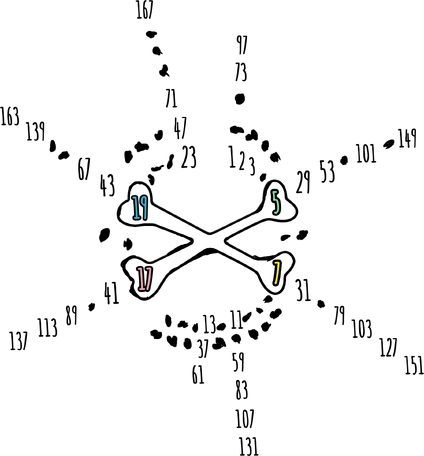
Crossbone Tuning (1st Order)
The first order of the Crossbone Tuning encompasses the first pair of twin pair of twin primes separated by 12, the set {5,7}|{17,19}.
The septave and pentave are not based around the octave, thus each individual septave and pentave will be completely unique and be found to approximate different intervals. Notice below that many of the intervals approximated happen to be harmonics! Those which are not harmonics happen to be readily usable just intervals no greater than 7-limit in the first sepent and 11-limit in the second sepent. (The sepent refers to the total keyspace represented by the pentave followed by the septave.)
One beautiful alignment of the 1st order of Crossbone is that it uses a combination of 17 and 19 tones. We notice that the standard 12-tone keyboard has 12 keys broken into a grouping of 5 notes and a grouping of 7 notes. This means that Crossbones tuning can be easily realized on any 'standard' keyboard, the first 5 7 5 grouping of keys representing the pentave, the second 7 5 7 grouping of keys representing the septave... spanning a total key range of 3 12-tone octaves, coinciding beautifully with the fact that the natural septave and pentave naturally occur between the 2nd and 3rd standard octave. Note that below, the intervals represented are octave-reduced, though the true harmonic range of the septave and pentave are true and preserved on the keyboard, representing the absolute pitch approximation I find to be much more intuitive in comparison to the octave-equivalent versions (ex. a twelfth being represented as 3/2 though sounding as a twelfth).

Intervals
First Septave: 19EDS
| Step #
|
Cents
|
Just Approximate
|
Cents Error
|
| 0
|
0
|
1/1
|
0
|
| 1
|
177.31
|
71/64
|
-2.39
|
| 2
|
354.62
|
79/64
|
-9.92
|
| 3
|
531.93
|
87/64
|
0.40
|
| 4
|
709.24
|
3/2
|
7.28
|
| 5
|
886.55
|
5/3
|
-3.21
|
| 6
|
1063.86
|
59/64
|
4.69
|
| 7
|
1241.17
|
128/125
|
0.11
|
| 8
|
1418.48
|
73/64
|
-9.31
|
| 9
|
1595.79
|
5/4
|
9.48
|
| 10
|
1773.10
|
89/64
|
2.22
|
| 11
|
1950.41
|
99/64
|
-4.82
|
| 12
|
2127.72
|
12/7
|
-5.41
|
| 13
|
2305.03
|
121/64
|
2.39
|
| 14
|
2482.34
|
67/64
|
3.03
|
| 15
|
2659.65
|
7/6
|
-7.22
|
| 16
|
2836.96
|
9/7
|
1.88
|
| 17
|
3014.27
|
10/7
|
-3.22
|
| 18
|
3191.58
|
101/64
|
1.73
|
First Pentave: 17EDP
| Step #
|
Cents
|
Just Approximate
|
Cents Error
|
| 0
|
0
|
1/1
|
0
|
| 1
|
163.9
|
35/32
|
8.76
|
| 2
|
327.8
|
77/64
|
7.66
|
| 3
|
491.7
|
85/64
|
0.43
|
| 4
|
655.6
|
93/64
|
8.61
|
| 5
|
819.5
|
103/64
|
-4.30
|
| 6
|
983.4
|
113/64
|
-0.82
|
| 7
|
1147.3
|
31/16
|
2.26
|
| 8
|
1311.2
|
16/15
|
-0.53
|
| 9
|
1475.1
|
7/6
|
8.23
|
| 10
|
1639.0
|
9/7
|
3.92
|
| 11
|
1802.9
|
91/64
|
-6.45
|
| 12
|
1966.8
|
14/9
|
0.88
|
| 13
|
2130.7
|
12/7
|
-2.43
|
| 14
|
2294.6
|
15/8
|
6.33
|
| 15
|
2458.5
|
33/32
|
5.23
|
| 16
|
2622.4
|
73/64
|
-5.39
|
1st order Crossbone Lattice
The Crossbone Lattice is a 4-dimensional lattice generated using the 5-limit, 7-limit, 17-limit, and 19-limit. By not including the 3-limit (but still implying the octave) and skipping over the 11 and 13 limits, we can arrive at very unique and interesting destinations.
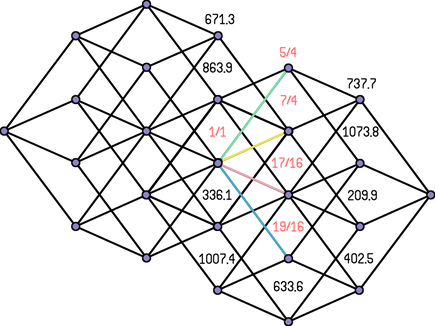
Because the lattice is octave-based and generated using the Crossbone primes, represented as harmonics, and doesn't enforce a relationship between them -as in Crossbone Temperament-, the relationship between the lattice and the temperament should be considered tangential, and the usage of the lattice considered novel. I personally use it simply to add 17 and 19 limit 'spice' to certain intervals generated using my 3rds and 7ths. Arriving at destinations by combination of 3rd and 7ths without piggybacking on the 5th I find to be very satisfying.
Crossbone Scale (1st order, 1st sepent)
The Crossbone Scale is an octave-repeating simplified version of the Crossbone Temperament, forcing the intervals found within the sepent into a 12-tone octave-repeating scale. Within the first sepent, when one simply neglects including the harmonic approximations (and the 128/125 anamoly), he is left with 12 just 7-limit ratios between 1/1 and 2/1:
1/1 - tonic
16/15 - major 5-limit half-step
7/6 - septimal minor third
5/4 - 5-limit major third
9/7 - septimal major third
10/7 - septimal tritone
3/2 - perfect fifth
14/9 - septimal minor sixth
5/3 - 5-limit major sixth
12/7 - septimal major sixth
7/4 - septimal minor seventh
15/8 - 5-limit major seventh
Because the scale is octave-repeating (though derived from the sepent), all sorts of 7-limit inversional fun can be had, and because it is , it can be played on a standard keyboard.


