51edo: Difference between revisions
+rank-2 temps table |
ArrowHead294 (talk | contribs) |
||
| Line 338: | Line 338: | ||
== Notation == | == Notation == | ||
=== Ups and downs notation === | |||
In 58edo, a sharp raises by six steps, so a combination of quarter tone accidentals and arrow accidentals from [[Helmholtz–Ellis notation]] can be used to fill in the gaps. | |||
{{Sharpness-sharp6}} | |||
If double arrows are not desirable, then arrows can be attached to quarter-tone accidentals: | |||
{{Sharpness-sharp6-qt}} | |||
=== Ivan Wyschnegradsky's notation === | |||
Since a sharp raises by six steps, Wyschnegradsky accidentals borrowed from [[72edo]] can also be used: | |||
{{Sharpness-sharp6-iw}} | |||
=== Sagittal notation === | === Sagittal notation === | ||
In the following diagrams, a sagittal symbol followed by an equals sign (=) means that the following comma is the symbol's [[Sagittal notation#Primary comma|primary comma]] (the comma it ''exactly'' represents in JI), while an approximately equals sign (≈) means it is a secondary comma (a comma it ''approximately'' represents in JI). In both cases the symbol exactly represents the tempered version of the comma in this edo. | In the following diagrams, a sagittal symbol followed by an equals sign (=) means that the following comma is the symbol's [[Sagittal notation#Primary comma|primary comma]] (the comma it ''exactly'' represents in JI), while an approximately equals sign (≈) means it is a secondary comma (a comma it ''approximately'' represents in JI). In both cases the symbol exactly represents the tempered version of the comma in this edo. | ||
Revision as of 15:09, 23 January 2025
| ← 50edo | 51edo | 52edo → |
Theory
51 = 3 × 17, and 51edo shares its fifth with 17edo.
Using the patent val, 51et tempers out 250/243 in the 5-limit, 225/224 and 2401/2400 in the 7-limit, and 55/54 and 100/99 in the 11-limit. It is the optimal patent val for sonic, the rank-3 temperament tempering out 55/54, 100/99, and 250/243, and also for the rank-4 temperament tempering out 55/54. It provides an alternative tuning to 22edo for porcupine, with a nice fifth but a rather flat major third, and the optimal patent val for the 7- and 11-limit porky temperament, which is sonic plus 225/224. 51 contains an archeotonic scale based on repetitions of 8\51, creating a scale with a whole-tone-like drive towards the tonic through the 17edo semitone at the top.
Alternatively, using the 51c val ⟨51 81 119 143], the 5/4 is mapped to 1\3 (400 cents), supporting augmented. In the 7-limit it tempers out 245/243 and supports hemiaug and rodan. The 51cd val ⟨51 81 119 144] takes the same 7/4 from 17edo, and supports augene.
51edo's step is the closest direct approximation to the Pythagorean comma by edo steps, though that comma itself is mapped to a different interval.
Odd harmonics
| Harmonic | 2 | 3 | 5 | 7 | 11 | 13 | 17 | 19 | 23 | 29 | 31 | |
|---|---|---|---|---|---|---|---|---|---|---|---|---|
| Error | Absolute (¢) | +0.0 | +3.9 | -9.8 | -4.1 | -10.1 | +6.5 | -10.8 | +8.4 | +7.0 | +5.7 | +7.9 |
| Relative (%) | +0.0 | +16.7 | -41.8 | -17.5 | -43.1 | +27.8 | -46.1 | +35.6 | +29.8 | +24.3 | +33.6 | |
| Steps (reduced) |
51 (0) |
81 (30) |
118 (16) |
143 (41) |
176 (23) |
189 (36) |
208 (4) |
217 (13) |
231 (27) |
248 (44) |
253 (49) | |
Subsets and supersets
51edo contains 3edo and 17edo as subsets. A step of 51edo is exactly 12 skismas.
Intervals
| Degrees | Cents | Ups and Downs Notation | ||
|---|---|---|---|---|
| 0 | 0.000 | Perfect 1sn | P1 | D |
| 1 | 23.529 | Up 1sn | ^1 | ^D |
| 2 | 47.059 | Downminor 2nd | vm2 | vEb |
| 3 | 70.588 | Minor 2nd | m2 | Eb |
| 4 | 94.118 | Upminor 2nd | ^m2 | ^Eb |
| 5 | 117.647 | Downmid 2nd | v~2 | ^^Eb |
| 6 | 141.176 | Mid 2nd | ~2 | vvvE, ^^^Eb |
| 7 | 164.706 | Upmid 2nd | ^~2 | vvE |
| 8 | 188.235 | Downmajor 2nd | vM2 | vE |
| 9 | 211.765 | Major 2nd | M2 | E |
| 10 | 235.294 | Upmajor 2nd | ^M2 | ^E |
| 11 | 258.824 | Downminor 3rd | vm3 | vF |
| 12 | 282.353 | Minor 3rd | m3 | F |
| 13 | 305.882 | Upminor 3rd | ^m3 | ^F |
| 14 | 329.412 | Downmid 3rd | v~3 | ^^F |
| 15 | 352.941 | Mid 3rd | ~3 | ^^^F, vvvF# |
| 16 | 376.471 | Upmid 3rd | ^~3 | vvF# |
| 17 | 400.000 | Downmajor 3rd | vM3 | vF# |
| 18 | 423.529 | Major 3rd | M3 | F# |
| 19 | 447.509 | Upmajor 3rd | ^M3 | ^F# |
| 20 | 470.588 | Down 4th | v4 | vG |
| 21 | 494.118 | Perfect 4th | P4 | G |
| 22 | 517.647 | Up 4th | ^4 | ^G |
| 23 | 541.176 | Downdim 5th | vd5 | vAb |
| 24 | 564.706 | Dim 5th | d5 | Ab |
| 25 | 588.235 | Updim 5th | ^d5 | ^Ab |
| 26 | 611.765 | Downaug 4th | vA4 | vG# |
| 27 | 635.294 | Aug 4th | A4 | G# |
| 28 | 658.824 | Upaug 4th | ^A4 | ^G# |
| 29 | 682.353 | Down 5th | v5 | vA |
| 30 | 705.882 | Perfect 5th | P5 | A |
| 31 | 729.412 | Up 5th | ^5 | ^A |
| 32 | 752.941 | Downminor 6th | vm6 | vBb |
| 33 | 776.471 | Minor 6th | m6 | Bb |
| 34 | 800.000 | Upminor 6th | ^m6 | ^Bb |
| 35 | 823.529 | Downmid 6th | v~6 | ^^Bb |
| 36 | 847.059 | Mid 6th | ~6 | vvvB, ^^^Bb |
| 37 | 870.588 | Upmid 6th | ^~6 | vvB |
| 38 | 894.118 | Downmajor 6th | vM6 | vB |
| 39 | 917.647 | Major 6th | M6 | B |
| 40 | 941.176 | Upmajor 6th | ^M6 | ^B |
| 41 | 964.706 | Downminor 7th | vm7 | vC |
| 42 | 988.235 | Minor 7th | m7 | C |
| 43 | 1011.765 | Upminor 7th | ^m7 | ^C |
| 44 | 1035.294 | Downmid 7th | v~7 | ^^C |
| 45 | 1058.824 | Mid 7th | ~7 | ^^^C, vvvC# |
| 46 | 1082.353 | Upmid 7th | ^~7 | vvC# |
| 47 | 1105.882 | Downmajor 7th | vM7 | vC# |
| 48 | 1129.412 | Major 7th | M7 | C# |
| 49 | 1152.941 | Upmajor 7th | ^M7 | ^C# |
| 50 | 1176.471 | Down 8ve | v8 | vD |
| 51 | 1200.000 | Perfect 8ve | P8 | D |
Notation
Ups and downs notation
In 58edo, a sharp raises by six steps, so a combination of quarter tone accidentals and arrow accidentals from Helmholtz–Ellis notation can be used to fill in the gaps.
| Step offset | 0 | 1 | 2 | 3 | 4 | 5 | 6 | 7 | 8 | 9 | 10 | 11 | 12 | 13 | 14 |
|---|---|---|---|---|---|---|---|---|---|---|---|---|---|---|---|
| Sharp symbol |  |
 |
 |
 |
 |
 |
 |
 |
 |
 |
 |
 |
 |
 |
 |
| Flat symbol |  |
 |
 |
 |
 |
 |
 |
 |
 |
 |
 |
 |
 |
 |
If double arrows are not desirable, then arrows can be attached to quarter-tone accidentals:
| Step offset | 0 | 1 | 2 | 3 | 4 | 5 | 6 | 7 | 8 | 9 | 10 | 11 | 12 | 13 |
|---|---|---|---|---|---|---|---|---|---|---|---|---|---|---|
| Sharp symbol | |
|
 |
|
 |
|
|
|
 |
|
 |
|
|
|
| Flat symbol | |
 |
|
 |
|
|
|
 |
|
 |
|
|
|
Ivan Wyschnegradsky's notation
Since a sharp raises by six steps, Wyschnegradsky accidentals borrowed from 72edo can also be used:
| Step offset | 0 | 1 | 2 | 3 | 4 | 5 | 6 | 7 | 8 | 9 | 10 | 11 | 12 | 13 |
|---|---|---|---|---|---|---|---|---|---|---|---|---|---|---|
| Sharp symbol | |
 |
 |
|
 |
 |
|
 |
 |
|
 |
 |
|
|
| Flat symbol |  |
 |
 |
 |
 |
|
 |
 |
 |
 |
 |
|
|
Sagittal notation
In the following diagrams, a sagittal symbol followed by an equals sign (=) means that the following comma is the symbol's primary comma (the comma it exactly represents in JI), while an approximately equals sign (≈) means it is a secondary comma (a comma it approximately represents in JI). In both cases the symbol exactly represents the tempered version of the comma in this edo.
Evo flavor
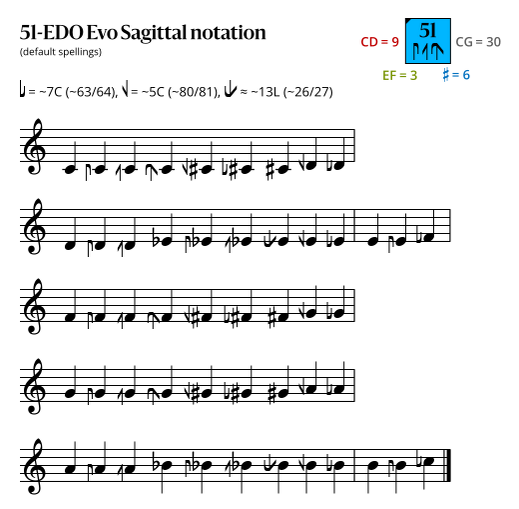
Revo flavor

Evo-SZ flavor

Regular temperament properties
| Subgroup | Comma list | Mapping | Optimal 8ve stretch (¢) |
Tuning error | |
|---|---|---|---|---|---|
| Absolute (¢) | Relative (%) | ||||
| 2.3.7 | 1029/1024, [17 -16 3⟩ | [⟨51 81 143]] | -0.339 | 1.63 | 6.92 |
| 2.3.5 | 128/125, [-13 17 -6⟩ | [⟨51 81 119]] (51c) | -2.789 | 2.41 | 10.3 |
| 2.3.5 | 250/243, 34171875/33554432 | [⟨51 81 118]] (51) | +0.581 | 2.77 | 11.8 |
Rank-2 temperaments
| Periods per 8ve |
Generator* | Cents* | Associated ratio* |
Temperament |
|---|---|---|---|---|
| 1 | 5\51 | 117.6 | 15/14 | Miracle (51e, out of tune) / oracle (51) |
| 1 | 7\51 | 164.7 | 11/10 | Porky (51) |
| 1 | 10\51 | 235.3 | 8/7 | Rodan (51cf…, out of tune) / aerodino (51ce) |
| 1 | 5\51 | 541.2 | 15/11 | Necromanteion (51ce) |
| 3 | 19\51 (2\51) |
447.1 (47.1) |
9/7 (36/35) |
Hemiaug (51ce) |
| 3 | 21\51 (4\51) |
494.1 (94.1) |
4/3 (16/15) |
Augmented (51c) |
* Octave-reduced form, reduced to the first half-octave, and minimal form in parentheses if distinct
Scales
- Porky[7], Palace: 7 7 7 9 7 7 7
- UFO scale (inflected MOS of Teefs[19]): 2 2 4 1 2 2 2 4 2 5 2 4 4 2 2 1 4 2 2
- Cosmic scale (subset of UFO scale): 21 9 4 9 8
Instruments
- Lumatone
- See Lumatone mapping for 51edo.
Music
- Whalectric (2022) – YouTube | score – 7:4 semiquartal 4|4 mode
- James Mulvale (FASTFAST)
- STARS (Thoughts and Prayers) (2020)
- Fugue (2023) – for organ in 51edo Porcupine[7] ssssssL "Pandian"