User:Unque/29edo Counterpoint Treatise: Difference between revisions
Cleaned up the preface on notation |
Various cleanup |
||
| Line 1: | Line 1: | ||
{{Breadcrumb|29edo}} | {{Breadcrumb|29edo}} | ||
{{Todo|inline=1| | {{Todo|inline=1|audio examples}} | ||
'''Note: This page is currently under construction, and will be subject to major expansion in the near future. Come back soon!''' | '''Note: This page is currently under construction, and will be subject to major expansion in the near future. Come back soon!''' | ||
| Line 10: | Line 10: | ||
A few notable notational features will be considered for this page. Intervals will be noted using extended diatonic notation (with ♯/♭ representing raising and lowering by a chromatic semitone, and ^/v representing raising or lowering by a diesis). Intervals included in diatonic modes will be noted with their diatonic names (where "major" and "minor" forms of an interval are respectively the wider and narrower interval that fall on a given degree), and intervals outside those modes will be denoted as "super-"/"supra-" and "sub-" forms of the closest diatonic interval. Where necessary, interval qualities may be abbreviated: m for minor, M for major, s for sub-, and S for super-/supra-. EDOstep notation (where n\29 represents n steps of 29edo, not to be confused with the JI interval n/29) may also be used for clarification when extended diatonic notation may provide difficulty to parse. | A few notable notational features will be considered for this page. Intervals will be noted using extended diatonic notation (with ♯/♭ representing raising and lowering by a chromatic semitone, and ^/v representing raising or lowering by a diesis). Intervals included in diatonic modes will be noted with their diatonic names (where "major" and "minor" forms of an interval are respectively the wider and narrower interval that fall on a given degree), and intervals outside those modes will be denoted as "super-"/"supra-" and "sub-" forms of the closest diatonic interval. Where necessary, interval qualities may be abbreviated: m for minor, M for major, s for sub-, and S for super-/supra-. EDOstep notation (where n\29 represents n steps of 29edo, not to be confused with the JI interval n/29) may also be used for clarification when extended diatonic notation may provide difficulty to parse. | ||
Interval equivalences created by 29edo will be considered equivalent here. Where multiple spellings are available in notation, sharps/flats will be prioritized over ups/downs, as it makes clear the movement by chromatic semitones; for instance, C♭ will be favored over vB. | Interval equivalences created by 29edo will be considered equivalent here. Where multiple spellings are available in notation, sharps/flats will be prioritized over ups/downs, as it makes clear the movement by chromatic semitones; for instance, C♭ will be favored over vB. However, extended diatonic names will be favored over fifthwise names when possible, as these names are easier to parse when discussing interval sizes; for instance, "subminor third" will be favored over "doubly augmented unison" or "doubly diminished fourth," even if the interval using spellings such as C♯-F♭ or C♭-C♯ | ||
== General Principles == | == General Principles == | ||
| Line 62: | Line 62: | ||
Note also that all four types of interordinal intervals have at least one type of resolution available. As such, the tension between two voices can be determined plainly by the type of cadence and the quality of the resolution, and conversely, the resolution can be determined plainly by the type of cadence and the quality of the tension. | Note also that all four types of interordinal intervals have at least one type of resolution available. As such, the tension between two voices can be determined plainly by the type of cadence and the quality of the resolution, and conversely, the resolution can be determined plainly by the type of cadence and the quality of the tension. | ||
{| class="wikitable" | {| class="wikitable" | ||
|+Determining | |+Determining cadential intervals for known resolutions | ||
!Cadence Type | !Cadence Type | ||
!Unison | !Unison | ||
| Line 82: | Line 82: | ||
|} | |} | ||
{| class="wikitable" | {| class="wikitable" | ||
|+Determining resolutions for known | |+Determining resolutions for known cadential intervals | ||
!Cadence Type | !Cadence Type | ||
!Subminor Third | !Subminor Third | ||
| Line 141: | Line 141: | ||
** 1 - P4 - P5 - M6 | ** 1 - P4 - P5 - M6 | ||
** 1 - M2 - P5 - M6 | ** 1 - M2 - P5 - M6 | ||
[[File:3-voice Contracting Cadence.png|thumb|An example of a three-voice cadence. Notice how the lower two voices create | [[File:3-voice Contracting Cadence.png|thumb|An example of a three-voice cadence. Notice how the lower two voices create an expanding cadence into the perfect fourth, while the highest voice moves in parallel with the middle voice.]] | ||
Inversions of these chords may apply; for instance, M3 - P5 - P8 is considered to have the same consonance potential as 1 - M3 - P5. It should be noted, however, that the highest and lowest voice will be the most prominent in a given chord, and it is thus encouraged that those voices play the root or fifth of the key in resolutions when possible. | Inversions of these chords may apply; for instance, M3 - P5 - P8 is considered to have the same consonance potential as 1 - M3 - P5. It should be noted, however, that the highest and lowest voice will be the most prominent in a given chord, and it is thus encouraged that those voices play the root or fifth of the key in resolutions when possible. | ||
Tensions towards these resolutions can be made by combining types of expanding and contracting cadences; for instance, the chord 1 - M3 - P5 may be approached by a tension | Tensions towards these resolutions can be made by combining types of expanding and contracting cadences; for instance, the chord 1 - M3 - P5 may be approached by a tension such as SM7 - m3 - sm6, where each voice in the tension differs from its resolution by one chroma. | ||
Finally, and perhaps most importantly, resolutions with lower consonance potential should be avoided as the final resolution of the piece, but are encouraged to be employed at the end of a phrase before a transition to another section. | Finally, and perhaps most importantly, resolutions with lower consonance potential should be avoided as the final resolution of the piece, but are encouraged to be employed at the end of a phrase before a transition to another section. | ||
| Line 151: | Line 151: | ||
==== Minor Modes ==== | ==== Minor Modes ==== | ||
Three diatonic modes contain minor triads over the root: Dorian, Aeolian, and Phrygian. Just like with the major modes, each of these modes has its own distinct sound that can provide different pros and cons for writing | Three diatonic modes contain minor triads over the root: Dorian, Aeolian, and Phrygian. Just like with the major modes, each of these modes has its own distinct sound that can provide different pros and cons for writing fugue subjects. | ||
The Dorian mode's major sixth degree is exceptionally useful as a lead into the diminished octave / submajor seventh, being four steps away rather than the awkward seven-step lurch that would occur in the other modes. The diminished octave is one of the most important types of leading intervals into the root, because it is included in four of the seven perfect types of cadences. This feature alone makes Dorian one of the most desirable minor modes for counterpoint writing, since the other modes must either employ a minor third step size, add more non-diatonic intervals to the subject to bypass this step size, or find another method of resolution. | The Dorian mode's major sixth degree is exceptionally useful as a lead into the diminished octave / submajor seventh, being four steps away rather than the awkward seven-step lurch that would occur in the other modes. The diminished octave is one of the most important types of leading intervals into the root, because it is included in four of the seven perfect types of cadences. This feature alone makes Dorian one of the most desirable minor modes for counterpoint writing, since the other modes must either employ a minor third step size, add more non-diatonic intervals to the subject to bypass this step size, or find another method of resolution. | ||
Revision as of 15:58, 25 September 2025

|
Todo: audio examples |
Note: This page is currently under construction, and will be subject to major expansion in the near future. Come back soon!
On this page, I attempt to document in full my experience with writing counterpoint using 29edo and the 29-form, with extrapolations that I've made into guidelines of a sort, which others may use as a jumping-off point for their own excursions into writing counterpoint, whether in 29edo itself or in other systems where these ideas or extrapolations therefrom may apply. These guidelines arise in large part from a combination of the writings of Johann Fux and Marchetto da Padova, analysis of the works of J.S. Bach, and parameters that arose simply from trial and error in my own composition.
Preface on Notation
A few notable notational features will be considered for this page. Intervals will be noted using extended diatonic notation (with ♯/♭ representing raising and lowering by a chromatic semitone, and ^/v representing raising or lowering by a diesis). Intervals included in diatonic modes will be noted with their diatonic names (where "major" and "minor" forms of an interval are respectively the wider and narrower interval that fall on a given degree), and intervals outside those modes will be denoted as "super-"/"supra-" and "sub-" forms of the closest diatonic interval. Where necessary, interval qualities may be abbreviated: m for minor, M for major, s for sub-, and S for super-/supra-. EDOstep notation (where n\29 represents n steps of 29edo, not to be confused with the JI interval n/29) may also be used for clarification when extended diatonic notation may provide difficulty to parse.
Interval equivalences created by 29edo will be considered equivalent here. Where multiple spellings are available in notation, sharps/flats will be prioritized over ups/downs, as it makes clear the movement by chromatic semitones; for instance, C♭ will be favored over vB. However, extended diatonic names will be favored over fifthwise names when possible, as these names are easier to parse when discussing interval sizes; for instance, "subminor third" will be favored over "doubly augmented unison" or "doubly diminished fourth," even if the interval using spellings such as C♯-F♭ or C♭-C♯
General Principles
There are a number of principles that are considered regardless of the tonality or species of counterpoint. These principles are here listed in order of prevalence; that is, if there exists a context where any two principles conflict, the one listed earlier on this list should take precedent.
Tonics and Resolution
A phrase should begin and end with all voices on the tonic, or on a perfect consonance with respect to it. At the end of a phrase, the tonic is to be approached from above or below by a conjunction (see Interval Categories). The chromatic semitone is primarily encouraged, but other resolutions are also possible.
Interval Categories
Intervals are divided into categories based on their consonance potential; that is, their utility as coherent melodic steps and as intervals between voices. Because each interval falls into the same category as its octave complement or octave-transposed forms, only intervals narrower than 15 dieses are listed here to avoid redundancy.
- Perfect consonances are permitted as melodic steps. Between voices, perfect consonances are used to create resolutions when approached by contrary motion. As such, they should be employed with caution between voices during the middle of a phrase.
- Unison (0\29)
- Perfect Fourth (12\29)
- Imperfect consonances are permitted as melodic steps. Between voices, imperfect consonances may be approached through any means, and as such are encouraged as the main class of interval to use in the middle of phrases.
- Minor third (7\29)
- Major third (10\29)
- Cadential consonances are permitted as melodic steps, but should be used with reserve. Between voices, cadential consonances may be approached through any means, but they tend to resolve by contrary motion to a perfect consonance.
- Subminor Third (6\29)
- Supraminor Third (8\29)
- Submajor Third (9\29)
- Supermajor Third (11\29)
- Conjunctions are permitted as melodic steps, and in fact should be the main type of step used. Between voices, conjunctions should be used with extreme caution, and should primarily be employed as passing tones–that is, they are approached and left in the same direction.
- Minor Second (2\29)
- Supraminor Second / Chromatic Semitone (3\29)
- Submajor Second (4\29)
- Major Second (5\29)
- Dissonances are not permitted as melodic steps, and should generally be avoided between any two voices.
- Augmented Third (13\29)
- Diminished Fifth (14\29)
- The Diesis or Superunison (1\29) is permitted as a passing tone in melodies. Two voices should never be separated by the interval of a diesis except as a brief transitional position between a unison and another interval. The same guidelines apply to the Suboctave (28\29) or the Superoctave (30\29).
Contour
Avoid rapidly climbing up or down, and avoid long periods of motion in a given direction; instead, prioritize a wavelike contour that has clear local "peaks" and "troughs." The peaks and troughs of a melody should most often occur on important notes, such as the tonic or fifth of the key. When employing step sizes larger than a major second, the next step should move in the opposite direction from whence it was approached, or move by a conjunction in the same direction.
Voice Ranges
The voices within a fugue should form a clear hierarchy of range; one voice should remain the lowest, another the highest, and so on for any additional voices. Two adjacent voices may play a unison, but a lower voice may not reach a pitch higher than the voice above it.
The interval between two adjacent voices generally should not exceed a Supermajor Tenth (40\29) unless absolutely necessary to avoid dissonances or provide melodic coherence within each individual voice.
Cadences
When resolving at the end of a phrase, cadences should generally involve two or more voices moving by conjunctions in opposite directions. One or more of the voices should land on the tonic pitch, and all others should land on perfect consonances with respect to one another.
In 29edo, the intervals between two voices should generally begin on perfect consonances, move towards imperfect consonances, and finally utilize cadential consonances to create tension before resolving. The interordinal intervals (supermajor and subminor thirds and sixths) are extremely tense, and each one either exceeds or falls short of a perfect consonance by two chromatic semitones (a total of 6\29). This creates an extremely clear path to resolution via two types of movement:
- In an expanding cadence, two voices move apart from one another by chromatic semitones to form a perfect consonance.
- In a contracting cadence, two voices move towards each other by chromatic semitones to form a perfect consonance.
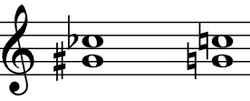
An example of an expanding cadence that resolves from a subminor third to a perfect fourth.

Every expanding cadence has an inverse contracting cadence, and vice versa; for instance, the resolution from C♯ - G♭ to C - G (a perfect fifth in C) is expanding, but from G♭ - C♯ to G - C (a perfect fourth in G) is contracting.
Note also that all four types of interordinal intervals have at least one type of resolution available. As such, the tension between two voices can be determined plainly by the type of cadence and the quality of the resolution, and conversely, the resolution can be determined plainly by the type of cadence and the quality of the tension.
| Cadence Type | Unison | Fourth | Fifth | Octave |
|---|---|---|---|---|
| Expanding | N/A | Subminor third (6\29) | Supermajor Third (11\29) | Supermajor sixth (23\29) |
| Contracting | Subminor third (6\29) | Subminor sixth (18\29) | Supermajor sixth (23\29) | Subminor tenth (35\29) |
| Cadence Type | Subminor Third | Supermajor Third | Subminor Sixth | Supermajor Sixth |
|---|---|---|---|---|
| Expanding | Fourth | Fifth | Minor seventh | Octave |
| Contracting | Unison | Major second | Fourth | Fifth |
Note that the minor seventh and major second are not perfect consonances; however, these relationships are still important to note for denser resolutions in multiple voices that contain these intervals (see the resolution notes under Tonality).
Diatonic Tonality
Due to the 29-form's inherent pull towards 3-limit structures, the diatonic scale is an integral part of its structure. The tonality of a fugue is most intuitively derived from the modes of the diatonic scale; specifically, the major and minor tonality respectively draw from the properties of the major and minor forms of the third degree of that scale.
No matter the tonality, perfect consonances with respect to the root take precedence over all other intervals, and should be the most emphasized intervals in a given melody. Subjects should be written primarily, if not entirely, in the diatonic scale, though the exact mode used depends on the tonality; however, countermelodies and elaborations on the subject should access additional tones outside of the diatonic scale to create more diverse harmonies and eventually use interordinals as final tensions to create cadences.
Major Tonality
Major Modes
Three diatonic modes contain major triads over the root: Lydian, Ionian, and Mixolydian. Each of the three modes offers its own unique modal sound when used as the scale for a subject, but some features may be more desirable than others for counterpoint writing in particular.
The Lydian mode may actually be the most desirable, as the major seventh and augmented fourth in melodies create strong leading tones into the root and fifth, leading to very satisfying melodic peaks. However, this comes at the expense of the perfect fourth, which is no longer available as a tone to emphasize in the melody.
The Ionian mode lowers the augmented fourth into a more consonant perfect fourth, allowing for more diverse melodic emphasis. While the fourth degree no longer "points" towards the fifth, it is more consonant, allowing for more diverse harmony. Additionally, the major third may now act as a leading tone into the perfect fourth, allowing for similarly satisfying melodic peaks.
The Mixolydian mode is a step darker than Ionian, lowering the seventh degree. This removes the leading tone into the root, but provides more diverse and interesting melodic content. The minor seventh degree forms an interval of a perfect fourth against the fourth degree, which allows for unexpected yet pleasant harmonic coherence.
Some combination of these modes is also permitted in the subject; it may be beneficial, for instance, to use a dual Lydian/Ionian scale that contains both types of diatonic fourths. However, these dual intervals should be used sparingly, in order to create the feeling of one stagnant and coherent diatonic scale.
Major Countermelodies
While subjects should adhere as closely as possible to the diatonic scale, elaborations and countermelodies are encouraged to extend beyond this scale to create more diverse and colorful harmonic content. The rules for melodic step sizes apply in the same way; it may be beneficial to employ diatonic intervals as step sizes in a non-diatonic pattern, such as a series of whole tones, in order to "escape" the diatonic structure.
Where possible, countermelodies should employ tones that differ from the diatonic structure by a diesis; for instance, in a major key, including the note a submajor third above the root (vE or F♭ in the key of C) is more desirable than the note a supraminor third above the root (^E♭ or D♯ in the key of C), as it contributes to the overall major tonality.
Major Resolutions
In the major tonality, expanding cadences are encouraged when resolving to fourths, and contracting cadences are encouraged when resolving to fifths. This motion ensures that the tonic pitch is approached from below rather than from above, which creates a brighter sound more indicative of a major key.
When using more than two distinct voices, it is often desirable to use fuller chords for resolutions at the end of a phrase, rather than simply doubling the root or fifth across octaves. The following chords are considered for major resolutions, listed in order of consonance potential:
- Requiring three or more voices:
- 1 - M3 - P5
- 1 - P4 - P5
- 1 - M2 - P5
- Requiring four or more voices:
- 1 - M3 - P5 - M7
- 1 - M3 - P5 - M6
- 1 - P4 - P5 - m7
- 1 - P4 - P5 - M6
- 1 - M2 - P5 - M6

Inversions of these chords may apply; for instance, M3 - P5 - P8 is considered to have the same consonance potential as 1 - M3 - P5. It should be noted, however, that the highest and lowest voice will be the most prominent in a given chord, and it is thus encouraged that those voices play the root or fifth of the key in resolutions when possible.
Tensions towards these resolutions can be made by combining types of expanding and contracting cadences; for instance, the chord 1 - M3 - P5 may be approached by a tension such as SM7 - m3 - sm6, where each voice in the tension differs from its resolution by one chroma.
Finally, and perhaps most importantly, resolutions with lower consonance potential should be avoided as the final resolution of the piece, but are encouraged to be employed at the end of a phrase before a transition to another section.
Minor Tonality
Minor Modes
Three diatonic modes contain minor triads over the root: Dorian, Aeolian, and Phrygian. Just like with the major modes, each of these modes has its own distinct sound that can provide different pros and cons for writing fugue subjects.
The Dorian mode's major sixth degree is exceptionally useful as a lead into the diminished octave / submajor seventh, being four steps away rather than the awkward seven-step lurch that would occur in the other modes. The diminished octave is one of the most important types of leading intervals into the root, because it is included in four of the seven perfect types of cadences. This feature alone makes Dorian one of the most desirable minor modes for counterpoint writing, since the other modes must either employ a minor third step size, add more non-diatonic intervals to the subject to bypass this step size, or find another method of resolution.
The Aeolian mode lowers that sixth to a minor one, which is useful in its own right. Notably, it can act as a leading tone downward into the fifth, creating a dark sound by building to and emphasizing the troughs of a melody rather than the peaks as in the major modes. Additionally, the Aeolian mode provides uniform minor triads over the root, fourth, and fifth degrees, which creates a more uniform sound when basing harmonies on chord functions.
Finally, the Phrygian mode is perhaps the most desirable minor mode for writing counterpoint. Like Aeolian, it contains a leading tone downwards into the fifth; however, it additionally lowers the second degree to a minor second, creating a similar leading tone downwards into the root. This makes the root and fifth both clear points to place a melodic trough, creating a very satisfying dark sound.
Just like with the major modes, a combination of these modes may be permitted in the subject; also just like the major modes, the dual intervals that arise should be used sparingly in order to create clearer melodic coherence in the subject.
Minor Countermelodies
Many of the same general principles apply to minor countermelodies as major ones: subjects should be largely diatonic, but their elaborations and countermelodies are encouraged to stray from that scale. Intervals that differ from diatonic by a diesis are similarly desirable; for instance, in a minor key, including the note a supraminor third above the root (^E♭ or D♯ in the key of C) is more desirable than the note a submajor third above the root (vE or F♭ in the key of C), as it contributes to the overall minor tonality.
Minor Resolutions
In the minor tonality, contracting cadences are encouraged when resolving to fourths, and expanding cadences are encouraged when resolving to fifths. This creates a darker tone, as it approaches the tonic via downwards motion from above.
Just like in the major tonality, fuller chords are often desirable when using more voices. The following chords are considered for the minor tonality, in order of consonance potential:
- Requiring three or more voices:
- 1 - m3 - P5
- 1 - M2 - P5
- 1 - P4 - P5
- Requiring four or more voices:
- 1 - m3 - P5 - m7
- 1 - M2 - P5 - M6
- 1 - P4 - P5 - m7

Just like in Major, inversions apply; that is, m3 - P5 - P8 has the same consonance potential as 1 - m3 - P5. Once again, the highest and lowest voice are the most prominent, and as such should tend to play the root or fifth of the key when possible.
Because the minor tonality is inherently darker than major, the more dissonant available resolutions are not discouraged as strongly as they are in major keys. However, the final resolution of a fugue often benefits from using a major resolution to create a bright turnaround, as this lends a greater sense of finality to the piece as a whole.