Harmonotonic tuning: Difference between revisions
Cmloegcmluin (talk | contribs) →Table of monotonic tunings: add remaining links |
Cmloegcmluin (talk | contribs) No edit summary |
||
| Line 302: | Line 302: | ||
The "-tonic" root of "monotonic" does share etymology with the musical terms "tone" and "tonic". They both come from the Greek word "tonikos" which means "a stretching". This is also the explanation for "tonic" water, which supposedly relaxes you by stretching your muscles. So, the term "monotonic tuning" reunites these divergent applications of stretching — function values, and instrument strings — back into one place. | The "-tonic" root of "monotonic" does share etymology with the musical terms "tone" and "tonic". They both come from the Greek word "tonikos" which means "a stretching". This is also the explanation for "tonic" water, which supposedly relaxes you by stretching your muscles. So, the term "monotonic tuning" reunites these divergent applications of stretching — function values, and instrument strings — back into one place. | ||
== Credits == | |||
The classifications and manners of specification for monotonic and arithmetic tunings here were developed by Douglas Blumeyer in March 2021, with significant input and guidance from Billy Stiltner, [[Shaahin Mohajeri]], [[Paul Erlich]], and [[Dave Keenan]]. | |||
Revision as of 00:42, 22 March 2021
A monotonic tuning is one whose step sizes are monotonic: they do not both increase and decrease.
- A diatonic tuning is not monotonic because it goes back and forth between whole and half steps.
- A segment of the overtone series is monotonic because its steps always decrease in size (within the interval of repetition).
- An EDO tuning is monotonic because the steps are all the same size.
 |
 |
 |
Categorization
Monotonic tunings can be categorized in two different ways: by shape, and by type.
Here are the three different shapes, according to their pitches sorted in ascending order:
- decreasing step size (e.g. overtone series)
- equal step size (e.g. EDO)
- increasing step size (e.g. undertone series)
And here are the three different types:
- arithmetic & rational (e.g. overtone or undertone series)
- arithmetic & irrational (e.g. EDO)
- non-arithmetic & irrational
Arithmetic tunings
An arithmetic tuning is one which has equal step sizes of any kind of quantity, whether that be pitch, frequency, or length (of the resonating entity producing the sound).
All arithmetic tunings are monotonic tunings.
Basic examples of arithmetic tunings:
- the overtone series has equal steps of frequency (1, 2, 3, 4, etc.; adding 1 each step)
- any EDO has equal steps of pitch (12-EDO goes 0/12, 1/12, 2/12, 3/12, etc.; adding 1/12 each step)
- the undertone series has equal steps of length (to play the first four steps of the undertone series you would pluck the whole length of a string, then 3/4 the string, then 2/4, then 1/4; adding -1/4 length each step)
Sequences
Other arithmetic tunings can be found by changing the step size. For example, if you vary the overtone series to have a step size of 3/4 instead of 1, then you get the tuning [math]\displaystyle{ 1, 1\frac 34, 2\frac 24, 3\frac14 }[/math], which is equivalent to [math]\displaystyle{ \frac 44, \frac 74, \frac{10}{4}, \frac{13}{4} }[/math], or in other words, a class iii isoharmonic tuning with starting position of 4. We call this the otonal sequence of 3 over 4, or OS3/4.
If the new step size is irrational, the tuning is no longer JI, so we use a different acronym to distinguish it: AFS, for arithmetic frequency sequence. For example, if we wanted to move by steps of φ, like this: [math]\displaystyle{ 1, 1+φ, 1+2φ, 1+3φ... }[/math] etc. we could have the AFSφ.
OS and AFS are equivalent to taking an overtone series and adding (or subtracting) a constant amount of frequency. By doing this, the step sizes remain equal in frequency, but their relationship in pitch changes. For a detailed explanation of this, see the later section on the derivation of OS.
The same principles that were just described for frequency are also possible for length: by varying the undertone series step size to some rational number you can produce a utonal sequence (US), and varying it to an irrational number you can produce an arithmetic length sequence (ALS). In other words, by shifting the undertone series by a constant amount of string length, the step sizes remain equal in terms of length, but their relationship in pitch changes.
Divisions
So far we've looked at arithmetic tunings produced by sequencing a single step repeatedly. But if an arithmetic tuning is defined by having equal step sizes of some kind of quantity (frequency, pitch, or length), then it also follows that they can be produced by taking a larger interval and equally dividing it according to that kind of quantity.
The most common example of this type of tuning is 12-EDO, standard tuning, which takes the interval of the octave, and equally divides its pitch into 12 parts. For long, we could call this 12-EPDO, for 12 equal pitch divisions of the octave (whenever pitch is the chosen kind of quality, we can assume it, and skip pointing it out; that's why 12-EDO is the better name).
But it is also possible to — instead of equally dividing the octave in 12 equal parts by pitch — divide it into 12 equal parts by frequency, or length. In the former case, you will have 12-EFDO, and in the latter case, you will have 12-ELDO. However, that's not exactly ideal because, as with arithmetic sequences, different acronyms are used to distinguish rational (JI) tunings from irrational (non-JI) tunings, and so EFD and ELD are typically reserved for irrational tunings, such as 12-EFDφ. So it would be more appropriate to name these two tunings 12-ODO and 12-UDO, for otonal divisions of the octave and utonal divisions of the octave, respectively.
Comparing Sequences and Divisions
We can state a few helpful analogies:
(n-)AQSp : n-EQDp
An arithmetic sequence of some kind of quantity Q is analogous to an equal division. Both require an interval p to be specified. The key difference is that a sequence is potentially open-ended — proceeding forever without repeating (such as the overtone series) — so its parameter n, for the total number of pitches, is optional.
OS : AFS :: OD : EFD
AS : APS :: __ : EPD
US : ALS :: UD : ELD
Each of these rows has the form rational sequence : irrational division :: rational division : irrational division. The first row is for frequency, the second for pitch, and the third for length.
We haven't looked in detail at the middle row, for pitch. EPD, again, is long for simply ED. AS stands for ambitonal sequence; these are sequences which are rational but ambiguous between otonality and utonality, such as a chain of the same JI pitch. There is one blank space in the system of analogies for rational divisions of pitch; these are theoretically impossible.
Non-arithmetic monotonic tunings
We've shown that new arithmetic tunings can found by adding (or subtracting) a constant amount of frequency from the overtone series. But addition is not the only operation we could try applying to the frequencies of a basic monotonic overtone series.
The next operation above addition is multiplication. This operation is not very interesting, however, because multiplying frequency is equivalent to adding pitch, which does not meaningfully change a tuning; this merely transposes it. The reason multiplying frequency is equivalent to adding pitch is because pitch is found by taking the logarithm of frequency, and taking the logarithm of something effectively gears it down one operation lower on the hierarchy of operations: addition, multiplication, exponentiation, tetration, etc.
The next operation above multiplication is exponentiation. Exponentiating frequency is equivalent to multiplying pitch. Multiplying all pitch values does give you meaningfully new tunings. However, it does not preserve the arithmetic quality of a tuning for frequency or for pitch. So, these are now non-arithmetic tunings.
For example, we could start with the overtone series, then take the square root of all the frequencies. This results in something like the overtone series, except you don't reach the 2nd harmonic until the 4th step, the 3rd harmonic until the 9th step, or the 4th harmonic until the 16th step, etc. Because the square root is the same as raising to the power of 1/2, this is equivalent to multiplying all pitches by 1/2 (i.e. dividing them by 2). We could call this the 1/2-powharmonic series.
The next operation above exponentiation is tetration. Tetrating frequency is equivalent to exponentiating pitch. This operation and beyond will not be explored here.
Adding frequency is called shifting a tuning. Exponentiating frequency (or multiplying pitch) is called stretching (or compressing) a tuning.
Here is a table to illustrate:
| operation | frequency | pitch |
|---|---|---|
| shifting | addition | Gaussian logarithm |
| transposition | multiplication | addition |
| stretching | exponentiation | multiplication |
| ... | tetration | exponentiation |
All powharmonic tunings are monotonic, but non-arithmetic and ir-rational.
Table of monotonic tunings
Shaahin Mohajeri has previously developed some tunings which qualify as monotonic. His n-ADO is equivalent to n-ODO, and his n-EDL is equivalent to n-UDn.
Example monotonic tuning charts and graphs for comparison
| monotonic tuning | frequency | pitch | length | ||||||||||||||||||||||||
|---|---|---|---|---|---|---|---|---|---|---|---|---|---|---|---|---|---|---|---|---|---|---|---|---|---|---|---|
| 1 | 2 | 3 | 4 | 5 | 6 | 7 | 8 | 9 | 1 | 2 | 3 | 4 | 5 | 6 | 7 | 8 | 9 | 1 | 2 | 3 | 4 | 5 | 6 | 7 | 8 | 9 | |
| 4-ODO = 4th overtone mode = 4-ADO | 1/1 | 5/4 | 3/2 | 7/4 | 2/1 | 5/2 | 3/1 | 7/2 | 4/1 | 0.00 | 0.32 | 0.58 | 0.81 | 1.00 | 1.32 | 1.58 | 1.81 | 2.00 | 1/1 | 4/5 | 2/3 | 4/7 | 1/2 | 2/5 | 1/3 | 2/7 | 1/4 |
| 4-EDO = rank-1 temperament w/ generator 300¢ = APS⁴√2 ≈ APS1.189 | 1.00 | 1.19 | 1.41 | 1.68 | 2.00 | 2.38 | 2.83 | 3.36 | 4.00 | 0.00 | 0.25 | 0.50 | 0.75 | 1.00 | 1.25 | 1.50 | 1.75 | 2.00 | 1.00 | 0.84 | 0.71 | 0.59 | 0.50 | 0.42 | 0.35 | 0.30 | 0.25 |
| 4-UDO = 4th undertone mode | 1/1 | 8/7 | 4/3 | 8/5 | 2/1 | 16/7 | 8/3 | 16/5 | 4/1 | 0.00 | 0.19 | 0.42 | 0.68 | 1.00 | 1.19 | 1.42 | 1.68 | 2.00 | 1/1 | 7/8 | 3/4 | 5/8 | 1/2 | 7/16 | 3/8 | 5/16 | 1/4 |
| 4-EFDφ | 1.00 | 1.15 | 1.31 | 1.46 | 1.62 | 1.87 | 2.12 | 2.37 | 2.62 | 0.00 | 0.21 | 0.39 | 0.55 | 0.69 | 0.90 | 1.08 | 1.24 | 1.39 | 1.00 | 0.87 | 0.76 | 0.68 | 0.62 | 0.54 | 0.47 | 0.42 | 0.38 |
| 4-ELDφ | 1.00 | 1.11 | 1.24 | 1.40 | 1.62 | 1.79 | 2.00 | 2.27 | 2.62 | 0.00 | 0.14 | 0.31 | 0.49 | 0.69 | 0.84 | 1.00 | 1.18 | 1.39 | 1.00 | 0.90 | 0.81 | 0.71 | 0.62 | 0.56 | 0.50 | 0.44 | 0.38 |
| overtone series segment = 9-OS = 9-OD9 | 1/1 | 2/1 | 3/1 | 4/1 | 5/1 | 6/1 | 7/1 | 8/1 | 9/1 | 0.00 | 1.00 | 1.58 | 2.00 | 2.32 | 2.58 | 2.81 | 3.00 | 3.17 | 1/1 | 1/2 | 1/3 | 1/4 | 1/5 | 1/6 | 1/7 | 1/8 | 1/9 |
| undertone series segment = 9-US = 9-UD9 = 9-EDL | 1/1 | 9/8 | 9/7 | 3/2 | 9/5 | 9/4 | 3/1 | 9/2 | 9/1 | 0.00 | 0.17 | 0.36 | 0.58 | 0.85 | 1.17 | 1.58 | 2.17 | 3.17 | 1/1 | 8/9 | 7/9 | 2/3 | 5/9 | 4/9 | 1/3 | 2/9 | 1/9 |
| 9-OS(3/4) | 1/1 | 7/4 | 5/2 | 13/4 | 4/1 | 19/4 | 11/2 | 25/4 | 7/1 | 0.00 | 0.81 | 1.32 | 1.70 | 2.00 | 2.25 | 2.46 | 2.64 | 2.81 | 1/1 | 4/7 | 2/5 | 4/13 | 1/4 | 4/19 | 2/11 | 4/25 | 1/7 |
| 9-US(3/4) | 1/1 | 28/25 | 14/11 | 28/19 | 7/4 | 28/13 | 14/5 | 4/1 | 7/1 | 0.00 | 0.16 | 0.35 | 0.56 | 0.81 | 1.11 | 1.49 | 2.00 | 2.81 | 1/1 | 25/28 | 11/14 | 19/28 | 4/7 | 13/28 | 5/14 | 1/4 | 1/7 |
| (1/⁴√2)-shifted overtone series segment = 9-AFS(1/⁴√2) | 1.00 | 1.84 | 2.68 | 3.52 | 4.36 | 5.20 | 6.05 | 6.89 | 7.73 | 0.00 | 0.88 | 1.42 | 1.82 | 2.13 | 2.38 | 2.60 | 2.78 | 2.95 | 1.00 | 0.54 | 0.37 | 0.28 | 0.23 | 0.19 | 0.17 | 0.15 | 0.13 |
| (1/⁴√2)-shifted undertone series segment = 9-ALS(1/⁴√2) | 1.00 | 1.12 | 1.28 | 1.48 | 1.77 | 2.19 | 2.88 | 4.20 | 7.73 | 0.00 | 0.17 | 0.35 | 0.57 | 0.82 | 1.13 | 1.53 | 2.07 | 2.95 | 1.00 | 0.89 | 0.78 | 0.67 | 0.56 | 0.46 | 0.35 | 0.24 | 0.13 |
| AS5/4 = 1D JI lattice of 5/4 = 5/4 chain | 1/1 | 5/4 | 25/16 | 125/64 | 625/256 | 3125/1024 | 15625/4096 | 78125/16384 | 390625/65536 | 0.00 | 0.32 | 0.64 | 0.97 | 1.29 | 1.61 | 1.93 | 2.25 | 2.58 | 1/1 | 4/5 | 16/25 | 64/125 | 256/625 | 1024/3125 | 4096/15625 | 16384/78125 | 65536/390625 |
| 9 pitches of 1/2-powharmonic series = harmonic series compressed by 1/2 | 1.00 | 1.41 | 1.73 | 2.00 | 2.24 | 2.45 | 2.65 | 2.83 | 3.00 | 0.00 | 0.50 | 0.79 | 1.00 | 1.16 | 1.29 | 1.40 | 1.50 | 1.58 | 1.00 | 0.71 | 0.58 | 0.50 | 0.45 | 0.41 | 0.38 | 0.35 | 0.33 |
| 9 pitches of 1/2-subpowharmonic = subharmonic series compressed by 1/2 | 1.00 | 1.06 | 1.13 | 1.22 | 1.34 | 1.50 | 1.73 | 2.12 | 3.00 | 0.00 | 0.08 | 0.18 | 0.29 | 0.42 | 0.58 | 0.79 | 1.08 | 1.58 | 1.00 | 0.94 | 0.88 | 0.82 | 0.75 | 0.67 | 0.58 | 0.47 | 0.33 |
| 9 pitches of 2-logharmonic series | 1.00 | 1.58 | 2.00 | 2.32 | 2.58 | 2.81 | 3.00 | 3.17 | 3.32 | 0.00 | 0.66 | 1.00 | 1.22 | 1.37 | 1.49 | 1.58 | 1.66 | 1.73 | 1.00 | 0.63 | 0.50 | 0.43 | 0.39 | 0.36 | 0.33 | 0.32 | 0.30 |
| 9 pitches of 2-sublogharmonic series | 1.00 | 1.05 | 1.11 | 1.18 | 1.29 | 1.43 | 1.66 | 2.10 | 3.32 | 0.00 | 0.07 | 0.15 | 0.24 | 0.36 | 0.52 | 0.73 | 1.07 | 1.73 | 1.00 | 0.95 | 0.90 | 0.85 | 0.78 | 0.70 | 0.60 | 0.48 | 0.30 |
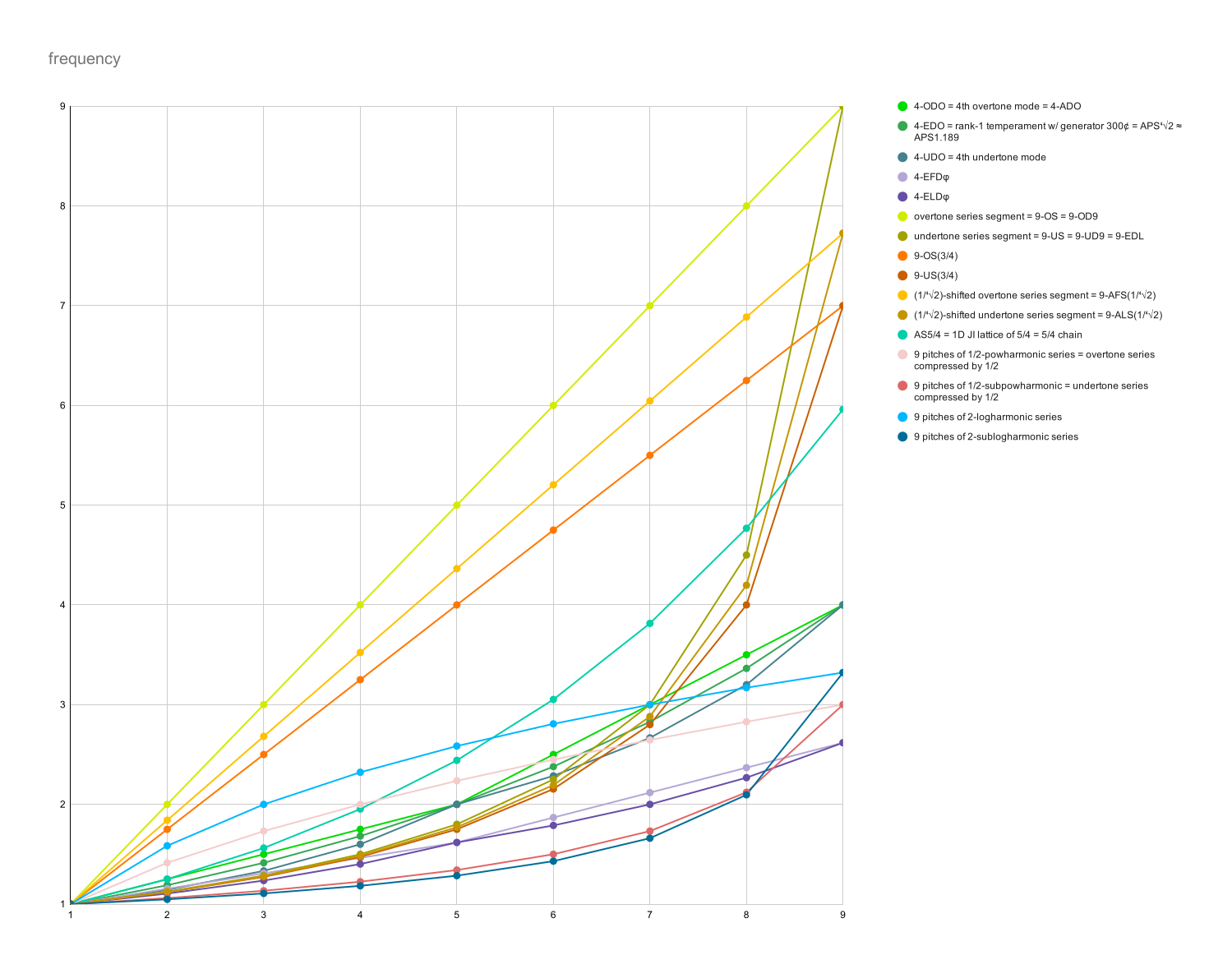
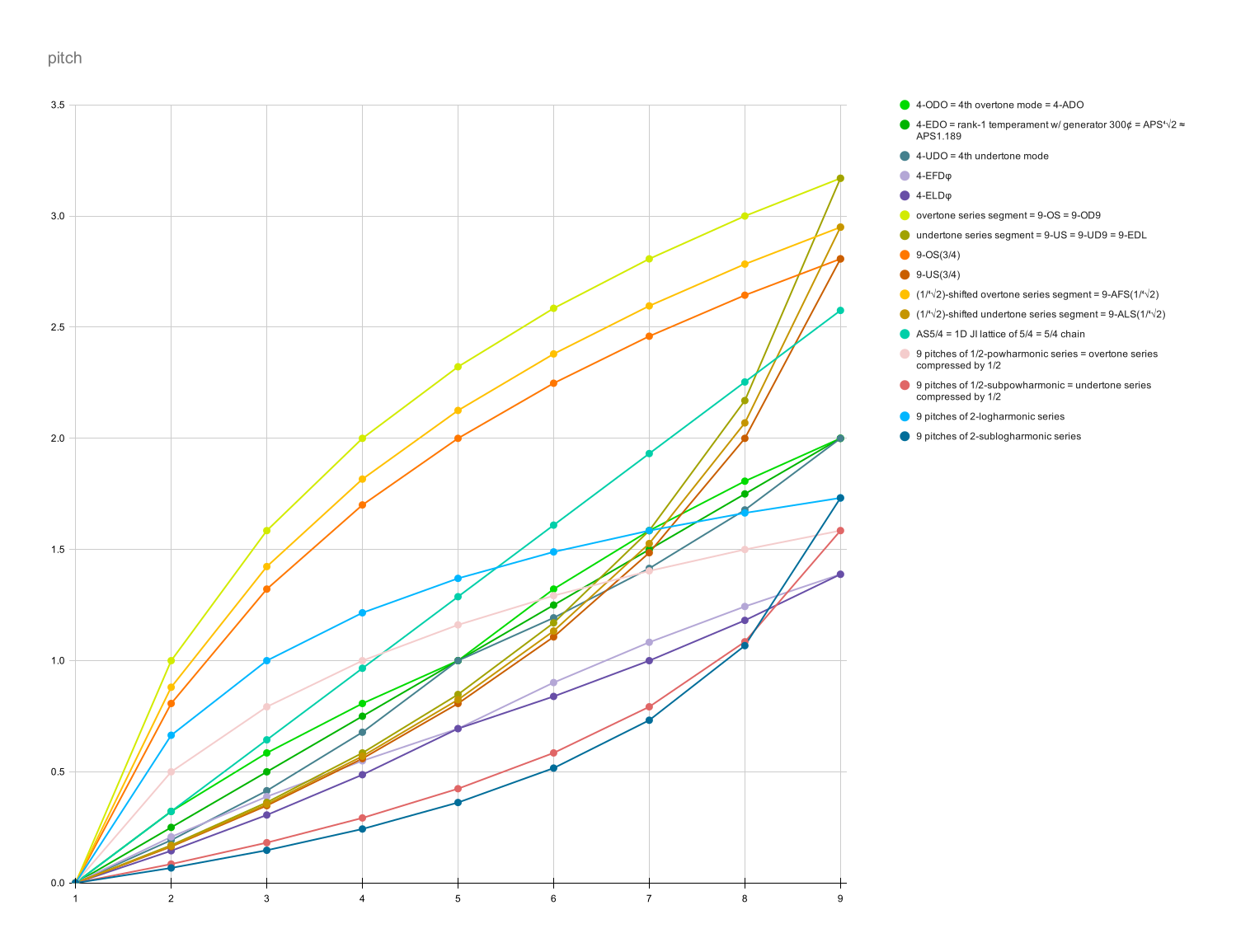
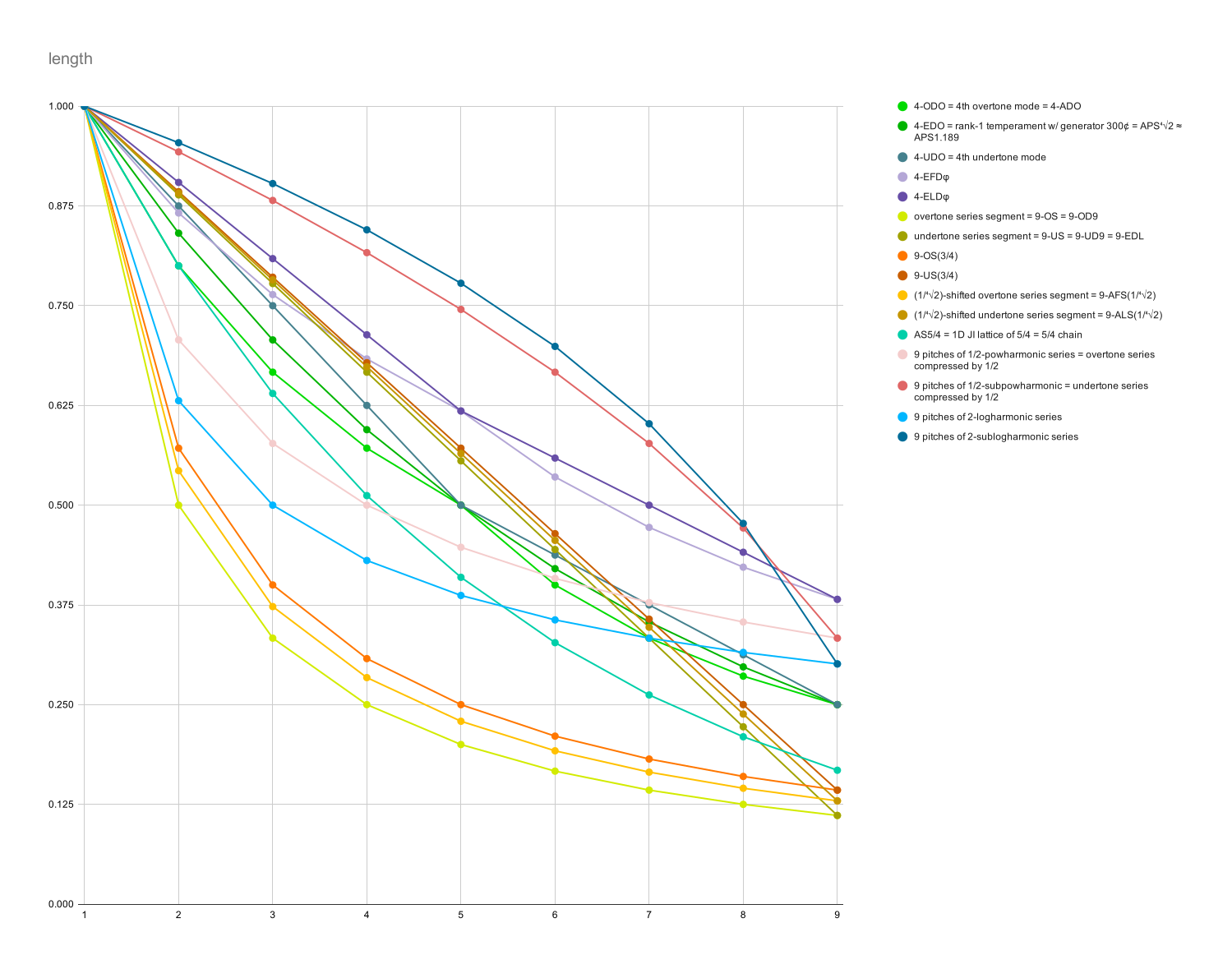
Derivation of OS
The tuning OS3/4 is the sequence [math]\displaystyle{ \frac 44, \frac 74, \frac{10}{4}, \frac{13}{4}... }[/math] and so on. Any OS is equivalent to shifting the overtone series by a constant amount of frequency. In the case of OS3/4, it is a shift by [math]\displaystyle{ \frac 13 }[/math]. Let's show how.
Begin with the overtone series:
[math]\displaystyle{ 1, 2, 3, 4... }[/math]
Shift it by [math]\displaystyle{ \frac 13 }[/math]:
[math]\displaystyle{ 1\frac 13, 2\frac 13, 3\frac 13, 4\frac 13... \\ }[/math]
Convert to improper fractions by first expanding the whole number:
[math]\displaystyle{ \frac 33 + \frac 13, \frac 63 + \frac 13, \frac 93 + \frac 13, \frac {12}{3} + \frac 13... \\ }[/math]
...then consolidating numerators:
[math]\displaystyle{ \frac 43, \frac 73, \frac{10}{3}, \frac{13}{3}... }[/math]
Resize to start at [math]\displaystyle{ \frac 11 }[/math] by multiplying every term by the reciprocal of the first term, [math]\displaystyle{ \frac 43 }[/math], which is [math]\displaystyle{ \frac 34 }[/math]:
[math]\displaystyle{ \frac 43 \cdot \frac 34, \frac 73 \cdot \frac 34, \frac{10}{3} \cdot \frac 34, \frac{13}{3} \cdot \frac 34... }[/math]
Cancel out:
[math]\displaystyle{ \frac{4}{\cancel{3}} \cdot \frac{\cancel{3}}{4}, \frac{7}{\cancel{3}} \cdot \frac{\cancel{3}}{4}, \frac{10}{\cancel{3}} \cdot \frac{\cancel{3}}{4}, \frac{13}{\cancel{3}} \cdot \frac{\cancel{3}}{4}... }[/math]
And we've arrived:
[math]\displaystyle{ \frac 44, \frac 74, \frac{10}{4}, \frac{13}{4}... }[/math]
So we can see that [math]\displaystyle{ \frac 13 }[/math] was the right amount to shift by because it is the delta from the starting position [math]\displaystyle{ 1 }[/math] to [math]\displaystyle{ \frac 43 }[/math], the latter of which is the reciprocal of the target step size [math]\displaystyle{ \frac 34 }[/math] and therefore the value that we need the starting position to equal in order to be sent back to [math]\displaystyle{ 1 }[/math] when we resize all steps from 1 to the target step size by multiplying everything by it.
A note on etymology
The "-tonic" root of "monotonic" does share etymology with the musical terms "tone" and "tonic". They both come from the Greek word "tonikos" which means "a stretching". This is also the explanation for "tonic" water, which supposedly relaxes you by stretching your muscles. So, the term "monotonic tuning" reunites these divergent applications of stretching — function values, and instrument strings — back into one place.
Credits
The classifications and manners of specification for monotonic and arithmetic tunings here were developed by Douglas Blumeyer in March 2021, with significant input and guidance from Billy Stiltner, Shaahin Mohajeri, Paul Erlich, and Dave Keenan.