Lattice: Difference between revisions
Rewrite (more work needed though!) |
→See also: fokker block |
||
| Line 24: | Line 24: | ||
File:Torus.png|A '''torus''' of notes in 15edo, notated by porcupine notation with LH-NiceIonian as the base scale. | File:Torus.png|A '''torus''' of notes in 15edo, notated by porcupine notation with LH-NiceIonian as the base scale. | ||
</gallery> | </gallery> | ||
== See also == | |||
* [[Fokker block]] | |||
== External links == | == External links == | ||
Revision as of 17:04, 25 April 2025

A lattice is a geometric construction that organizes pitches (or pitch classes) according to their intervallic relationships. In a lattice, pitches are represented by points, and tones that differ by a specific interval consistently appear in fixed relative positions to each other. These points can be connected by lines to highligh specific consonances. This creates a structure where pitch relationships can be analyzed through their geometric arrangement, which can be visualized in a lattice diagram.
Most lattice diagrams reduce the dimensionality by one through octave equivalence, meaning intervals separated by octaves are treated as equivalent points. This reduction makes a lattice diagram more comprehensible when projected onto a two-dimensional plane.
While lattices are often used to represent just intonation, they can also be applied to tempered spaces, in particular rank-3 systems generated by two distinct intervals (aside from the period) and which thus function equivalently to three-prime JI subgroups.
Tonnetz
The Tonnetz is a prominent example of a lattice representing 5-limit intervals. In its conventional hexagonal arrangement, the perfect fifth (3/2) and major third (5/4) intervals are positioned 60 degrees apart, with the major sixth (5/3) placed 60 degrees from the major third and 120 degrees from the perfect fifth. This arrangement results in 5-limit major triads (4:5:6) and minor triads (10:12:15) forming triangular patterns within the lattice structure. The Tonnetz can be generalized to other subgroups with 3 primes, such as 2.3.7, where a respective fundamental chord such as 6:7:8 can be assigned to a triangle.
Lattices can be extended to incorporate more dimensions. For instance, Vogel's Tonnetz extends Euler's 5-limit Tonnetz to the 7-limit, resulting in a 3-dimensional diagram. Similarly, other lattices can be constructed for different subgroups or temperaments.
Examples
-
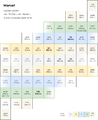 A square lattice representing marvel temperament.
 -
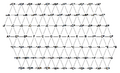 A hexagonal lattice representing 41edo's mapping of 5-limit intervals, using ups and downs notation.
 -
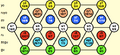 A hexagonal lattice representing a subset of 7-limit intervals, using color notation.
 -
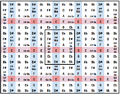 A torus of notes in 15edo, notated by porcupine notation with LH-NiceIonian as the base scale.


See also
External links
- Beginner's guide to lattices: See chapter 1.3 of Alternative Tunings: Theory, Notation and Practice by Kite Giedraitis (2016)
- "lattice/lattice diagram" on Tonalsoft Encyclopedia
- "Octave Equivalent Music Lattices" by Graham Breed (2008)
- "Unison Vectors and Periodicity Blocks in the Three-Dimensional (3-5-7-) Harmonic Lattice of Notes" by Adriaan Fokker (1969)
- "Harmonic Lattice Diagrams" by Joseph L. Monzo (1998)