User:Nick Vuci/Moments of Symmetry: Difference between revisions
Added sections |
|||
| (11 intermediate revisions by the same user not shown) | |||
| Line 1: | Line 1: | ||
WORK-IN-PROGRESS AS OF | WORK-IN-PROGRESS AS OF 25 OCT 2025 | ||
'''Moments of Symmetry (MOS)''' are scales created by a simple procedure that generates the common [[2L 3s|pentatonic]] and [[5L 2s|diatonic]] scales, but also a wide range of novel xenharmonic scales that share | '''Moments of Symmetry (MOS)''' are scales created by a simple procedure that generates the common [[2L 3s|pentatonic]] and [[5L 2s|diatonic]] scales, but also a wide range of novel xenharmonic scales that share similar melodic coherence and structural balance. First described by [[Erv Wilson]] in the 1970's, the concept shares fundamental similarities and is often thought of as synonymous with the concept of Well-Formed scales, as well as the more generalized concept of [[Maximum variety|MV2 scales]]. Over time, MOS have become a fundamental concept in xenharmonic theory, inspiring a wide range of musical uses, analytical approaches, and derivative concepts such as [[MODMOS]], multi-MOS, and [[MOS rhythm|MOS-based rhythm]]. | ||
MOS are commonly notated with either a [[Step pattern|scale signature or a step pattern]]. For example, the common major scale of 12-EDO would be notated: | |||
As a concrete step pattern: 2 2 1 2 2 2 1 | |||
As an abstract step pattern: L L s L L L s | |||
As a scale signature: 5L 2s | |||
== Construction == | == Construction == | ||
| Line 18: | Line 26: | ||
To find the equal tuning that supports a given MOS pattern at a particular hardness, simply multiply the number of each step type by its relative size and sum the results. For example, for the 5L 2s pattern at a hardness of 2:1, calculate 5×2+2×1=12, showing that 12-EDO supports this pattern. | To find the equal tuning that supports a given MOS pattern at a particular hardness, simply multiply the number of each step type by its relative size and sum the results. For example, for the 5L 2s pattern at a hardness of 2:1, calculate 5×2+2×1=12, showing that 12-EDO supports this pattern. | ||
| Line 28: | Line 35: | ||
== Spectrum of MOS == | == Spectrum of MOS == | ||
As a generator moves through all possible positions within a fixed period, MOS emerge in specified ranges bounded by equal divisions. This spectrum is symmetric and mirrored at the midpoint of the period, with generators larger than half the period produce the same MOS as their complements.<gallery mode="slideshow" widths="200" heights="200"> | |||
File:MOS Spectrum.gif|The entire MOS spectrum at 6-levels | |||
. | File:MOS Spectrum mirror.gif|Showing the mirror-like symmetry of the half period. The same patterns repeat from 0-600 cents and 1200-600 cents. | ||
File:MOS Spectrum Level2.gif | |||
. | File:MOS Spectrum Level3.gif | ||
</gallery> | |||
. | |||
== Formal definitions and conditions of MOS == | == Formal definitions and conditions of MOS == | ||
Latest revision as of 00:36, 27 October 2025
WORK-IN-PROGRESS AS OF 25 OCT 2025
Moments of Symmetry (MOS) are scales created by a simple procedure that generates the common pentatonic and diatonic scales, but also a wide range of novel xenharmonic scales that share similar melodic coherence and structural balance. First described by Erv Wilson in the 1970's, the concept shares fundamental similarities and is often thought of as synonymous with the concept of Well-Formed scales, as well as the more generalized concept of MV2 scales. Over time, MOS have become a fundamental concept in xenharmonic theory, inspiring a wide range of musical uses, analytical approaches, and derivative concepts such as MODMOS, multi-MOS, and MOS-based rhythm.
MOS are commonly notated with either a scale signature or a step pattern. For example, the common major scale of 12-EDO would be notated:
As a concrete step pattern: 2 2 1 2 2 2 1
As an abstract step pattern: L L s L L L s
As a scale signature: 5L 2s
Construction
-
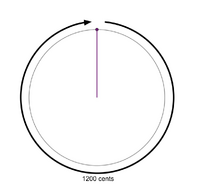 An interval is chosen to be the period (the 1200 cent octave in this example). The period is represented with a circle; intervals are represented with purple lines and points radiating out from the middle which move clockwise.
 -
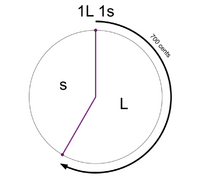 An interval is chosen to be a generator (the 700 cent perfect fifth in this example). This is the 1L 1s MOS pattern.
 -
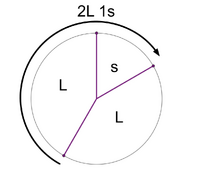 Stacking the generator upon itself yields a scale with 2 step sizes. This is the 2L 1s MOS pattern.
 -
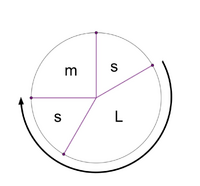 Stacking the generator 2 times yields a scale with 3 step sizes (not MOS).
 -
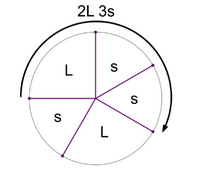 Stacking the generator 3 times yields a scale with 2 step sizes. This is the 2L 3s MOS pattern.
 -
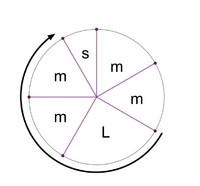 Stacking the generator five times yields a scale with 3 step sizes (not MOS).
 -
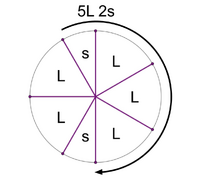 Stacking the generator 6 times yields a scale with 2 step sizes. This is the 5L 2s MOS pattern.
 -
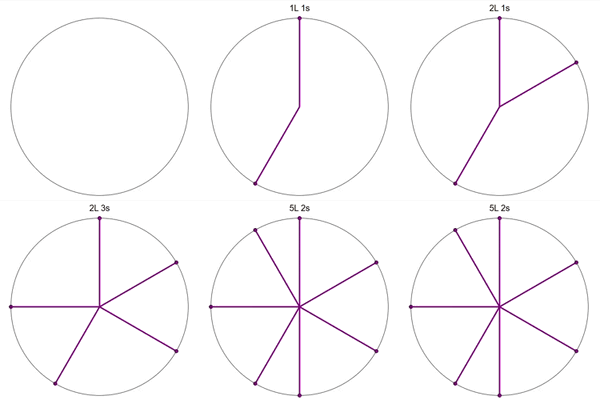 The generator sequence animated with the moments of symmetry labelled.


Step Ratios
The step ratio—also referred to as the hardness—of MOS denote the relative sizes of the large and small steps and is a key factor in classifying MOS patterns. A step ratio of 2:1, meaning the large steps are twice the size of the small steps, is considered the basic form of the MOS. When the difference between the large and small steps increases (i.e., the large step becomes larger and the small step smaller), the MOS is considered harder, as the contrast in step sizes becomes more pronounced. Conversely, when the size difference decreases (i.e., the large step becomes smaller and the small step larger), the MOS is considered softer, due to the more subtle contrast.
To find the equal tuning that supports a given MOS pattern at a particular hardness, simply multiply the number of each step type by its relative size and sum the results. For example, for the 5L 2s pattern at a hardness of 2:1, calculate 5×2+2×1=12, showing that 12-EDO supports this pattern.
For a more thorough discussion on the spectrum of step ratios, please see TAMNAMS.
-
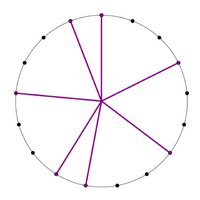 When the L:s ratio is 3:1, the MOS is hard. The hard 5L 2s is supported by 17-EDO.
 -
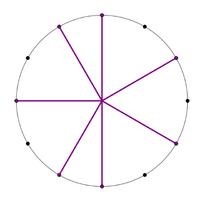 When the L:s ratio is 2:1, the MOS is basic. The basic 5L 2s is supported by 12-EDO.
 -
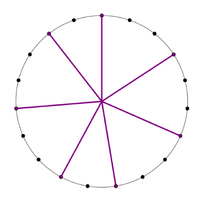 When the L:s ratio is 3:2, the MOS is soft. The soft 5L 2s is supported by 19-EDO..


Spectrum of MOS
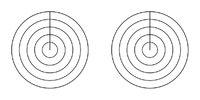
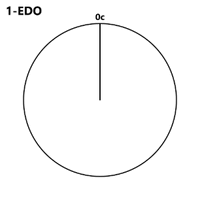
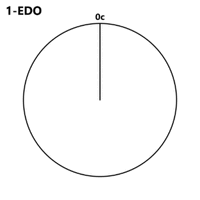
As a generator moves through all possible positions within a fixed period, MOS emerge in specified ranges bounded by equal divisions. This spectrum is symmetric and mirrored at the midpoint of the period, with generators larger than half the period produce the same MOS as their complements.
-
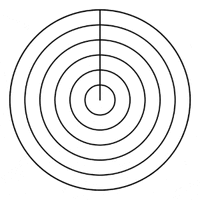 The entire MOS spectrum at 6-levels
 -
 Showing the mirror-like symmetry of the half period. The same patterns repeat from 0-600 cents and 1200-600 cents.
 -
-


Formal definitions and conditions of MOS
.
.
.
.
.
See also
External links
- "Introduction to Moments of Symmetry" in the Wilson Archives, hosted on Kraig Grady's website Anaphoria
- Wilsonic MTS-ESP and iOS apps by Marcus Hobbs
- Moments of symmetry calculator (V2) by Diego Villaseñor
- Moments of Symmetry in equal divisions of the octave calculator by Billy Stiltner
- Moment of Symmetry generator demo by Aaron Krister Johnson